Pennywort (Hydrocotyle vulgaris) grows well with just water and light; regular watering is all it needs to survive.
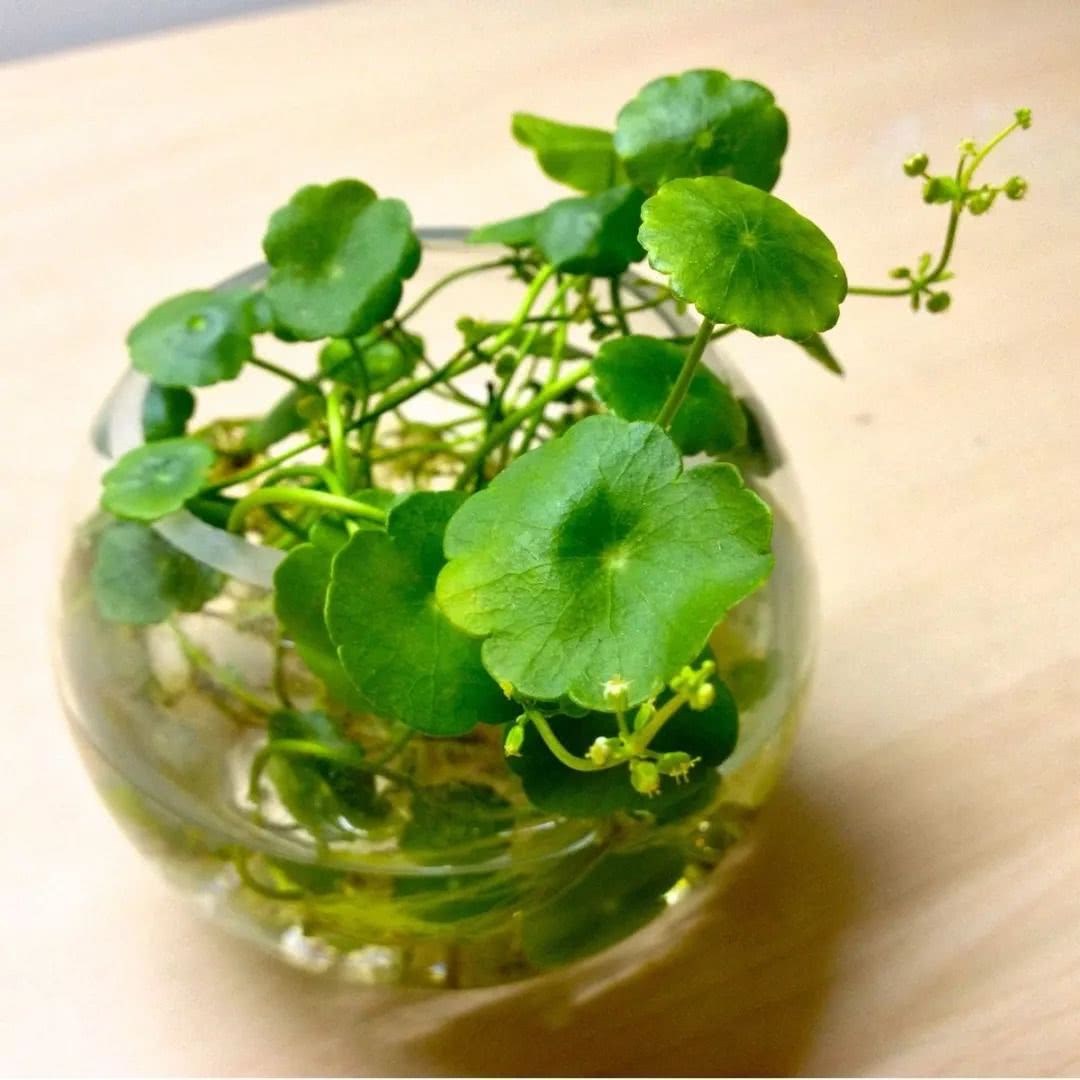
Some plants are especially tough when it comes to adapting to their environment, and they can keep growing vigorously as long as a few basic care conditions are met. Pennywort is a typical low-maintenance plant: just keep it in a warm environment, in a spot with good air circulation and fairly ample light, and keep it well watered, and it will keep growing.
The most important thing when caring for pennywort is to maintain a warm, humid environment year-round. Keep the growing temperature above 5°C recently and avoid temperatures that are too low. In winter you need to move it indoors, and you can place it on a windowsill facing east or south.
Pennywort is not demanding about soil and has no requirements for drainage. It is best to choose a soil with some water-holding capacity; you can use yellow soil, garden soil or peat soil. As long as there is moisture in the soil, pennywort will grow well.
Pennywort can also be grown as a hydroponic plant and does not need soil culture. Its biggest feature is that it can be grown half in water and half in soil. It was originally a plant that grows by the water, and it can grow as long as there is moisture.
Many people's pennywort develops yellow leaves, some people's pennywort produces a great many flowers, and other people's pennywort leaves grow especially small. As long as you appropriately improve the care environment, pennywort can return to a healthy, vigorous state of growth.
If pennywort develops yellow leaves, just cut off the yellow leaves in time and improve the air circulation around it, avoiding keeping it in a closed space.
Another thing to note is that flowering consumes a great deal of nutrients in pennywort, so if you see that your pennywort has produced quite a lot of flowers, cut them off in time. This preserves more nutrients and lets the leaves grow more vigorously.
If the leaves keep getting smaller and smaller, it is very likely due to insufficient light or light that is not intense enough. You need to place it on a balcony or windowsill facing south and give it more than eight hours of direct light each day.
When caring for pennywort you also need to maintain fairly high air humidity. You can regularly mist water around it to avoid dry air. This is especially true for pennywort kept indoors in winter: if the air is dry, its leaves tend to dry out and curl.
Many people do not know how to propagate pennywort, but it is actually very easy to propagate. It is generally propagated by cutting stems. Be careful not to cut off only the leaves and leaf stalks; you also need to cut off the creeping stems at the base. Its growth nodes will produce leaves, and there should be at least three growth nodes so that it can easily take root and sprout.
The cut stems can be put directly in water to take root and sprout. Of course, they can also be inserted directly into soil, keeping the soil moist. The key to propagation is to keep things moist and avoid drought, keep the environment well ventilated, and maintain the temperature between 20~25°C.