How to heel in roses this way, and grow them easily until they burst out of the pot
In the process of growing roses, we often hear a word, heeling in. It is heard not only when growing roses, but also very commonly in the cultivation of other flowers. So what exactly does this frequently appearing "heeling in" mean?
First let's talk about the concept of heeling in. Heeling in is a temporary protective measure before nursery stock is planted or leaves the nursery. If dug-up nursery stock is not to be planted in its final position immediately, it is temporarily gathered into bundles or planted in rows with soil mounded up on a small patch of land free of wind damage, frost damage and standing water, so as to prevent it from losing water and withering, which would affect its survival.
In plain terms, it means the plant has been dug out, but for the time being it is not going to be planted in its final position. During this transitional period, planting it temporarily is called heeling in. But some flower growers ask, can't we just prepare everything and get it done in one go? Must we really fuss back and forth like this, which instead damages the roots?
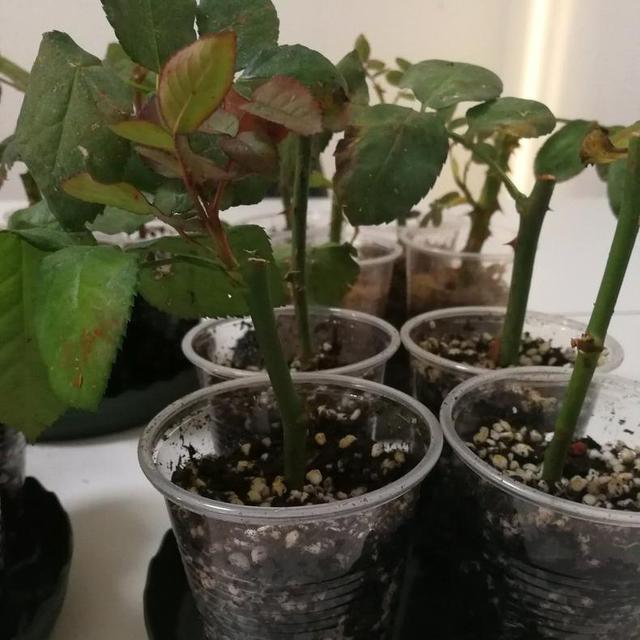
Fellow flower growers may not know that in the process of growing roses, heeling in generally means temporarily planting the seedling in a small pot during propagation by cuttings, and waiting until it is relatively more mature before transplanting it again. Doing so fully fits the classic route of flower growing we mentioned earlier: small seedlings use small pots.
Not only that, the containers used for heeling in are mostly rather small. Such a small environment makes it easy to control the moisture of the potting soil, and the growing environment for the seedling is also reduced by a notch. Moreover, heeling in relatively requires less potting soil, yet it is more meticulous. Another aspect is that it lets the rose experience and adapt to the soil growing environment in advance, allowing the root system to gradually improve, thereby increasing the survival rate and the rate of bursting out of the pot.
When carrying out the operation, we first take the cutting seedling out of the cutting medium. During this process, damage is often at its most likely. We can first soak the medium in water, and some organic nutrient solution specially for roses can be properly added to the water. This both increases nutrients and helps avoid root damage when taking it out. Soak the medium until it breaks apart, then take the cutting seedling out intact.
After taking it out, put it into a small flower pot prepared in advance. When placing it, first spread a layer of substrate soil about 3cm deep on the bottom of the pot, then put the prepared cutting seedling into the pot, and finally add the remaining mixed medium until it is filled to about 1cm from the pot surface, and that is enough.
After it is placed, the remaining watering and seedling-acclimation steps are the same as those for potting up cuttings. We only need to wait until about 1 month after heeling in is completed to carry out final planting. There is no restriction on the type of final planting; both ground planting and pot planting are fine.
When planting in the final position, the effect is even better if the heeled-in seedling is planted together with the heeling-in medium into the pot or into the soil for ground planting. It would be even better if the final planting soil and the heeling-in soil can be kept the same. The rose seedling has already adapted to the soil environment, and doing so will make it grow even faster.
Finally, it should be mentioned that heeling in rose seedlings is not a mandatory requirement, and there is no problem if you do not heel them in. It is just that, as we said above, after heeling in there is a great promoting effect on the subsequent growth of the rose plant, so flower growers who are interested can give it a try.