Growing Syngonium as a bonsai is very simple, just pay attention to these 4 points, and the leaves will be emerald green and well-formed
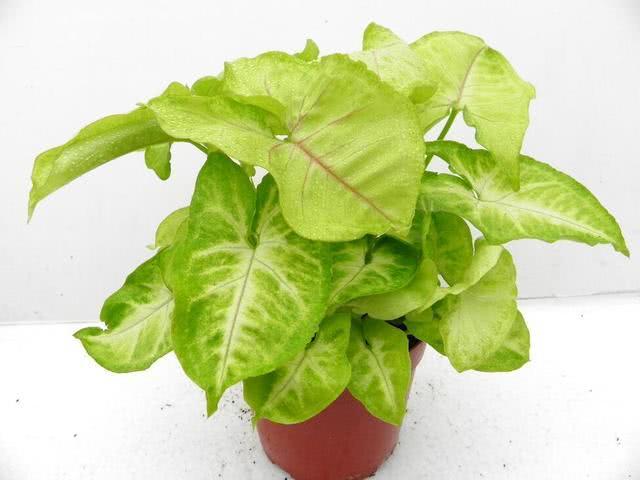
Syngonium is often also called purple-stem taro; its leaf color is extremely pleasing to the eye, shaped like an arrow or an oblate circle, and the leaf surface is often accompanied by light-colored cracks. The young leaves of the whole plant are lighter in color, while the old leaves are darker, so its appearance has distinct layers and is relatively rich. As a well-known potted plant in southern China, it is very suitable for growing indoors as a potted plant, and because of the simplicity of its cultivation and management, it is often also made into a bonsai.
I. Cultivation of Syngonium
The main ways to plant Syngonium are division and cuttings propagation, and in daily life, because growing Syngonium from cuttings is simpler and easier, people mostly use the cutting method to plant Syngonium. On a Syngonium plant with good growth, choose relatively lush side branches to cut, and the length of the selected branch is generally best at about ten cm.
The branch should preferably have several buds, which shows that the branch is relatively young and tender. About ten days to two weeks after the branch is cut and planted, it can generally take root. At this time, the potted plant still needs to grow in a cool and shady place, rather than growing under light. After the young seedling grows several young leaves, it can be managed and cared for under normal conditions.
II. Care of Syngonium
1. Soil requirements
Potted Syngonium is suitable for growing in soil with good water retention and relatively fertility. Especially for household potted plants, use culture soil mainly composed of sandy soil or garden soil, and add an appropriate amount of river sand or peat soil, etc., to ensure that the soil has excellent drainage. It is best to mix in a little decomposed cake fertilizer or manure. In addition, because Syngonium is not suitable for growing in alkaline soil, the acidity and alkalinity of the soil should be adjusted at certain intervals to ensure it is between slightly acidic and neutral.
2. Light requirements
As one of the semi-shade plants, Syngonium is relatively suitable for growing in an environment with appropriate light, especially diffused light; under conditions of too strong light, such as the summer sun, it often easily causes the leaves to be scorched and the leaf surface to become dull in color, so in this case, certain shading preparation is usually also needed. In addition, try to avoid growing in a dark environment for too long, otherwise the plant will fail to grow tall and develop poorly.
3. Watering requirements
Because Syngonium has extremely poor drought tolerance, the potted plant must keep the potting soil moist most of the time, especially in the hot summer, when the amount of watering should be more than usual. In addition, avoid water accumulation in the potting soil. During the rainy season, place the potted plant in a cool, ventilated place to grow.
4. Fertilization requirements
For Syngonium, during the seedling stage it needs more nutrients. In spring and summer, it needs to be fertilized once about every 15 days, mainly with nitrogen and potassium fertilizers, but a single element should not be added too much, otherwise the plant is more likely to suffer from diseases.