Fatsia japonica has many varied leaf shapes on its branched foliage. How should you fertilize and water it when planting in a courtyard?
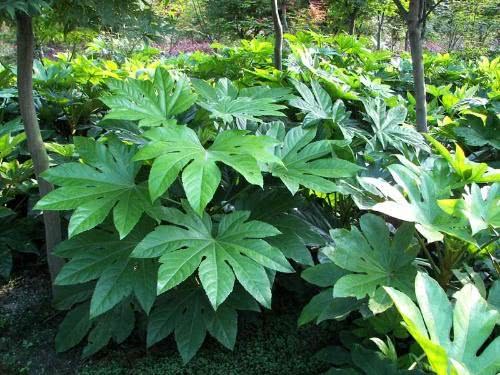
Fatsia japonica is also known by the alias Jingangzuan. Because its branched foliage bears roughly eight leaves that look like eight corners, it got this name. Its plant form is relatively tall, so it is very suitable for cultivation in courtyards or various large venues, such as guesthouses, clubs or hotels, and so on; in addition, it is also a particularly good choice as a potted ornamental plant, with fairly large leaves and evergreen foliage all year round, and it has an obvious effect on indoor decoration or arrangement.
I. Cultivation of Fatsia japonica
There are many ways to plant Fatsia japonica, and the common ones are division, cuttings and seed propagation, among which propagation by cuttings is the simplest, so in daily life people most often use the cutting method to plant Fatsia japonica. There are two periods each year suitable for propagating Fatsia japonica by cuttings. If you choose to plant in spring, it is best to do so in March to April each year; if you cultivate in autumn, then choose August to September, which is preferable. Usually, from a well-growing Fatsia japonica plant, select relatively young cuttings, and the length cut is generally best at 12-15 cm.
When taking cuttings from branches, it is not advisable to use the "straight insertion" method; instead, use the "slanting insertion" method for cuttings, inserting about a bit more than one third of the branch's length into the soil, and finally water in an appropriate amount of moisture, and it can be placed in a semi-shaded environment to grow. If cultivating in a greenhouse, you can also keep the temperature at around 18-20 degrees, so that the branches root faster, generally completing rooting in about two to three weeks. Then carry out suitable cultivation, and after the seedlings grow some leaves, you can carry out normal management of the potted plant.
II. Care of Fatsia japonica
1. Soil requirements
Potted Fatsia japonica is best grown in soil that has fairly good water permeability and looseness, and at the same time you must ensure the soil is fairly fertile; otherwise, given that the plant itself does not grow fast, the plant will be unable to grow tall for a long time. For household potted Fatsia japonica, a culture soil based mainly on leaf mold or sandy soil is generally used. If conditions permit, you can also add a small amount of peat soil and river sand, mix them thoroughly, and then use the mixture. In addition, the soil needs to be loosened by certain measures at intervals, which can avoid the soil becoming compacted or hardened.
2. Light requirements
Because Fatsia japonica has extremely good shade tolerance, it is suitable for growing in a semi-shaded environment, and is not suitable for growing for a long time in an environment with too high light intensity. For this reason, the difference between summer and winter is extremely obvious. In summer the sunlight is too intense, so the plant needs mostly shading; while in winter the temperature is lower and the sunlight is fairly suitable for the plant, so it can grow in the sun for a longer time.
3. Moisture conditions
Unlike its light requirements, Fatsia japonica has a relatively high demand for moisture. Especially in spring and summer, which are the periods of vigorous growth for Fatsia japonica, you usually need to water about once every three days, and in the relatively dry summer, you should even water every day, preferably in the morning or evening. If the plant is watered insufficiently, its leaves are very prone to turning yellow and even withering, which has a major impact on the plant's ornamental value, and is hard to change in the short term, so you should pay extra attention to watering the plant.
4. Fertilization requirements
Fatsia japonica also has a relatively high demand for nutrients in spring and summer, so it should be fertilized about once every half a month, but in summer this can be appropriately reduced, because high temperatures may cause the plant to enter a brief dormant state. Each fertilization should apply thin fertilizer, otherwise the plant may be burned.