Appreciation and Creation of Taiwan Juniper: Discovering the Beauty of Taiwan, China's Bonsai
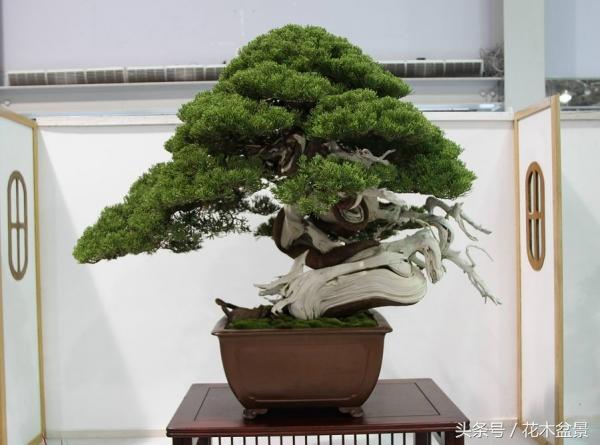
People who love flowers, trees and bonsai are people of refined taste
Southern Taiwan, China has a tropical monsoon climate, while the north has a subtropical monsoon climate. Taiwan, China is a mountainous island, with mountains covering two-thirds of the island's total area. Taiwan, China has a great variety of plants, with as many as more than 4,000 species, equivalent to 2/3 of Europe's woody plant species. Among the various tree species, more than 300 have relatively high economic value. The forest coverage rate is 57.8%, which is why it is called a plant kingdom.
Most of the so-called "Taiwan juniper" are field-grown junipers, originally propagated by cuttings from 5 old trees with a diameter of more than one chi in the Yangmingshan nursery more than 40 years ago. Its overall characteristics are: a tightly structured foliage mass, emerald green color, and xylem rich in oils. In addition, a "Golden Taiwan Juniper" has recently appeared in Taiwan, China. Not only is its trunk peculiar and vigorous, but its emerald green and golden scale-like leaves interlace to form beautiful foliage, making it a form completely different from other cypresses and a rare and precious masterpiece.
The juniper introduced from Taiwan, China has large and coarse scale leaves, with a slightly yellow-green leaf color; while Japanese juniper has small and fine scale leaves, with a dark green leaf color.
Steps for creating a juniper bonsai:
Step one: tree style design.
First, after obtaining the material, you need to have a creative concept, use this concept to solve the questions of "What should be done in the future? Why do it this way?", and then draw a rendering of the tree style design.
Step two: selecting branches to remove or keep.
Remove unnecessary branches, and keep the branches that may become shari as well as the branches that must be retained.
Step three: designing the live vein.
Cypress bonsai is somewhat different from bonsai of other tree species. It is a tree species suitable for shaping into a tree form evoking high mountains, that is, a vigorous image after enduring great wind, rain and snow at high altitude. The Chinese character for cypress is exactly the character for wood combined with the character for white. A tree growing in a harsh environment will certainly produce shari, and from a distance some white shari will come into view. Therefore, our third action is to leave the live vein and create a scene of having endured the battering of great wind and snow in nature.
Step four: wire carving.
Because field-grown material has not experienced the battering and trials of the natural environment, artificial means must be used to create a sense of great age, and wire carving is the most commonly used technique.
Step five: arrangement of large branches, small branches and foliage masses.
This step cannot be accomplished overnight. It requires initial shaping, and afterward an overall layout, including the proportions of the foliage masses and the creation of a sense of splendor, all completed in subsequent creation.
Notes during the creation process:
1. Proportions of branches:
The proportions of some branches and the trunk in the material require 2 to 3 years.
2. Leaf maturity:
When a cypress has just been potted for a short time, the leaves will still grow excessively and lack a sense of age, and time is needed to wait for its maturity.
3. Shari:
Some time is needed for weathering, to become more real and closer to nature.
4. Live vein:
Some time is needed for care, to make it more raised and to display a better sense of three-dimensionality and vitality.
5. Pot selection:
Wait until the material has a certain degree of maturity, then pair it with a relatively good pot.
For more bonsai and flower and plant care, please follow the WeChat official accounts: Huamu Penjing (ID: huamupenjing) and Yanghua Renjia (ID: yanghuarenjia)