The peony grows weak and spindly - it may have caught this disease
20. Is your peony growing very weak and spindly? Watch out - it may have caught this disease!
This is an excerpt from the original "Peony Cultivation" column article by Lan Yao
Yesterday Lan Yao introduced the 4 common major diseases of peonies. Besides those four major diseases mentioned yesterday, there are some other diseases that peonies are also prone to, so today let's continue introducing them.
1. White star disease
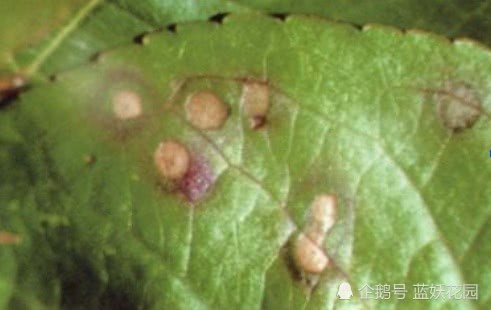
White star disease, also called ring spot disease, is relatively common on peonies. In the early stage of the disease, the spots on the leaves appear net-shaped or nearly circular, about 4-10mm in diameter, and are quite numerous, light brown to grayish white, with brown edges. Old lesions have obvious concentric rings, and in the center of the lesion grows a grayish-black mold-like substance - this mold-like substance is the spore body of the pathogen.
Ring spot disease is mainly prevented. In early spring before the peony sprouts, spray with lime sulfur mixture to sterilize, which can effectively reduce the incidence rate. In the early stage of the disease, spray with mancozeb, once a week for 2-3 consecutive sprays, and it can be cured.
2. Dieback disease
The pathogen of dieback disease mainly invades through wounds. Plants with many wounds and weaker growth are most susceptible.
Dieback disease mainly infects the stems, branches and other parts of the peony. When the stem is affected, light brown lesions appear, gradually expanding into red-brown oval lesions. The lesions can encircle the stem, causing the branches and stem above the lesion to die quickly.
Dieback disease should be mainly prevented. In daily care, pay attention to applying more phosphorus and potassium fertilizer to enhance the plant's resistance, while reducing the occurrence of wounds. Once the disease occurs, spray the entire plant with solutions such as carbendazim and mancozeb, and apply fungicide to the infected parts for treatment.
3. Brown spot disease
Brown spot disease is very similar to black spot disease, and is most damaging during the hot, humid rainy season. It is a fungal disease. When it occurs, it starts from the lower leaves and gradually spreads upward. In the early stage it appears as circular or oval purple-brown spots, and later as black spots with distinct boundaries. In severe cases, the lesions can join together into patches, causing the leaves to wither and yellow, affecting flowering.
To prevent brown spot disease, in early spring before sprouting, spray carbendazim to sterilize and prevent it. After the disease occurs, promptly spray with mancozeb or carbendazim for treatment, once every 5-7 days, for 2-3 consecutive sprays.
4. Root-knot nematode disease
Compared with other diseases, controlling root-knot nematodes is more troublesome.
After root-knot nematodes invade, they produce irregular tumor-like growths of varying sizes on various parts of the fine roots and thick roots - these are root knots. In the early stage of infection they are yellow-white with a smooth surface, and in severe cases they turn brown and break apart and rot.
Root-knot nematodes cause peonies to shed leaves prematurely. When the disease is severe, the peony will drop all its leaves as early as August. Repeated occurrence can cause the peony plant to be stunted, with small leaves, small flowers, or even no flowers at all.
For root-knot nematodes, prevention is greater than treatment. Before planting, if diseased seedlings are found, they must be dealt with promptly. They can be soaked in 0.1% isofenphos-methyl for 30 minutes, or soaked in warm water at 48°C-49°C for 30 minutes. Sterilizing the potting soil when potting up can effectively prevent it.
Although Lan Yao has shared a lot of knowledge about peony cultivation, flower lovers will inevitably still encounter some problems during the cultivation process. Starting tomorrow, Lan Yao will talk about how to deal with common problems in the peony cultivation process. Welcome to keep following.
If you want to learn flower growing with Lan Yao and quickly say goodbye to being a beginner, pleasefollow my WeChat public account: Lan Yao Garden (ilanyao)