The thistle draws blood and repels enemies with its spines, once a life-saving battlefield herb for stopping bleeding
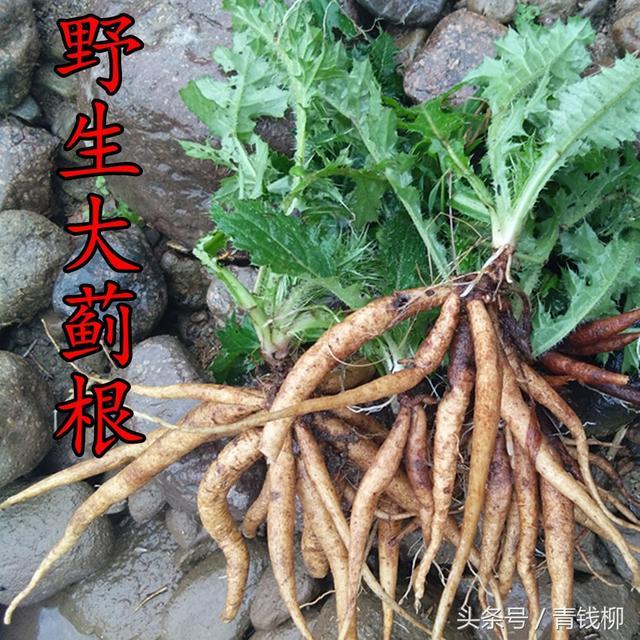
Repelling enemies and drawing blood in adversity, the cat-tiger thistle, the battlefield life-saver for stopping bleeding, the greater and lesser thistle
Legend
Repelling enemies and drawing blood in adversity, the cat-tiger thistle
Plants of the genus Cirsium are a very distinctive genus, covered in prickles from the leaves to the flower buds. Tao Hongjing said the greater thistle is the tiger thistle and the lesser thistle is the cat thistle. Li Shizhen, answering across the centuries, said, "It is named for the ferocious appearance of its seedlings," but he also cited a rather evocative explanation from Kou Zongshi's Ben Cao Yan Yi of the Song dynasty: its "flowers are like a bun (ji)," and "thistle (ji)" and "bun (ji)" are homophones, hence the name.
Yet this armed-to-the-teeth appearance was indeed once used as a weapon. Legend has it that when the Roman Empire invaded Scotland in the 1st century BC, the Scots, whose weapons were still quite primitive by comparison, were retreating again and again, until they reached a patch of waste grassland by a river, when suddenly a soldier screamed out, having been pricked by a kind of thorny wild grass. The commander had a sudden inspiration and devised a plan to lure the Romans into this grassland. At that time most soldiers had no shoes, and those who did wore strappy sandals, which could not protect against the sharp thorns of the wild grass. The Scots strapped armor to their feet and finally defeated the Romans as they hopped about from the pricks, forcing the Romans to eventually build Hadrian's Wall. This thorny wild grass was the thistle. There is also a legend that the thistle aided in battle during a war between Scotland and Denmark. In any case, to remember its service in saving the nation, the thistle flower became the national flower of Scotland and appears on various Scottish emblems.
The battlefield life-saver for stopping bleeding, the greater and lesser thistle
Although what is discussed here is the lesser thistle, the greater thistle cannot go unmentioned. Many ancient Chinese medical texts discuss them together, because their effects are similar, both capable of cooling the blood, stopping bleeding and breaking blood stasis, and both used to treat various bleeding symptoms.
It is said that in ancient times a general was struck by an arrow and fell from his horse. A soldier saw the lesser thistle growing by the roadside and immediately picked it to apply to the wound, saving the general's life. But there are also legends in which it was the greater thistle that stopped bleeding on the battlefield, and the one who fell from his horse became Pang Tong of the Three Kingdoms. Pang Tong was perhaps rather unlucky; after being healed once, he was still eventually shot to death. Nevertheless, this shows that in ancient times both were used to stop bleeding, the difference being that the greater thistle is better at dispersing stasis and reducing swelling and at strengthening and settling the qi downward, while the lesser thistle specializes in breaking blood stasis and treating strangury.
There has always been controversy about the original plants of the two. Of course, it is generally acknowledged that the greater thistle grows taller and more imposing. In the modern pharmacopoeia, the lesser thistle is Cirsium setosum (field thistle) and the greater thistle is Cirsium japonicum. However, some scholars believe that the greater thistle recorded in certain ancient texts is the mature field thistle, while the lesser thistle is the seedling, and in fact some places still use them this way today.
Medicinal properties of the lesserthistle (whole herb)
Nature Cool
Flavor Sweet, bitter
Meridians entered Heart meridian, Liver meridian
Actions Cools the blood and stops bleeding, disperses stasis and resolves toxins, reduces abscesses.
Indications For epistaxis, hematemesis, hematuria, bloody strangury, bloody stool, abnormal uterine bleeding, traumatic bleeding, and abscesses and sores.
Applications Ben Cao Shi Yi: Breaks old blood stasis, stops fresh bleeding, sudden massive bleeding, bloody dysentery, bleeding from metal wounds, vomiting, etc. Grind and take the juice warm; made into a decoction with sugar, it treats metal wounds and spider, snake and scorpion poisoning, and is also good taken orally.
Ri Hua Zi Ben Cao: The root treats heat-toxin wind and chest and diaphragm oppression, opens the appetite and promotes digestion, reduces fever, and tonifies deficiency. The seedling removes restless heat; grind fresh and take the juice.
Cautions: Contraindicated in those with bleeding from deficiency cold and those with spleen-stomach deficiency cold. Use with caution in those with qi deficiency. Avoid contact with iron utensils.
Cold-tossed and stir-fried field thistle
The tender seedlings of field thistle are excellent wild vegetables. The tender seedlings and rhizomes can be collected in March and April. At this time the fine prickles on the leaf margins do not prick the mouth, and the flavor is slightly sweet, making it suitable for eating. Once summer arrives and the leaf stems become hard, it can no longer be eaten.
Cold-tossed field thistle: Take an appropriate amount of field thistle, remove debris and wash clean, blanch in boiling water, then remove and squeeze dry. Season with salt, vinegar, mashed garlic and sesame oil, and dried shrimp and sheet jelly can also be added.
Stir-fried field thistle: After blanching the field thistle, cut it into sections. Heat oil in a wok, add chopped scallions and fry until fragrant, add the field thistle and stir-fry, add refined salt for flavor, add MSG, and remove from the wok to serve.
This dish can cool the blood, clear heat and resolve toxins, and is suitable for patients suffering from excessive wind-heat.
Field thistle porridge
100 grams of field thistle, 200 grams of japonica rice, 3 grams of scallion. Remove debris from the field thistle, wash clean, blanch in boiling water, cool in cold water, then remove and chop finely. Chop the scallion into small pieces. Rinse the japonica rice clean and soak in cold water for half an hour. Take a clay pot, add cold water and the japonica rice, bring to a boil over high heat, then reduce to low heat and cook until the porridge is almost done. Add the field thistle, and once it boils, add salt and MSG for seasoning, sprinkle with chopped scallion, drizzle with sesame oil, and it is ready to eat.
Field thistle vegetable balls
200 grams of field thistle, 50 grams of dried shrimp, 300 grams of fine cornmeal, 100 grams of white flour, 50 grams of bean flour, 4 grams of yeast, 20 grams of white sugar. Add yeast and an appropriate amount of warm water to the several flours and knead into a dough; cover and let stand to ferment. Add an appropriate amount of soda water to the fermented dough and knead evenly, then let rest for 10 minutes. Wash the field thistle clean, blanch in boiling water, then chop into fine pieces, add the stir-fried dried shrimp, peanut oil, a little refined salt and chicken essence, and mix well to make the filling. Press the cornmeal dough into wrappers, wrap the filling into vegetable balls, grease the bottom, place in a steamer and steam over high heat for 15 minutes.