How can you tell good Fuding white tea from bad at a glance?
Newcomers to tea often face a test: how to quickly judge the grade of the tea in front of them. This is not just about face; your tea-tasting skill is your capital for making tea friends, and it is also the fundamental reason you can keep drinking good tea!
Seriously speaking, recognizing tea requires long-term experience and a large number of samples; it cannot be mastered overnight. But there are always some general rules that let you use the process of elimination to filter out too much interference and learn and compare with more standard samples.
I. Before brewing
1. Look at the dry tea, overall: neat strips, uniform color, and no excessive broken bits or impurities are superior; uneven thickness and obvious color differences are inferior, and suggest blending.
2. Look at the dry tea, individual: tightly rolled strips, oily luster, and natural color are superior; uneven strips, dull and lusterless, overly bright color, or especially dry and lifeless are inferior.
3. Smell the dry tea: pure aroma with strong penetration is superior; off or mixed odors and a fleeting aroma are inferior. However, not every good tea will be very fragrant, especially new white tea; the dry tea may have no noticeable aroma. Here you need to distinguish between a light aroma and a fleeting, negative aroma. Simply put, it may not be fragrant, but it must not be chaotic in fragrance.
II. During brewing
1. Look at the cup lid: if you brew in a gaiwan, pay attention to the foam when rinsing the tea. Little foam that disperses quickly and basically no impurities on the cup lid are superior; lots of foam that does not disperse and more impurities remaining on the cup lid are inferior. Good tea is treated carefully throughout the entire production and storage process; this principle makes sense, right?
2. Smell the cup lid: first, when smelled hot there should be no unpleasant odor, and in addition the aroma should be rich and pure, and after cooling it should cling to the wall for a long time, which is superior; if hot smelling reveals sour, astringent, burnt, or other off odors, and the aroma is mixed and not lasting, it is inferior.
III. While drinking
1. Sip the tea: the taste of the tea liquor is rich and varied, hard to describe one by one, but one thing is common: the higher the integration of tea and water, the better. To borrow a tea friend's pet phrase, "this tea makes the water taste better," this is the simplest yet also the hardest requirement to meet. If this sip of tea liquor truly delights you, it is certainly not bad!
2. Aftertaste: once the tea liquor goes down the throat, the real test of the tea begins. Smooth entry, with the aroma and charm lingering in the mouth and nasal cavity for a long time, and strong salivation and sweet aftertaste on the tongue surface or in the mouth are superior; if entry feels prickly, the aroma is weaker than when the tea liquor was in the mouth, the tongue surface turns astringent, and the mouth feels sticky as if coated with a plastic film, then this tea liquor certainly has many problems, such as coarse old raw material grade, inadequate production technique, or hot and humid storage, and so on.
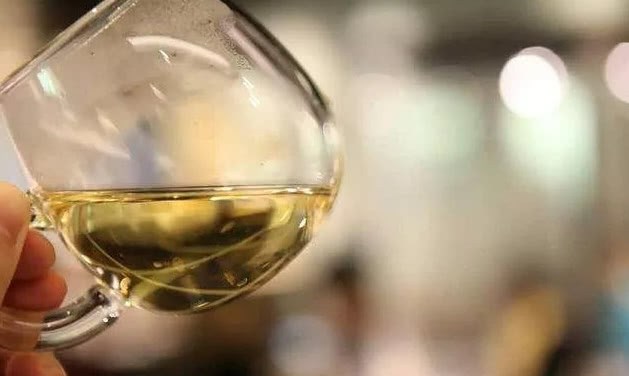
3. Look at the liquor color: clear and transparent is superior; murky and unclear is inferior.
4. Look at changes in the liquor color: if the brewing method is normal, then the changes in liquor color throughout the drinking process can reveal the grade of the white tea. A liquor color that remains stable throughout and gradually becomes lighter is superior; one that drops sharply after a few infusions and is very unpourable is inferior. For tea liquor whose quality changes rapidly, be careful about the possibility of "using technique to raise the raw material grade."
IV. After drinking
Look at the brewed leaves: the brewed leaves are like a woman's skin; they cannot hide secrets. This is a very deep subject; today I will only discuss a few of the simplest points.
1. Flexibility: good brewed leaves should unfurl naturally, soft yet elastic (doesn't that sound a lot like skin?). Too stiff or too tender both fail to count as superior. When gently rubbed and twisted by hand, those that do not easily break down are better than those that crumble at a pinch.
2. Uniform color: at a glance, brewed leaves that show a unified color with no obvious light or dark differences are superior; mottled and mixed, or dark and light, means you should be careful. If there are scorched red spots in the leaf surface, the production technique is not good enough.
3. Luster: after draining the brewed leaves and letting them air naturally for a few minutes, those that quickly lose water and dry on the surface are certainly not as good as brewed leaves that always remain oily and moist. This is much like the skin's ability to retain water.
To learn more about white tea knowledge,
Welcome to follow the WeChat public account [Riquan Tea Factory, public account ID: 15659252304]