The penis fish is the truly abstinent yet filthy species of the year, even geoduck clams bow down in defeat
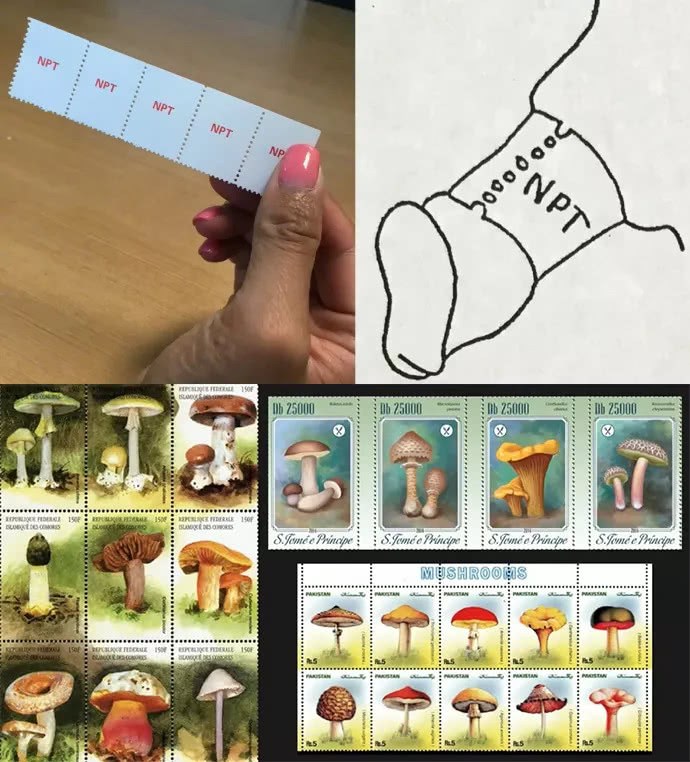
When talking about certain mushrooms, besides whether they are edible, tasty and how to eat them, people often can't help butcomment on how dirty they are, and scientists even use them for "serious" research.
For example, at the just-concluded 28th first"Ig Nobel Prize", the reproductive medicine prize even drove a car. The rese(te)arch(hers) used postage stamps (as shown below) to test whether a man's penis can function properly.
Image: improbable.com
And when it comes to dirty yet delicious mushrooms, we cannot fail to mention bamboo fungus.
Here, a close-up of bamboo fungus. Image: wiki
Bamboo fungus, dirty from its scientific name to its appearance
Bamboo fungus is the collective name for a group of well-known fungi in the genus Phallus of the family Phallaceae, with about 10 or so species in total. What is generally sold on the market islong-skirted bamboo fungusPhallus indusiatus andshort-skirted bamboo fungusP. duplicata. If you pull off that holy lace skirt, the whole bamboo fungus looks simply unbearable to look at. Don't blame it, though; the genus name Phallus itself comes from Greek and refers to an erect penis. One member of the genus is calledcommon stinkhornP. impudicus (also called skirtless bamboo fungus), and it is even more filthy, as its species epithet means "lewd," because its namer, the great Linnaeus, thought it looked too much like a penis... Speaking of this, the Chinese notion of "like supplements like" is about to act up again, but there is no evidence that eating bamboo fungus will make a certain part longer.
I'm still a baby, I don't understand. Image: Margot et Herman
It is worth mentioning thatdeath capAmanita phalloides, whose name sounds like a species of Phallus, is actually not. It contains the highly toxic phalloidin. If you encounter this thing in the wild, please be sure to ignore it.
Image: s-media-cache-ak0.pinimg.com
Bamboo fungus with its own lace skirt
Let our minds temporarily escape the prison of filth and imagine a mature bamboo fungus, like a tall, fair-skinned beauty with black hair, wearing a lace skirt, with a graceful figure. The most eye-catching thing about bamboo fungi is probably their mesh lace skirt, which we call the "indusium." The species epithet of the long-skirted bamboo fungus, indusiatus, means "wearing gauze." Different species of bamboo fungus have different appearances and colors of indusium. The skirt of the short-skirted bamboo fungus is shorter than that of the long-skirted bamboo fungus; the skirt of the yellow-skirted bamboo fungus P. multicolor is a bright lemon yellow, but it is poisonous, so if you find it in the wild, please ignore it. There is also a bamboo fungus with the scientific name P. cinnabarinus, whose skirt is a super fashionable rose quartz color. By identifying the indusium, various bamboo fungi can be roughly distinguished.
Yellow-skirted bamboo fungus. Image: wiki
P. duplicatus. Image: wiki
P. cinnabarinus. Image: wiki
Unfortunately, some people see these skirts but fail to associate them with the beautiful image of a beauty wearing a skirt. Bamboo fungus is called in Japankomuso mushroom[xùn], the komuso mendicant monk is plainly dressed and wears a deep woven hat called a "tengai," which looks like the indusium of bamboo fungus. The komuso mushroom got its name from this, and a strong abstinent vibe comes rushing at you.
Komuso mendicant monk. Image: wiki
No matter how different the indusium is, bamboo fungi look pretty much the same after being dried. Therefore, dried products are graded only by grade, not by species. High-quality dried bamboo fungus has a complete fruiting body and smells of the rich fragrance natural to mushrooms,light yellow in color. If it is abnormally white, it is very likely fumigated with sulfur during processing, and you should be alert to the danger of excessive sulfur dioxide residue.
Image: ae01.alicdn.com
Is bamboo fungus actually the descendant of bamboo?
Early people thought bamboo fungus was part of bamboo, especially when seeing dried products, they thought it was bamboo flowers or bamboo membrane. Is that really so?
--Of course not. However, with the character "bamboo" in its name, bamboo fungus really does have some relationship with bamboo. Bamboo fungus is a saprophytic fungus,mostly found in bamboo forests. The reasons are roughly two. First, the leaf litter layer of bamboo forests is composed of a large amount of dead branches and fallen leaves, containing a large amount of humus, which provides a good nutrient source for the growth and development of its mycelium and also provides a convenient environment for the attachment of the basal rhizomorphs of bamboo fungus; second, the development of the mycelium of bamboo fungus generally does not need sunlight, and evenlight has an inhibitory effect on its growth. Therefore, bamboo forests with high canopy density naturally become a hotbed for their growth.
But if you think bamboo fungus can only grow in bamboo forests, then you are greatly mistaken. Bamboo fungus has no specificity for nutrients. In other words, like other macrofungi, they are not picky eaters, so as long as conditions are suitable, they can also grow happily on decomposed straw from various crops (the technology for field cultivation of bamboo fungus is now quite mature).
Image: c1.staticflickr.com
Bamboo fungus eggs, have you ever played with them?
Fresh bamboo fungus is not easy to preserve. In the past, when logistics were underdeveloped, if you wanted to eat fresh ones, you could only go to a restaurant in the place of production. For ordinary households, being able to eat rehydrated dried products was already not easy. With the development of logistics, plus merchants being very clever, wanting to eat fresh bamboo fungus is much easier. First, you will receive a few pitch-black eggs--bamboo fungus eggs. These are actually theirbutton stage。
Here, this is the egg of bamboo fungus. Image: Attacking Succulents
The button stage is not mysterious. It develops from therhizomorphs and myceliumof bamboo fungus. Generally, merchants will have you keep the eggs in the refrigerator. In just one or two days, the eggs begin to break their shells, and the baby bamboo fungus inside pokes its head out!
The whole process begins with a small crack appearing in the membrane at one end of the button, exposing a large amount of gelatinous substance. Under pressure, the mushroom-cap-shaped cap together with the columnar stipe pushes the membrane open, and then the stipe grows rapidly until the whole thing is exposed outside, leaving the membrane of the button at the other end. This part is called thevolva. During this process, the indusium gradually opens from inside the cap and finally completely covers the stipe, and the whole egg-breaking process is complete. The snow-white stipe and the deep green cap complement each other, along with the pure white reticulated long skirt. At this moment, you will feel the creator's "teasing": clearly it is about to go into your stomach, yet you can't help but stop to admire it for a while.
Growing bamboo fungus eggs is a very special experience, and its degree of surprise far exceeds the process of eating. Image: Attacking Succulents
Most fungi reproduce by releasing spores into the air, but bamboo fungus does not do this. During the egg-breaking process, you can observe that the cap is covered with a coffee-green liquid, and it smells of a pungent, putrid stench. This is actually their viscousspore liquid, secreted by the spore-producing tissue on the cap. Although humans cannot praise this smell, in the vast forest, it is a delicious fragrance that attracts mosquitoes and flies. These small insects are attracted and land on the cap, their bodies covered with spore liquid, and then fly away to rest elsewhere, completing the mission of spore dispersal. Generally, the cap part is not eaten (however, I ate it too, and felt it was nothing much).
Image: il9.picdn.net
After this process ends, the fruiting body slowly loses water and dries up. After a long time, it tastes like chewing wax, so if you want to eat it, please do so early. Nowadays, there is also the habit of not waiting for it to break its egg, but cutting the bamboo fungus egg in half and stir-frying it or cooking it in hot pot. It is said to taste even more delicious.
How to eat bamboo fungus
There are extremely many ways to cook bamboo fungus. Common cooking methods are making soup, stir-frying, and blanching in hot pot. Cooking it whole in the pot preserves the original flavor. People in Guangdong like to eat fine bamboo fungus soup: one old hen, a few slices of lean meat, a few dried bamboo fungi, and then simmer slowly for several hours. No seasoning is needed, just a pinch of salt is enough. The soup is exceptionally delicious, and the bamboo fungus is smooth and chewy, truly a delicacy on earth. Or stir-fry fresh vegetables with oyster sauce, asparagus or lily bulbs both work, add stock and thicken, with rich sauce and bright oil, fresh and tasty.
Delicious bamboo fungus soup. Image: wiki
The indusium of bamboo fungus is also put to great use. Hot pot restaurants wrap shrimp paste in the indusium to make bamboo fungus shrimp paste, blanched in boiling broth, blending mountain delicacies and seafood into one, with a unique texture. Everyone is advised to give it a try.
Besides eating, bamboo fungus also provides inspiration for many designers. Image: Browsing Digital Art on DeviantArt
This article is a 2016 Dining Table Species Calendar article, from Species Calendar author @Attacking Succulents.
If you like him, you can also follow
Attacking Succulents
id: love123dr
to provide you with all-around succulent knowledge
Calendar Girl's Advertisement
Delicious mushrooms, beautiful mushrooms
We drew an entire book
A Nature Series · Mushroom Book
1 notebook = get to know 100 kinds of mushrooms
A notebook that can lie flat at 180 degrees
Super convenient for writing and taking photos