I think I've seen this sister before, do you remember?
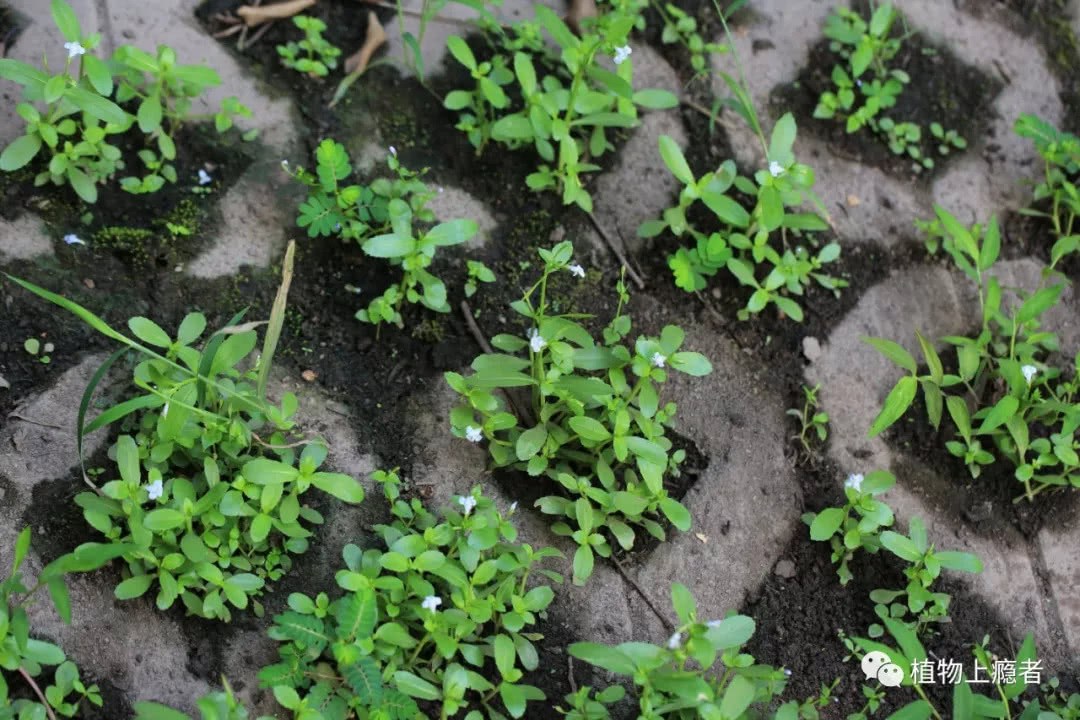
Lindernia antipoda
Lindernia antipoda
Scrophulariaceae, genus Lindernia
Annual herb
September is the season of the Lindernia genus -- actually, that's an illusion.
This year I noticed that Lindernia had already started blooming in June. It's just that the whole summer was too hot, and outdoor activities were almost reduced to zero, while the flowering period of Lindernia is long, so it wasn't until early September that we came out of the air-conditioned rooms and fell in love at first sight.
The first time I encountered Lindernia antipoda, I almost mistook it for Lindernia ruellioides. Their flower shapes are really similar, but something always felt a bit off. Looking more carefully, I found that the leaves of these two species are clearly different. Lindernia ruellioides has broader leaves with neat fine serrations along the edges; Lindernia antipoda, on the other hand, has narrower, more elongated leaves with shallow and blunt serrations along the edges -- the difference is quite obvious.
Lindernia antipoda leaves are oblong with shallow, blunt serrations along the edges
Lindernia ruellioides leaf edges have sharp and neat serrations
Once I clearly recognized that they were different species, comparing them again, the flower differences became apparent: Lindernia ruellioides flowers are slightly larger and more purple in color; the upper lip is noticeably broader and plumper, and curls backward. Lindernia antipoda flowers are more white, the upper lip is nearly straight, and the corolla is about two millimeters shorter. What they have in common is that they both look like the "Qing dynasty bitten-lip makeup" invented by Yu Zheng -- the flower lips are extremely flat; in the throat you can see two elongated golden-yellow anthers, which flower enthusiasts jokingly call "two gold teeth."
Flower of Lindernia antipoda
Flower of Lindernia ruellioides, do they look alike?
The one below is relatively rare. I've encountered it twice in different places. The flowers are noticeably more purple, and the serrations along the leaf edges are not very obvious either. After discussing with flower enthusiasts, although it's not typical enough, it still matches the description of Lindernia antipoda's flowers and leaves in the Flora of China, so for now I'll just treat it as one too.
Atypical Lindernia antipoda
Let's review: there are two sensitive points for identifying species in the genus Lindernia -- one is the depth of calyx splitting, and the other is the length ratio of the fruit to the persistent calyx. Lindernia antipoda and Lindernia ruellioides are the same: the calyx is deeply 5-parted to the base, and the capsule is slender and oblong, much longer than the persistent calyx.
An interesting detail is that when Lindernia antipoda is flowering, the pedicel is tilted upward; when it fruits, it suddenly makes a nearly ninety-degree turn and becomes horizontally extended.Lobelia chinensisalso has similar characteristics. I firmly believe there must be some mystery behind this, though I haven't found the answer yet.
Calyx deeply 5-parted to the base, pedicel nearly upright
Capsule much longer than persistent calyx, horizontally extended
Lindernia antipoda prefers wet habitats. The plant is delicate, no more than ten to twenty centimeters tall. Recently it rained for several days in a row, and I deliberately went to see them after the rain. The small white flowers had been blown down all over the ground, and the tender green leaves were stained with mud. It was a scene of scattering and turning to dust, and seeing it made my heart ache with tenderness. Eileen Chang's famous line, "When she saw him, she became very low, so low into the dust, but flowers bloomed in her heart," is nothing but a literary fantasy. If you truly sink low into the dust, the flowers would have long withered.
The scientific name of the genus Lindernia is named after the 18th-century German botanist Franz Balthasar von Lindern. The species epithet antipoda is composed of the Greek roots anti (opposite) + pous (foot), meaning diametrically opposite -- I wonder what it refers to? The English name of Lindernia antipoda is also quite puzzling: sparrow false pimpernel -- the three words separately mean sparrow, false, and pimpernel, but together they make no sense.
Lindernia antipoda is also a medicinal herb. Mr. Yang Shiyou of the Yueqing City Drug Inspection Institute in Zhejiang Province said in an article that Lindernia antipoda is a medicinal material that Yueqing City has sold to Hong Kong, China, Singapore, and Taiwan, China over the years, and is also a medicinal material favored by local coastal fishermen, often taken in whole boxes to sea. It can clear heat and drain dampness, remove blood stasis and reduce swelling. It is usually harvested in September, and the whole plant is dried for medicinal use.
Lindernia anagallis
Flower addicts have a special kind of happiness: after getting to know one plant, encountering its close relatives feels like Baoyu meeting Daiyu for the first time -- "This sister, I have seen before..." Truly full of joy. The genus Lindernia has over twenty species. Last autumn, I first got to know Lindernia crustacea and Lindernia ruellioides, and then soon encountered Lindernia anagallis and Lindernia antipoda. I deliberately looked back at last year's old article and found two comments that were particularly well written, worth sharing with everyone:
@Yiliang:"Looking at wildflowers, there's always a sense of surplus joy stolen from between heaven and earth."
@Past:"Only the clear breeze on the river and the bright moon among the mountains -- the ear receives them and they become sound, the eye meets them and they become color -- these are what you and I share. Add one more thing that you and I share, and that is the plants in the mountains and fields."
The four seasons cycle, and wildflowers are the most faithful. Knowing Lindernia is September's exclusive joy, and I wish to share it with you
There are 3 kinds of two-lipped small flowers in the picture. To the lower left of Lindernia antipoda is Mazus pumilus, and to the lower right is Lindernia crustacea
Distribution:
Chongqing, Sichuan, Yunnan, Guizhou, Guangxi, Guangdong, Hunan, Hubei, Anhui, Jiangxi, Fujian, Zhejiang, Jiangsu, and Taiwan, China, and other provinces. Widely distributed in tropical and subtropical regions from India to northern Australia. Mostly grows in fields and moist grasslands.
The article and plant images (unless otherwise credited) are all original works by the author
Your sharing and appreciation are my greatest support
Plant Addict
WeChat ID: plantfiend
Discovering the unique beauty of every plant