Grow a whole new pot of kalanchoe from a single stem or leaf, and you will never need to go to the flower market again
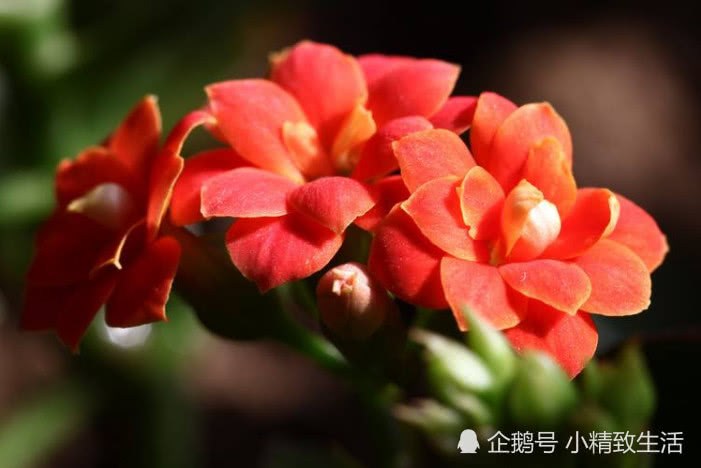
There is a saying in gardening circles: "have succulents, have kalanchoe." Here "succulents" refers to succulent plants, while "kalanchoe" refers to kalanchoe. Of course, kalanchoe is itself a type of succulent, so we do not need to take these sayings too seriously. Still, kalanchoe not only has an auspicious name, but also blooms in a wide variety of forms, each one more beautiful than the last. That is why kalanchoe is also a very popular houseplant, and many people like to buy one or several pots to take home and grow.
In fact, kalanchoe can be propagated by stem cuttings or leaf cuttings. Below, Xiaojingzhi will learn together with everyone how to take kalanchoe cuttings. Once you have mastered it, you can save quite a bit of money on buying flowers!
1. Leaf cuttings
Kalanchoe leaf cuttings can be taken all year round, but they root most easily in summer and autumn. When pruning the branches and leaves of kalanchoe, simply take the cutting as you prune.
From the pruned kalanchoe branches and leaves, choose large, thick leaves without disease spots to serve as the mother leaf, so that the mother leaf has enough nutrients to supply its rooting and sprouting. When removing the leaf from the stem, be careful to keep it intact and not damage the growth point on the leaf stalk.
Because the process of rooting for kalanchoe leaf cuttings is rather long, after removing the mother leaf it is recommended to soak it in rooting solution, which can speed up later rooting. After soaking, take it out and place it in a ventilated, shady environment to dry until the wound is dry and shrunken.
Insert the leaf stalk of the prepared mother leaf obliquely into the potting soil, water it, and keep the potting soil moist until it roots and sprouts.
The process of rooting and sprouting for leaf cuttings is rather long, and slow ones may even need five or six months. So if you accidentally knock off a few leaves, you can take leaf cuttings to avoid waste; if you need to propagate quickly, you can use the stem-cutting method.
2. Stem cuttings
Kalanchoe stem cuttings can also be done in all four seasons; the main thing to note is keeping them warm in winter.
Choose robust kalanchoe stems and cut them into small sections of two nodes each. Keep the leaves on the upper node and remove the leaves on the lower node (the removed leaves can be used for leaf cuttings!).
You can soak them in rooting solution or not, but whether you soak them or not, you must place the small stem sections in a ventilated, shady place to dry until the wounds are dry and shrunken.
After the wounds have dried, insert the stem sections into the potting soil. Be careful not to insert them the wrong way round; bury the lower node, water, and then keep the potting soil moist until they root and sprout.
Stem cuttings are much faster than leaf cuttings; they generally root in two to three weeks, and after one month they can be potted up.
3. Pruning
During the growth process, kalanchoe needs constant pruning to keep it lush and branching.However, note that you must not top or pinch out the growing tips before kalanchoe blooms, because kalanchoe must have 3 pairs of branches before it can form buds and bloom. If you top or pinch out the growing tips before the flowering period, it may fail to bloom.
After kalanchoe leaf cuttings or stem cuttings have taken root and been potted up, when they grow to five or six cm they need their first pinching out, in order to remove apical dominance and stimulate the sprouting and growth of side branches.
When kalanchoe grows to about ten cm, you can top it once, removing the tender shoots at the top of the plant so that it produces more top buds.
During the growth period of kalanchoe, be careful to regularly cut off poorly growing and overly dense branches.
Note: all the branches and leaves pruned off above can be used for stem cuttings or leaf cuttings!
How about it, isn't it super easy? Once you have learned it, get to work right away and let kalanchoe fill your balcony!
Compiled and published by Xiaojingzhi Life; we hope it is helpful to you!