Practical advice on selecting and introducing orchid species: how to choose a suitable variety
Promote Chinese orchid culture, spread orchid knowledge
Selecting and introducing orchids is very complicated. If the selection is poor, it will directly affect your enthusiasm for cultivating orchids; introducing inferior plants or fake plants will directly harm your economic interests. Therefore, when selecting and introducing orchids, every orchid enthusiast should take a cautious attitude and must not select and introduce them blindly. Now I will discuss a few personal views on how to select and introduce orchids from the perspective of orchids and cymbidiums, which may serve to offer a modest spur to induce others to come forward with valuable contributions. According to traditional methods of judging orchids, there are plum-petal, lotus-petal, narcissus-petal, pure-color, and butterfly-petal types, and those meeting the above conditions are considered superior varieties. At the same time, these plum-petal, lotus-petal, narcissus-petal, pure-color, and butterfly-petal flowers not only require a well-formed flower shape, delicate flower color, and broad petals, but also require good substance and structure - a long flowering period and lasting durability without losing shape. An old proverb says: "A thousand plum petals may be found over generations, but a single lotus petal is nowhere to be sought." This shows that true plum petals, lotus petals, narcissus petals, pure-color, and butterfly petals are relatively hard to obtain. An orchid that has reached grade and is also pure-color is a once-in-a-generation encounter, making it an absolute rarity among orchids. When selecting and introducing orchids, enthusiasts can consider two factors according to their own preferences. The traditional aesthetic view takes elegance and lightness as the first choice, pursuing purity of variety, with well-formed flower structure as the highest grade. The other is the pursuit of novelty, rarity, and uniqueness, pursuing new flowers and strange flowers, especially mutated wild-collected orchids. Regardless of individual preferences, when selecting and introducing orchids and cymbidiums, one should focus on considering the following aspects:
First, consider the fragrance of the orchid. Under normal circumstances, famous Jiangsu and Zhejiang orchid and cymbidium varieties are almost all richly fragrant. The fragrance of orchids can generally be described with words such as secluded fragrance, clear fragrance, strong fragrance, light fragrance, and sandalwood fragrance, among which secluded fragrance is the most elegant, and almost all Jiangsu and Zhejiang orchids and cymbidiums belong to the secluded-fragrance type. Many spring orchids from Hubei, Anhui, and Henan have no fragrance. Among true cymbidiums, plum-, lotus-, and narcissus-petal orchids have a stronger fragrance than willow-leaf-petal orchids, and the fragrance of strange flowers surpasses that of petal-form flowers. Comparing fertile-centered flowers with pure-color flowers, pure-color flowers must be a notch higher. Among the various orchids and cymbidiums, their fragrances each have their own merits. An ancient poem says: "Though without the bright beauty of a delicate maiden, it has its own secluded fragrance like a virtuous person." One should choose orchids and cymbidiums of the secluded-fragrance type.
Second, one must distinguish the flower types of famous orchid and cymbidium varieties. When selecting orchid and cymbidium flowers, the flower grade must be well-formed, the three outer petals must be balanced, with a level shoulder or flying shoulder. When the orchid and cymbidium petals spread and open, the main petal must be rounded at the base, with a constricted base and flared corners, tight edges, and the tips of the two lateral sepals clearly forming a pouch - these are famous flower types. The flower types of famous orchid and cymbidium varieties differ from those of ordinary orchids and cymbidiums. Ordinary orchid and cymbidium petals are pointed, long, and thin, while the petals of famous orchid and cymbidium varieties are short, round, and thick, and the two are easily distinguished when placed side by side. In this way, when selecting and introducing orchids, you will not be easily deceived, and you can choose the orchids you like with clear targets. Only by selecting and introducing such orchids and cymbidiums will they have vitality.
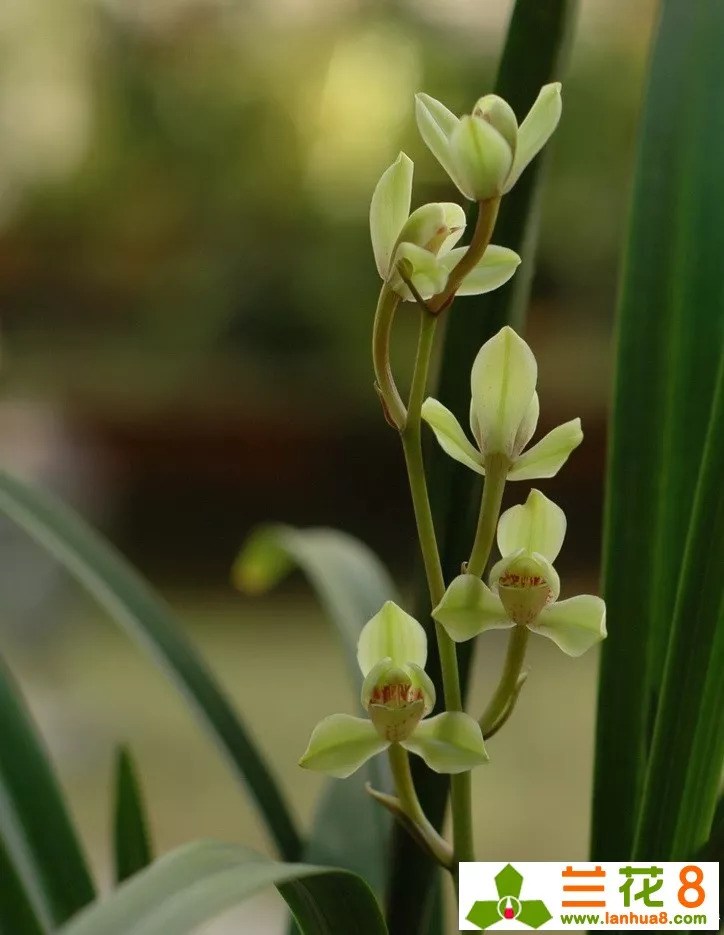
Third, one must select good flower colors for orchids and cymbidiums. The flower color of orchids and cymbidiums is based on green, and green appears plain, quiet, and elegant. Among greens: tender green is first; old green is second; red turning to green is next; and those with a dark luster and a purple tinge within the green are even lower.
Fourth, one can also select and introduce orchids by looking at flower buds; selecting and introducing by looking at flowers is relatively narrow, and in actual selection and introduction it is impossible to come into contact with many blooming orchids for you to choose from. That requires orchid enthusiasts to determine whether an orchid variety is good or bad by looking at flower buds, and this requires two premises: first, cymbidium flower buds are relatively difficult to identify; second, spring orchid flower buds are best examined after the beginning of winter. The flower buds of famous spring orchid varieties and ordinary spring orchids are relatively easy to distinguish. The flower buds of famous spring orchid varieties often have an outer bract that is slender and tightly wrapped, with the tip slightly hollow inside and the middle swollen, appearing round and bullet-shaped. The bract tips mostly have rice-grain-like white dots, and the bract is thick and solid, often with pinkish color and a misty sand-like pattern, with fine green veins running to the top, obvious and clear. The flower buds of ordinary spring orchids are pointed and long. The outer bracts of pure-color spring orchid flower buds must be green bracts, or white bracts with white veins.
Fifth, some people also select species based on the orchid's leaves. For example, in many famous orchid varieties such as Luyun, Huanqiuhe, and Zhengtonghe, the leaf surface is relatively thick and fleshy, the leaf tip is spoon-shaped, and the fleshy roots are thin and round, which is relatively obvious and distinctive. They are different from the leaves of ordinary orchids and cymbidiums. This can only serve an identifying role after the famous orchid has been confirmed. But beginners in orchid cultivation need to pay special attention: many orchid peddlers now chemically treat orchid leaves, turning long leaves into short plants, broad leaves, and round tips, with leaf shapes like famous orchids. Ordinary plants are turned into variegated plants; the price is very cheap and the temptation is very strong, and if you are not careful you will often be deceived.
Sixth, orchid selection and introduction cannot be done in isolation within a small circle, especially for orchid enthusiasts in the north. The north does not produce orchids, and in the internet age, one will inevitably go online to buy the orchid varieties one likes. Buying orchids online is convenient and the range of choices is wide, and it is indeed a good way to exchange orchids. But there is also a problem: after looking at a few photos online, can you really see whether the flower is good or bad? How can you be sure that what is being exchanged is this variety, while what is sent is an ordinary plant or a diseased plant? I believe that if buying orchids online, one must find an honest and reliable orchid garden. You must never buy just because someone says it is a good plant, or in the end the one who suffers will certainly be you. It is best to select and introduce orchids among fellow enthusiasts, or at orchid exhibitions where you can see the flowers and plants.
Seventh, when selecting and introducing orchids, one must choose carefully and prudently, and set the price according to quality. For the same variety, there are differences in generation. Seedling plants in mother-and-child generations, with orchid roots that are pure white or grayish-white and not too badly damaged, with crystal tips on the seedling roots, or orchid roots slightly yellow but without crystal tips yet with firm root bodies, are the first choice as good plants. Orchid roots that are blackish-brown with a water-soaked appearance, or whose root skin is already empty, or diseased plants must absolutely not be selected. I personally believe that in orchid selection and introduction one must choose strong seedlings, large seedlings, and disease-free plants, and it does not matter if the price is a little higher. Such orchid plants have a high survival rate and also a high rate of producing new shoots, are easy to rebloom, and give a quick return. When selecting and introducing new varieties, one can also choose according to these requirements. Article source: Siming Library
Orchid Bar, your good teacher on the road of orchid cultivation