Cold-hardy flowers that survive at -20°C, live as soon as they touch soil, smell better than osmanthus, and one plant turns into a sea of flowers
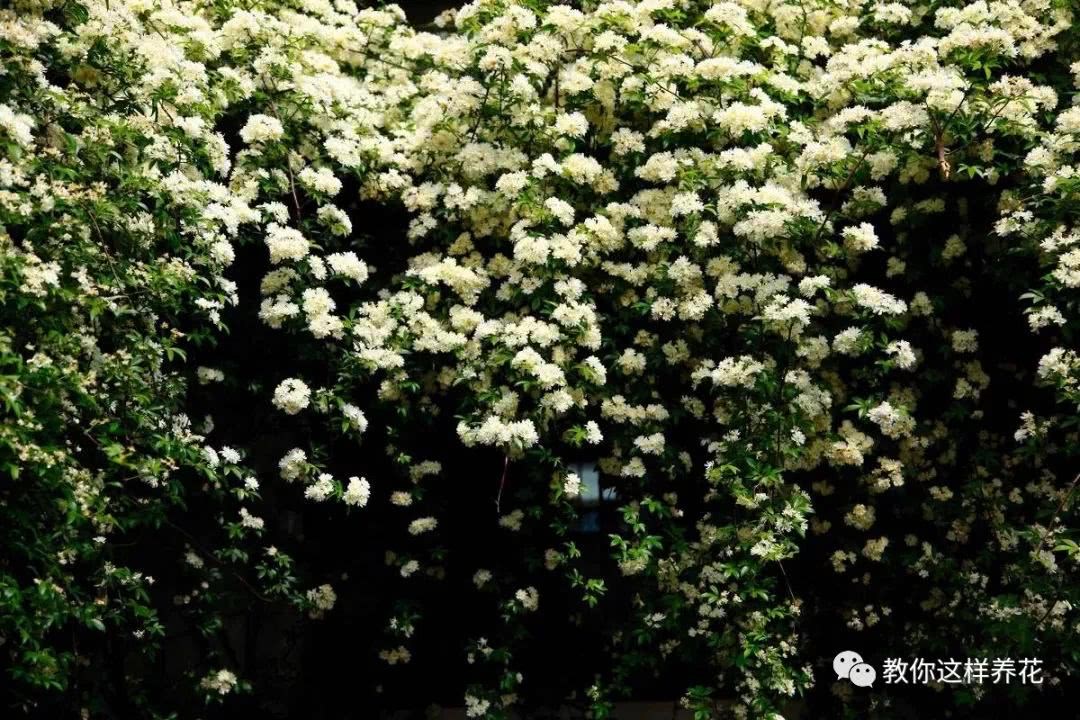
Everyone is familiar with roses, but not many people know about Banksia rose. The woody fragrance used in Chinese medicine and the Banksia rose we are talking about are not the same plant: the woody fragrance in Chinese medicine is a plant of the Asteraceae family, while the Banksia rose is a plant of the Rosaceae family, closely related to roses and Chinese roses. The Banksia rose is fairly cold-hardy and can be grown in the open ground even in North China; its fragrance is fresh and pleasant, making it an excellent ornamental flower. Let's take a look!
“
Banksia rose
”
-Banksia rose-
The Banksia rose is a traditional flower of our country. Every year in late spring and early summer, pure white or cream-yellow blossoms are set among the green leaves, giving off a rich fragrance that leaves a lasting impression. And when summer comes, its dense branches and leaves shield people from the scorching sun, bringing cool shade.
The Banksia rose grows very fast; plant it and within two or three years it will bloom, and on a balcony it can stretch out 5-6 m, turning into a balcony sea of flowers. The key point is that the Banksia rose hardly gets sick and almost never has pests; it is just too easy to care for!
The Banksia rose blooms relatively early, flowering every year in April-May, with a large number of blooms and a delicate fragrance. When in bloom, the scent can drift very far, so some people also call it "Seven-Mile Fragrance" or "Ten-Mile Fragrance."
Besides being ornamental, the Banksia rose has a pure fragrance; when half-open, the flowers can be picked to scent tea. Pickled with white sugar and made into Banksia rose sugar cake, it can rival rose sugar cake.
-Care of the Banksia rose-
For a potted Banksia rose, choose a relatively large pot and use loose, breathable, fairly fertile soil with good drainage, and apply some base fertilizer at the bottom.
The Banksia rose likes a growing environment with plenty of sunlight. During the growing season, keep the soil moist and avoid waterlogging; after budding in spring, apply a compound fertilizer once or twice to encourage larger, more fragrant flowers. After winter begins, dig a trench around its roots and apply decomposed organic fertilizer, then water thoroughly. The Banksia rose is fairly cold-hardy; many northern flower lovers plant it directly in the open ground, and overwintering is no problem.
In winter or early spring, prune the plant once, cutting away leggy branches, dead branches, diseased branches and overly dense branches to improve ventilation and light penetration inside the plant.
The Banksia rose is highly adaptable; generally, 2-3 years after planting it can bloom, and its branches can extend to more than 6 m. Plant a few and they can grow into a flower wall!
-Propagation of the Banksia rose-
The Banksia rose is generally propagated mainly by cuttings and layering, though some people also propagate it by sowing seed. Layering has a higher survival rate, while cuttings are more convenient; each has its pros and cons.
For Banksia rose cuttings, use hard wood before or after spring budding, or semi-hard wood before or after flowering; both root very easily. Use river sand, perlite or akadama as the cutting medium, put it in a plastic cup with holes in the bottom, insert the trimmed branches with buds into it, place the plastic cup on a tray, make sure there is water in the tray, and keep it in a bright place to grow. Once roots have formed, transplant it.
Layering mostly uses the air-layering method. In the growing season, select vigorous branches, make a cut at the lower part of a node, wrap it into a bag shape with plastic film, fill it with soil, water it, then tie the bag opening tightly and keep the soil moist; the survival rate is very high.
(Banksia Rose Bar, -3°C zhu)
-Grafting Chinese roses onto Banksia rose-
As mentioned earlier, the Banksia rose is closer to Chinese roses and roses, so many flower lovers use the Banksia rose's fast growth as rootstock to graft Chinese roses. Compared with wild rose, its compatibility is a little poorer, but the grafting success rate is still very high. The stems of mountain Banksia rose are relatively thick, straight and long, and many people use them to make rose trees.
Northern flower lovers can graft with white Banksia rose; white Banksia rose grows fast and is more cold-hardy. Southern flower lovers can graft with double-petaled Banksia rose; double-petaled Banksia rose is more heat-tolerant. Grafting can be done in both spring and autumn, and the commonly used methods are bud grafting and bark grafting.
For the bud grafting method, take plump, well-filled buds from one-year-old branches, cut a T-shaped incision in the bark of the rootstock down to the xylem, insert the cut bud into the rootstock incision, align and press the bud and rootstock cambium closely together, and tie it tightly with grafting tape so it heals and grows.
Bark grafting is relatively simple, easy to master, and has a fairly high survival rate. Cut the top of the mountain Banksia rose flat, make 2 cuts in the vertical direction, with a width similar to the scion; the scion will be inserted into it in a moment.
Cut the side of the scion near the rootstock flat, insert it into the bark, and tie it well with grafting film. Then find a plastic bag to cover it, spray a little water mist inside, tie it well to increase humidity and help the scion survive.
The grafted tree-form Chinese rose, covered in flower buds all over the tree, is truly beautiful.
The Banksia rose is easy to care for and grows fast
Whether grown on its own or grafted with Chinese roses
It is great either way
It is not afraid of cold either, and can be grown in both the north and the south
If you like it too
Then get a pot
Show it to flower lovers who need it!