A wild vegetable by the roadside that looks like a white stick is highly nutritious and can also stop bleeding, but few people have eaten it
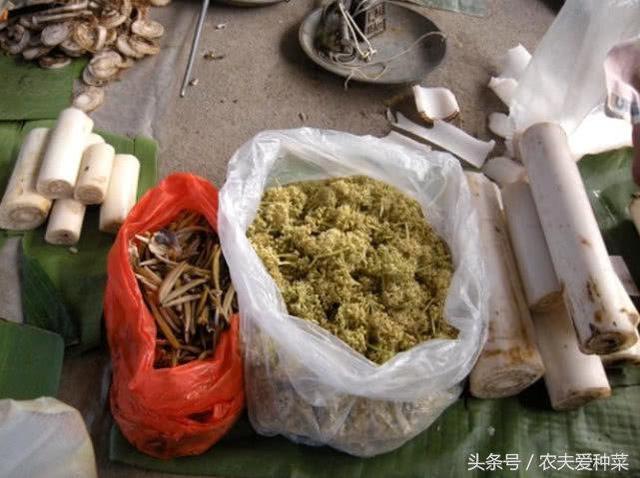
On the road I met someone selling a kind of white vegetable. This vegetable looked like white sticks, of varying lengths, neatly placed on banana leaves. Only after asking did I learn that this is wild banana heart, an edible wild vegetable.
In fact, the banana plant is still quite common in rural areas of the south. I remember that when I was little, a big banana tree grew in front of my second grandmother's door. It would bear many bananas, in clusters just like bananas, and although they tasted very astringent, as a greedy child I did eat them a few times. What I am talking about today, though, is the heart of this kind of banana tree, which is also edible and even more delicious than the bananas.
Everyone knows the banana plant. It can grow into a large tree 2.5-4 m tall, with broad leaves. The leaves are oblong, 2-3 m long and about 30 cm wide, and it stays green all year round. Its stem is generally wrapped in layer after layer of skin. After cutting down a banana plant and peeling off the old outer parts, the tenderest part in the middle of the banana stem is the banana heart. Once cut into short pieces, it looks like white sticks.
The preparation of banana heart is fairly simple. First boil it until soft and tender, then dress it with salt and chili and eat it, or stir-fry it, but it must always be boiled first before stir-frying. Banana heart is rich in nutrients, sweet in taste and cool in nature, and has effects such as clearing heat and detoxifying, promoting urination and reducing swelling. In the past, banana heart was also chopped up and applied to treat external injuries, with a certain bleeding-stopping effect.
The banana plants we see do not necessarily have an edible heart. What is mainly edible is the heart of the wild banana. The wild banana is a perennial herbaceous plant. It likes warmth, has strong stem-splitting ability, tolerates partial shade, has fairly strong adaptability, and grows quickly.
Nowadays there are also quite a few cultivated banana plants, mainly grown as fruit trees or as garden landscaping trees. Banana plants are very suitable for planting in places with fertile, loose soil and good air permeability. They are also very shade-tolerant, and partial shade or scattered light is enough for them to grow well, while too much shade makes the plants grow poorly and makes it hard for them to flower.
But banana plants are not cold-tolerant. In winter the temperature must be kept above 4°C, though they can also tolerate short periods of low temperatures at 0°C. Banana plants also like moisture. During the growing period, water them more and spray the plants to maintain air humidity. In summer, with high temperatures and frequent rain, watering should be controlled and drainage should be paid attention to; avoid continuous waterlogging in the soil, which can cause root rot.
Cultivated banana plants, unlike wild ones, are not left unfertilized. We can plant them in front of and behind the house, at the edges of fields and corners of the land, and so on. Before planting, be sure to apply enough base fertilizer, such as barnyard manure and compost. During their growing period, a decomposed organic fertilizer should also be applied once a month, which is even more helpful for improving quality.