How to Make a Schefflera Branch from the Roots: A Detailed Guide to Practical Methods
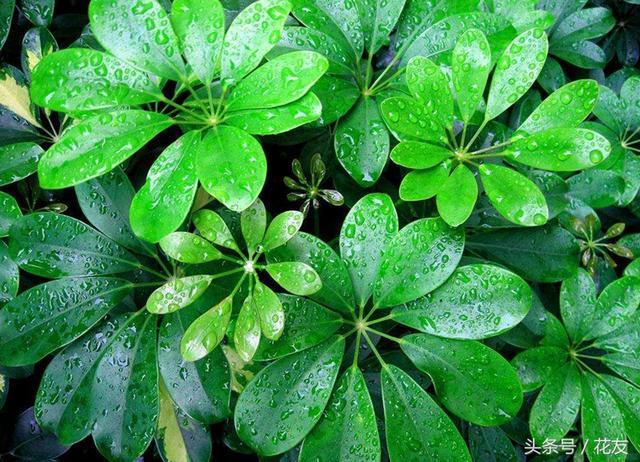
Potted Schefflera (umbrella tree) usually shows its ornamental value when it has lush branches and leaves and stays evergreen. But sometimes, due to neglect of care orotherfactors, a potted Schefflera can grow into a single-trunk form, while the Schefflera that some growers produce is often short and full, and seems to have higher ornamental value than the single-trunk one. Of course, different people have different tastes; some like the single-trunk style, while others prefer the full plant shape. And most people's taste in potted Schefflera leans toward the latter.
Schefflera
Indeed, the Schefflera that everyone grows in pots mostly appears with a full, short plant shape, but under natural growth conditions, the plant generally appears in a single-trunk form. So this requires us to intervene with artificial auxiliary means to achieve it. In order to obtain a dwarfed and full plant shape, we usually need to find a way to encourage the potted Schefflera to grow more branches from the roots. So how does Schefflera branch from the roots?
Schefflera
First, before the plant enters the growing season when it is in a sprouting state, we need to carefully examine the plant and then make a practical plan. And to promote sprouting in the plant, the plant's growing environment must be suitable, and water and fertilizer also need to be sufficient, because sprouting consumes a lot of nutrients and water. Then, according to our intended effect, we should cut the trunk or remove the top of the potted plant at a suitable position. Since the growth points of Schefflera are mainly concentrated at the top shoot of the main trunk, once the apical dominance at the top is removed, its growth points will be dispersed throughout the whole plant.
In order to achieve the effect of dwarfing the plant and promoting root sprouting and branching, we generally need to cut the young Schefflera plant as low as possible, leaving only 2-3 nodes. And after removing the upper growth point, since the growth points are dispersed downward, some lateral buds will sprout from the lower part near the plant's roots. Of course, during this period we especially need to do a good job of moisture retention, and we can spray more water on the remaining stump part, so that in addition to many lateral buds sprouting from the roots and then growing into branches, it can also promote the sprouting and growth of aerial roots.
Schefflera: Sharing Potted Schefflera Growing Experience, Beautifying the Study, Living Room, and Office
In this operation process, in addition to strengthening water and fertilizer management, the position where we cut is also very critical. If the cutting position is too high, after branches sprout, the plant shape will often be relatively tall as well; but if the cutting position is too low, especially if the main trunk is completely cut off, since there are no buds below that can sprout, it may be difficult for buds to appear. Even if it sprouts through the roots, it is often difficult for buds to emerge due to its own limitations, and even if buds appear, it usually takes a very long time, and there may even be a phenomenon that causes the plant to die.
Schefflera
Therefore, in order to ensure that the vitality of the potted Schefflera is not harmed, it is generally necessary to keep 2-3 nodes and then cut off the upper part. At least 1 node also needs to be kept, and it is necessary to ensure that there are axillary buds below that can sprout smoothly; only in this way can we usually achieve the purpose of beheading or trunk cutting, and ultimately realize root branching and an increase in aerial roots. Only then can the whole potted plant be expected to achieve the purpose of dwarfing and a full plant shape. However, sometimes after cutting, a large number of lateral buds will sprout from the roots, and we can make an overall consideration and decide which to keep or remove. Generally, we keep a few branches in better growing condition as new main branches for cultivation, and the rest can be kept or removed according to our own needs.
Friends interested in growing flowers can follow the WeChat public account: Hua You, where wonderful articles on flower growing and flower appreciation are shared with you every day, and fellow flower lovers can enjoy the sea of flowers with you. Submission email: [email protected].