Sugar apple is edible and closely resembles the lychee; it is the best antioxidant fruit for delaying skin aging
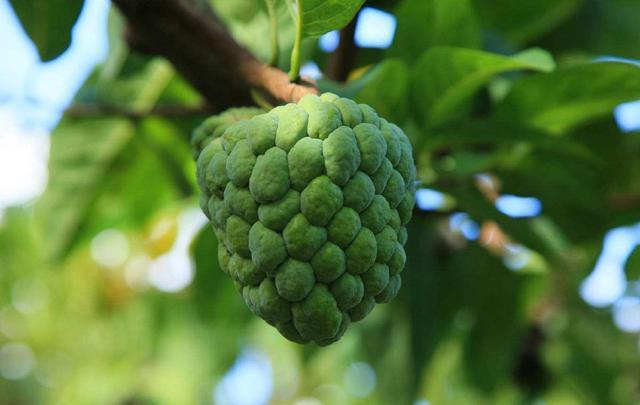
Sugar apple (tropical plant)
(another name for the sugar apple fruit) generally refers to sugar apple (tropical plant)
Sugar apple (scientific name:Annona squamosaLinn.), of the family Annonaceae and genus Annona, a deciduous smalltree; the bark is thin, grayish white, and much branched. The leaves are thinly papery, elliptic-lanceolate, pale green on the underside; the lateral veins are flat above and raised below. The flowers are solitary or 2-4 clustered at the branch tips or opposite the leaves, greenish yellow;flower budslanceolate; sepals triangular, finely pubescent; outer whorl petals narrow and thick, oblong; stamens oblong, with a broad connective; carpels hairless, each carpel with 1 ovule. The fruit is an aggregate berry formed from numerous round or oval mature carpels loosely joined and easily separated, globose or heart-shaped conical, hairless, yellow-green, covered on the outside with a white bloom. The flowering period is May-June, and the fruiting period is June-November.
It is cultivated in Zhejiang, Taiwan, China, Fujian, Guangdong, Guangxi, Hainan and Yunnan and other provinces and regions in China. It is native to tropical America; it is now cultivated in tropical regions worldwide. The fruit is edible and closely resembles the lychee in appearance, hence the name "sugar apple"; it is a famous fruit of tropical regions, containing 2.34% protein, 0.3% fat, and 20.42% carbohydrates; the seeds contain up to 20% oil. The bark fiber can be used to make paper. The roots can be used medicinally to treat acutedysentery, depression, and spinal bone disease; the fruit can treat malignant sores and swelling, and strengthen the spleen. It is a hosthosttree for the lac insect.
Morphological characteristics
Deciduoussmall tree, 3-5 m tall; the bark is thin, grayish white, and much branched.
The leaves are thinly papery, arranged in two rows, elliptic-lanceolate, or oblong, 6-17.5 cm long and 2-7.5 cm wide, with an acute or obtuse apex and a broadly cuneate or rounded base; the underside is pale green, initially finely pubescent, later becoming hairless;lateral veins8-15 on each side, flat above and raised below.
The flowers are solitary or 2-4 clustered at the branch tips or opposite the leaves, about 2 cm long, greenish yellow, drooping; the flower buds are lanceolate; the sepals are triangular and finely pubescent;
outer whorlpetalsnarrow and thick, fleshy, oblong, with an acute apex, finely pubescent, arranged in valvate fashion; the inner whorl petals are very small, reduced to scale-like forms, and finely pubescent;
stamensoblong, with a broad connective and a nearly truncate apex; the carpels are oblong, hairless, with an ovate-lanceolate stigma, each carpel with 1 ovule.
The fruit is an aggregate berry formed from numerous round or oval mature carpels loosely joined and easily separated, globose or heart-shaped conical, 5-10 cm in diameter, hairless, yellow-green, covered on the outside with a whitebloom。flowering periodMay-June, fruiting period June-November.
Distribution range
It is cultivated in Zhejiang, Taiwan, China, Fujian, Guangdong, Guangxi, Hainan and Yunnan and other provinces and regions in China. It is native to tropical America; it is cultivated in tropical regions worldwide.
Growth habits
Light
Sugar apple is light-loving and shade-tolerant; with sufficient light the plants grow robustly and the leaves are thick. Increasing light during the fruit development stage can improve fruit quality.
Temperature
Sugar apple needs a warm climate and appropriate rainfall, and is not tolerant of frost or cold, overcast weather.
The optimum growth temperature for common sugar apple is an average maximum of 25-32°C and an average minimum of 15-25°C; the optimum average temperature for fruit ripening is 25-30°C.
The critical temperature for sugar apple trees to overwinter safely is 0°C.
Most sugar apples are semi-deciduous fruit trees, entering natural dormancy or forced dormancy caused by environmental conditions in late winter or early spring.
Dormancy frees the plants from the effects of late winter or early spring frost or drought.
Appropriate low winter temperatures help accelerate leaf drop and promote sprouting.
However, the role of low temperature in inducing sprouting is not as essential as in other deciduous fruit trees.
The temperature during fruit ripening must be neither too low nor too high.
When low temperatures are encountered, especially below 13°C, the fruit develops physiological disorders, often showing rust spot disease, and ripening is delayed.
Excessively high temperatures, on the other hand, cause premature ripening and easily lead to fruit rot.
Water
Sugar apple is relatively sensitive to water; too much or too little water is detrimental to plant growth.
Sugar apple growth is affected even by short-term flooding, causing leaf drop and few flowers.
Irrigation or rainfall is important for flowering and early fruit set.
Too little water during this period will lead to flower and fruit drop, and slow fruit growth.
At the same time, water also affects fruit quality; it has been reported that in Australia the fruit cracking rate of irrigated sugar apple was 9.8%, while that of non-irrigated sugar apple was 20%.
Under low humidity (relative humidity below 70%), sugar apple shows increased flower drop, stigma drying, and a marked decrease in fruit set.
During the full flowering period of sugar apple in southeastern Queensland, the daytime relative humidity during the hottest time is often below 30%; in production they use high-density planting, windbreak forests and misting to increase orchard humidity.
However, excessively high humidity (above 95%) dilutes the sugary secretions on the stigma, resulting in a low pollen germination rate and hindering fertilization.
Soil
Sugar apple fruit trees have strong adaptability to various soils. They can grow in soils ranging from sandy to clay loam. However, to obtain high and stable yields, sandy soil or sandy loam is preferable. This is because heavy clay soil with poor drainage affects flowering and fruit set. Loose sandy loam does not have this drawback and is easy to control through fertilization and irrigation. If the soil layer is shallow, soil can be mounded to thicken the layer, improve drainage, and mulching can also be carried out to promote the development of absorbing roots in the surface soil layer.
Propagation methods
Sowing
The use of seedling propagation in production is limited to common sugar apple; hybrid sugar apple cannot be used as a mother tree. The seed source for seedling propagation is very important; seeds should come from large, well-shaped fruits on high-yielding, high-quality mother plants of superior varieties (common sugar apple).
It is best to use fruits set by artificial pollination of the same variety. Harvest the seeds when the fruit is fully mature, when the fruit is pale greenish yellow and the suture lines between the small fruits are obvious.
For cultivation as grafting rootstock, the requirements for seed collection can be lowered.
After the seeds are removed, wash them clean, remove shriveled and small seeds, and dry them in the air before sowing.
If the sugar apple seeds have been stored, they should be sun-dried before sowing to promote germination.
Before sowing, the seeds can be soaked in 200 ppm gibberellin for 24-36 hours to promote earlier germination.
The seedbed is best with fertile sandy loam, into which decomposed organic fertilizer is applied and mixed evenly.
Dig ditches and raise beds; the bed width should be convenient for field operations.
Either drilling or broadcasting may be used, with a sowing rate of 7-8 kg per mu.
After sowing, cover with fine sand or fine soil, press lightly, water thoroughly, then cover with grass or plastic agricultural film to retain moisture.
After emergence, uncover the grass or plastic agricultural film to avoid bending the seedlings.
During the seedling stage, attention should be paid to water and fertilizer management; generally water once every 3-4 days, and once a day during drought.
After reaching 6-8 leaves, topdressing can begin to help cultivate strong seedlings.
Grafting
Sugar apple grafting propagation generally uses common sugar apple as the rootstock, as such rootstock has the characteristics of good compatibility, dwarfed tree form, and earlier fruiting period. Grafting can generally be carried out only when the rootstock reaches a thickness of about 0.8 cm. Grafting time: whip grafting is generally in spring, while budding is better in summer and autumn; winter grafting generally cannot survive. For the sugar apple scion, select outer branch tips of vigorous, pest-free superior-variety mother trees; after collecting the scion, cut off the leaves, keeping 0.3-0.5 cm long petioles to reduce water evaporation. This method is suitable for the growing season when sap is flowing, so that the bark of the rootstock can be peeled.
Cultivation techniques
Planting
When planting sugar apple, grafted seedlings using common sugar apple as rootstock should be selected; the best planting time is spring, especially before sprouting, when the survival rate is highest. They can also be planted in the rainy season in June-July, but attention must be paid to drainage, as sugar apple roots are most averse to waterlogging. At planting, the seedlings should preferably be graded; seedlings transferred from other places need to have their roots soaked in water for 3-5 hours before planting. After that, place the seedling into a hole 20-30 cm deep; for water-deficient mountain land, the depth can be appropriately increased by 10 cm, so that the root system spreads out; fill soil while lifting the seedling and firming it. After planting, make a tree basin around it, cover with mulch such as straw, and water thoroughly to settle the roots.
Fertilizer and water
The fertilization principle for sugar apple is scientific fertilization according to tree size and different growth stages, mainly applying organic fertilizer, combining organic and inorganic fertilizers, and gradually moving toward green agriculture.
Generally fertilize 3 times a year. The first time is before and after winter pruning, combined with deep plowing of the soil and orchard cleaning; apply mainly organic fertilizer, digging deep and applying deeply, applying heavily and completely, applying all the organic fertilizer, as well as 80% of the annual phosphorus fertilizer and 20% of the nitrogen and potassium fertilizer;
The second time is during the young fruit period after the summer fruit flowers (May-June), applying 35% of the annual total nitrogen fertilizer, 10% phosphorus fertilizer and 20% potassium fertilizer;
The third time is during the young fruit period of the winter fruit (September-October), applying the annual total ofnitrogen fertilizer35%, phosphorus fertilizer 10% and potassium fertilizer 35%.
When applying, ditches should generally be dug and filled, not broadcast; the ditches can be dug as strip ditches, ring-shaped, half-ring-shaped, radial, etc.
And according to the tree condition, foliar topdressing can also be carried out; foliar topdressing is also a limited way to supplement the nutrition of the fruit and tree. For foliar topdressing, Plant Power 2003,Tianda 2116、potassium dihydrogen phosphateand other foliar fertilizers can be used.
Water
First, field drainage and irrigation facilities should be well established to prevent severe drought and waterlogging. Irrigation should be carried out during the sprouting to flowering period, the new shoot growth and young fruit expansion period, the rapid expansion period, after fruit harvest, and during dormancy, with appropriate watering as the situation requires. Sugar apple roots are most averse to waterlogging, so drainage work should be done well in the rainy season to prevent water accumulation in the orchard.
Pruning
Sugar apple should be pruned every year to maintain tree shape and promote flower bud differentiation. Pruning is generally carried out twice a year, once in winter (January-March) and once in summer (June-September). The purpose of pruning is to reduce the tree spread, dwarf the plant, and tidy the tree shape. Winter pruning requires artificial forced defoliation of the whole plant to promote flower bud differentiation and make growth uniform. The fruiting form of sugar apple is generally controlled as round-headed or semi-round-headed; pruning is the key technique for off-season production.
Pest and disease control
Anthracnose
Damage symptoms: mainly causes leaf drop, black fruit, and rotten fruit.
Control method: during the new shoot emergence and post-bloom fruit set periods, spray 1-2 times with 50% carbendazim wettable powder at 500 times dilution or 70% thiophanate wettable powder at 800-1000 times dilution.
Root rot
Causes: waterlogging, root injury, high temperature and high humidity, and application of undecomposed garbage and miscellaneous fertilizer easily cause this disease; applying fermented and decomposed organic fertilizers such as bean bran and poultry and livestock manure helps suppress the occurrence of the disease.
Control method: give priority to prevention, promptly dig out and burn diseased plants, and spread 10:1 lime and sulfur powder on the site, applying 0.5 kg per plant.
Stem-end rot
Damage symptoms: mainly causes seedling death, dieback of shoots, and rotten fruit.
Chemical control: after new shoots sprout or during the post-bloom fruit set period, spray 1-2 times (can be combined withanthracnosecontrol), with 50% carbendazim wettable powder at 500 times dilution or 0.5% Bordeaux mixture.
Red spider mite
Control method: inspect for the pest and spray at the right time; if no predatory mites are found and the red spider mite density exceeds 2 per leaf and is trending upward, spray comprehensively: use 1.8% abamectin emulsifiable concentrate at 2000 times dilution or 15% pyridaben at 1500-2000 times dilution or 24%spirodiclofensuspension concentrate at 3000-5000 times dilution for control.
Scale insects
Control method: during the new shoot periods and young fruit periods in spring and autumn. Use 2.5% deltamethrin at 3000 times dilution for control.
Main value
Nutrition
Nutrient content per 100 grams of sugar apple fruit pulp: water 8.36 g,soluble solids18.0%-26%, fat 0.14%-0.3%, minerals 0.6%-0.7%, carbohydrates 23.9%, calcium 0.2%, phosphorus 0.04%, iron 1.0%, organic acids 0.42%, total sugars 15.3%-18.3%, vitamin C 0.265 g, protein content 1.55 g, etc., containing many substances needed by the human body.
Health benefits
Sugar apple has the effect of activating brain cells and is often used outside China to treat brain atrophy. Patients who regularly eat sugar apple experience a clear auxiliary dietary therapeutic effect in alleviating the condition. In addition, sugar apple has a relatively high fiber content, which can effectively promote intestinal peristalsis and expel retained stool accumulated in the intestines. At the same time, it is also the best antioxidant fruit, capable of effectively delaying skin aging and whitening the skin.
Since 1970, American experts have conducted more than 20 studies on sugar apple (Annona squamosa). The research results show that extracts of sugar apple can effectively fight the malignant cells of 12 types of cancer, including colon cancer, breast cancer, prostate cancer, lung cancer and pancreatic cancer, among others. At the same time, sugar apple also has antifungal and antiparasitic effects; in addition, it can help regulate blood pressure, and it is also an antidepressant and a broad-spectrum antibiotic.
Ornamental use
Besides being grown as a tropical fruit tree, sugar apple (Annona squamosa) is also suitable for planting as an ornamental in garden green spaces, whether as a specimen planting or in mass plantings, both giving excellent results.