Want to make bonsai? These six trees are a must.
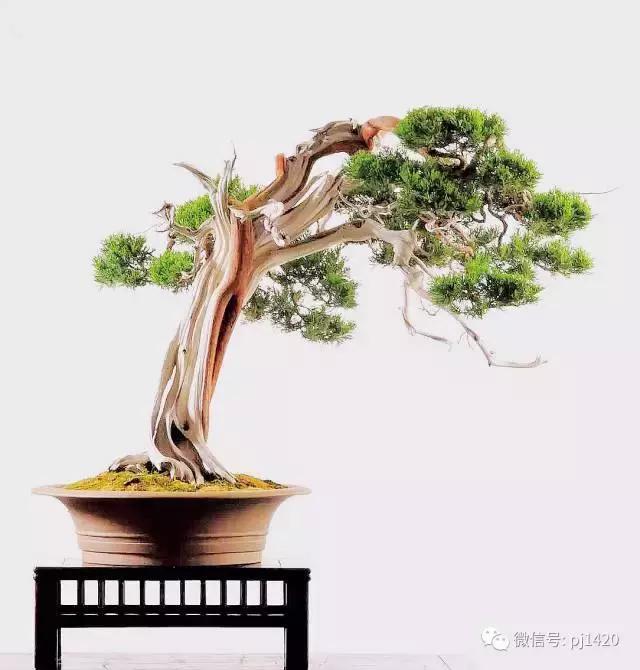
▲Wang Yongkang's Chinese juniper (zhenbai) work
1、Junipers and cypresses
Juniper and cypress bonsai can be called the king of bonsai, and among them Chinese juniper (zhenbai) is the most precious. Cypress and pine share equal fame; there is a saying of "pines and cypresses staying evergreen." The aesthetic features of cypress are almost the same as those of pine, but there are also differences. Besides being ancient, emerald green, strong, and peculiar, there is also its toughness: cypress bark has a striped texture that twists like a rope, and the branches are not easy to break. Because the vitality of cypress is stronger than that of pine, if a cypress in the forest is struck by lightning and its trunk is broken at the waist, as long as there is about one cun of bark it will not die, even if branches are broken and the trunk is damaged. Therefore, bonsai enthusiasts like to use cypress to create shari (deadwood trunks) to express the idea of dead wood coming back to life in spring. The "shari" in Japanese bonsai mostly uses this characteristic of cypress.
▲ Chinese juniper (zhenbai), Gengyuan collection
▲ "White Rising Dragon" Chinese juniper (zhenbai), work by Masahiko Kimura
2、Pines
The pine's upright, tall and vigorous shape, and its spirit of standing proudly through wind and snow, make it easy for people to feel its wildness and arrogance, and it can show an unconventional presence in bonsai works. The mottled, layered, aged pine bark, the bent, twisted and coiled forms, and the pine-needle crown like clouds or an umbrella are all unique beauties of pine bonsai.
▲"First Exploration of the Sea of Clouds" mountain pine, work by Su Guqiang
▲"Chanting Clouds" work by Han Xuenian
▲"Majestic Bearing of the South" mountain pine, work by Huang Zhurong
▲ "Vigorous Pine and Verdant Green" mountain pine, work by Han Xuenian
3、Podocarpus (Luohan pine)
Podocarpus bonsai has a lush, elegant and graceful tree posture, ancient yet vigorous, with leaves fresh green in all four seasons, giving a sense of strength and noble purity. If attached to rocks and shaped into an eagle-claw-embracing-rock posture, it is even more antique and unique. Podocarpus combined with bamboo and rock in a landscape is extremely elegant. A forest-style podocarpus bonsai, paired with grazing scenery, can give people the enjoyment of wild charm. If cultivated properly, after decades or even a hundred years it can remain flourishing without decline, becoming an excellent podocarpus bonsai, so podocarpus occupies an unusual position in our country's bonsai art.
▲ "Vigorous Wind Like a Painting Reflecting the Spirit" podocarpus, work by Li Zhengyin
▲"Ancient Trees Reaching the Sky" podocarpus, work by Wu Guorong
▲ Podocarpus, work by Pei Jiaqing
▲"Majestic Bearing of the High Slope" podocarpus, work by Zhu Weixing
4、Boxwood
Boxwood bonsai has a beautiful and dignified tree posture, fine dense leaves, vigorous and antique branches and trunk, full of aged character, showing the large within the small, naturally taking shape, and because it grows relatively slowly its tree form is stable, and it is evergreen in all four seasons, among other merits. Since ancient times it has been recognized as one of the finest bonsai tree species. A good boxwood bonsai is very hard to obtain.
▲ Work by Wang Yuyou
▲"Tang Style and Han Charm" work by Zhang Jianrong
▲"First-Rate Peace of Mind" boxwood, work by Zhao Weibin
▲"Jadeite" boxwood, work by Liu Tengyun
5、Ancient plum
One of our country's top ten famous flowers, its character of icy flesh and jade bone, standing alone in early spring, and keeping fragrance through cold is deeply cherished by people. Ancient plum stump bonsai has a vigorous and antique momentum; in the cold winter and twelfth month, golden flowers bloom in full, and a faint clear fragrance overflows everywhere, filling the room, so that anyone who smells it will certainly feel refreshed. That spirit of fearing no severe cold and struggling against it is even more inspiring. The reason ancient plum stump bonsai is special is that it is cultivated starting from the tree stump, and the twisted branches appear vigorous and powerful, with a particularly distinctive form. In appreciating plum, the old is valued, not the tender.
6、Orange jasmine (Jiulixiang)
Orange jasmine has the characteristics of an elegant tree posture, vigorous branches and trunk, being short and sturdy yet vigorous, fine leaves and strong branches, and gnarled, intertwined roots. It is evergreen in all four seasons, blooms white and fragrant, and has bright red fruits, making it an excellent bonsai material. It is also one of the main tree species of Lingnan-style bonsai. Common tree forms include the straight-trunk style, double-trunk style, and slanting-trunk style, all with a rather vigorous and antique flavor.
▲ Orange jasmine, work by Chen Yanming
▲"Fragrance Drifting for Miles" orange jasmine, work by Hong Rongxing
▲"Fragrance Drifting for Miles" orange jasmine, work by Dai Lanlin
▲"Fragrance Drifting to Welcome Guests" orange jasmine, work by Peng Yongxian