Calathea orbifolia care has two sides, and its simple methods make it a new choice for indoor greenery
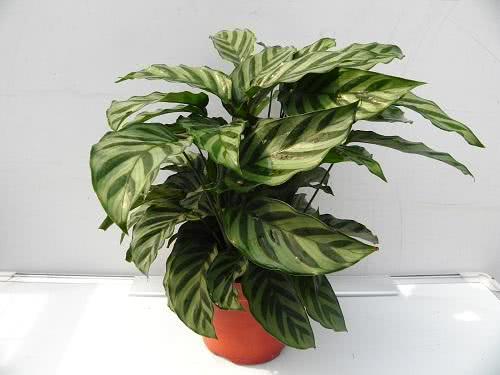
Calathea orbifolia is one of the good indoor ornamental plants. It is a small to medium-sized plant; generally, a mature Calathea orbifolia is about 20-30 cm tall. Its leaves are round or round-oval, with relatively dark stripes, and the colors usually alternate between green and gray-green. At the same time, the whole plant is relatively symmetrical. A potted Calathea orbifolia placed in a corner of the living room or bedroom, or even on a desk, is a very good choice.
I. Cultivation of Calathea orbifolia
Calathea orbifolia is usually cultivated by the cutting propagation method, because selecting its branches is relatively simple. If grown from seed, the plant often grows relatively slowly, and the success rate is far lower than that of cutting propagation. From a robustly growing Calathea orbifolia, cut off strong branches, and keep the length moderate; too long or too short will affect the success rate of cutting, and generally 10-15 cm is suitable.
Next, simply disinfect the wound on the branch. After the wound has healed to a certain extent, insert the branch into the soil. Be careful to keep a certain distance between the branches. After three to four weeks, the branches can generally take root successfully. At this time, be careful to water the potted plant an appropriate amount, then continue cultivating for about one month, and the plant can be transplanted to an environment with sufficient light for growth, with normal management of the potted plant.
II. Care of Calathea orbifolia
1. Light requirements
Calathea orbifolia is a typical semi-shade plant, and it has good shade tolerance. During its growth period, it does not need too much light. It is enough for the plant to receive an appropriate amount of diffused light every day, and it is not suitable to grow under strong light. Especially in summer, overly intense sunlight can easily cause the leaves to wither and turn yellow, generally starting from the leaf edges. The phenomenon is relatively inconspicuous; if it is discovered, the situation is often already relatively serious. Therefore, try to avoid this problem as much as possible, so the plant should preferably be given sufficient shading preparation in advance, or the potted plant should be placed in a cool place to grow.
2. Soil requirements
Calathea orbifolia does not have high requirements for soil quality. For household potting, it is relatively suitable to choose humus soil or sandy soil as the main growing soil for Calathea orbifolia. In order to give the soil good water retention and air permeability, a certain amount of garden soil and river sand, etc., often also needs to be added. At the same time, place an appropriate amount of sufficient base fertilizer at the bottom layer of the soil to ensure good fertility of the potting soil. In this way, the plant's nutrient sources are more diverse, and there is no need to worry that too little fertilization at times will affect the plant's growth.
3. Water requirements
Calathea orbifolia has relatively high water requirements. During the plant's growth period, the potting soil is best kept in a relatively moist state. This is because its drought tolerance is relatively poor. If it grows in relatively dry soil for too long, its branches and leaves often tend to show signs of withering, and if water is not replenished in time, it may also lead to the death of the plant. It should be watered about two to three times a week. It is not suitable to add water too much or too frequently, as this easily greatly increases the probability of water accumulation in the pot. Therefore, each watering is best applied with a tool similar to a watering can, so that the soil is less likely to show water accumulation.
4. Nutrient requirements
During the plant's peak growth seasons, such as spring and autumn, Calathea orbifolia has a somewhat higher demand for nutrients, and generally topdressing should be done once about every 15-20 days. Summer and winter are the opposite. At this time, fertilization should be cautious and in small amounts. The plant's demand for nutrients during this period is not high. If not paid more attention, excessive fertilization easily occurs, which will cause the leaves to become overly thick and their color to darken, etc.