For succulents this season, control watering and fertilizing well, and the leaves will be plump and beautiful.
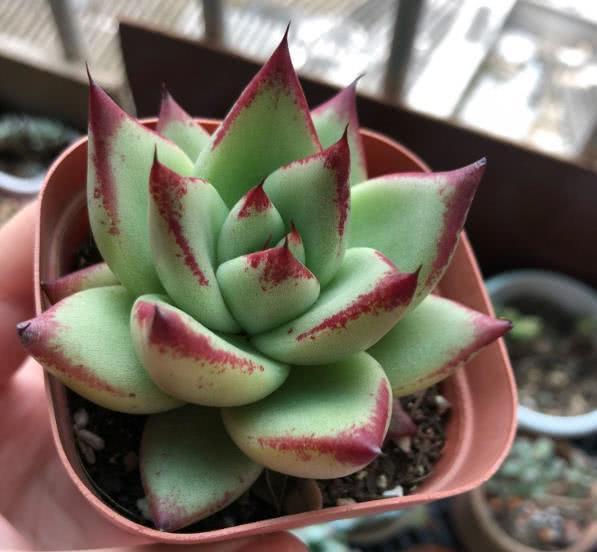
Succulents should be watered according to their growth state. Whether a species is dormant in winter or dormant in summer, watering into the pot must stop during the dormant period. However, species that are dormant in summer must have water set out in walkways and other places to evaporate, so as to maintain a certain level of air humidity. For plants in the vigorous growth period, their water needs should be fully met. Seedlings should be watered more, and large bulbs less (referring to frequency); terrestrial types should be watered less, and epiphytic types more; water more during the bud and flowering period, and less after the flowers fade and the fruit drops; plants with many thin leaves should be watered more, and those with few thick leaves less.
In summer the sunlight is intense and the water in the pot soil evaporates quickly. Prevent the pot soil from becoming too dry and the soil temperature from getting too high. Generally, you can follow the principles of "do not water until dry" and "when dry, water thoroughly," but do not water at midday. In autumn the temperature gradually turns cold, and the plants begin to enter their growth period. The amount of watering should be a little more, and you can water until water flows out from the bottom of the pot, but do not water until the pot soil is completely dry.
Dry completely means the bottom of the flower pot is dry; water thoroughly means, as long as the pot soil has not cracked, watering until water seeps out from the bottom of the pot. Winter is cold and dry, and the plants enter the dormant period. Apart from watering a small amount in a greenhouse or in a relatively high-temperature environment, water should generally be strictly controlled in low-temperature environments, so as to avoid a drop in the concentration of the plant cells' sap and a weakened cold resistance that leads to freezing to death.
The succulents Huangli (Sedum adolphi) and Haworthia are both relatively easy to keep alive. Use the soaking method, or simply water directly at the roots. Just be careful to follow "dry then wet." Watering means watering thoroughly only when completely dry, and not watering when not dry. They are afraid of long periods of rain and continuous watering that causes waterlogging. In the hot summer, water 4 to 5 times a month, without watering thoroughly. Just maintaining the plant's normal growth is enough; too much water in summer easily causes rot. In winter, when the temperature is below 5°C, gradually stop watering; below 3°C, keep the pot soil dry, and try to keep it no lower than minus 3°C.
When watering succulents, do you water the leaves or the soil? Succulents can be watered once they have settled into the pot. Do not pour water over the top; water from the edge of the pot to minimize the impact on the succulents' new root growth. When water on the leaves meets relatively strong sunlight, the water droplets act as a convex mirror and, after absorbing sunlight, burn the leaves. In addition, water accumulating in the gaps between leaves may, due to poor ventilation, cause black rot. As soon as the newly grown roots get a sauna, the roots rot and black rot occurs, especially in summer, so you must be careful.
If you use granular soil or other planting media with good air permeability, the water dries quickly. With good ventilation, you can appropriately increase the amount of watering. If you use ordinary soil, or peat soil with poor water and air permeability, then you must water cautiously. This type of planting medium is prone to mold infection, causing the whole plant to rot in an instant. You can try spreading breathable stone material such as volcanic rock on the surface to reduce the chance of infection.
This is a gathering place for succulent lovers, sharing succulent care tips; you are welcome to follow and exchange ideas.