Though seals are small, there is no small amount of knowledge in them
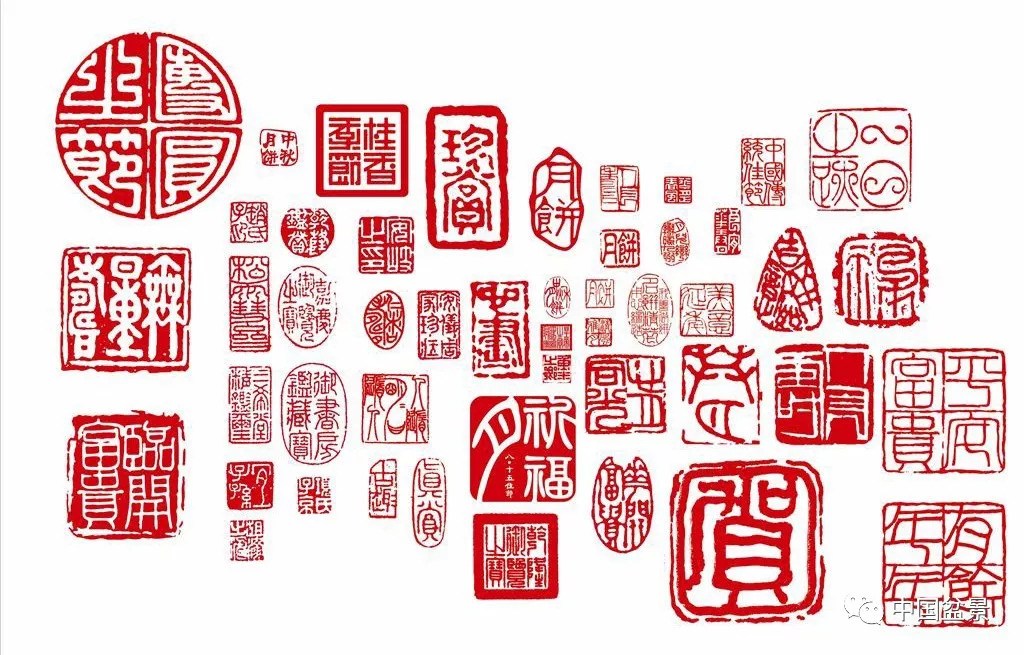
As an art category with distinctive ethnic, historical and cultural characteristics, seal art is like a rare flower, continuously giving off a unique fragrance in the broad and profound garden of Chinese art, drawing people into this tiny world.
Seals
The artistic role of seals
The seal on a calligraphy work is an indispensable part of the work; without the seal, it is not a complete calligraphy work.
Seals were originally tokens of trust, serving a verifying function. After the Song and Yuan dynasties, because attention was paid to inscriptions and signatures on painting and calligraphy, calligraphy and seals set each other off beautifully, not only adding color to calligraphy works and enlivening the atmosphere with an effect of "adding flowers to brocade," but also adjusting the center of gravity, remedying deficiencies in composition, and giving the work a stabilizing and balancing effect.
Signing and sealing a calligraphy work shows solemnity and can prevent forgery; stamping elegant and meaningful leisure seals can also express the calligrapher's aspirations and tastes. Therefore, calligraphers of all ages have attached great importance to the use of seals, even carving them themselves, so that calligraphy and seals are organically combined, producing a more beautiful and stronger artistic appeal.
Several commonly used types of seals
Name seals
Name seals are seals used for inscriptions and signatures. Names may be written together or separately. For inscription seals, using one ming and one zi is standard, and one surname plus one given name is also acceptable. If the inscription gives the ming, use the zi seal; if the inscription gives the zi, use the name seal. If the inscription includes the surname, a given-name seal may be used; if the inscription has no surname, or if there is no inscription, a name seal should be used to facilitate identification of the author.
In Mr. Qi Gong's calligraphy works, one can see the old gentleman's name seal and courtesy-name seal.
The ancients used seals with attention to etiquette: when a junior wrote to a senior, a ming seal should be used; between peers, a zi seal; and when a senior wrote to a junior, a hao seal was enough. Doing the opposite would make one a laughingstock. The modern painter and calligrapher Zhang Daqian believed that as for the shape of name seals, "square is best, round is still acceptable, while waist-round, natural-form and the like are all unusable."
Name seals generally fall into two types: zhuwen (yangwen, relief) and baiwen (yinwen, intaglio). When two name seals are stamped on a calligraphy work, it is best for one to be relief and one intaglio, with the two seals suitable in size. When multiple seals are used at the end of the inscription, the order is first the name seal, then the zi and hao seals.
So-called yangwen means the characters are raised on the stone; yinwen is the opposite.
Leisure seals
Leisure seals, also called compositional seals, include the opening seal, edge-blocking seal, corner-pressing seal and waist seal.
The opening seal is a seal stamped at the upper right of a calligraphy work, also called a "form-following seal." It is carved according to the shape of the stone, and generally should not be square; semicircular, rectangular, round, semicircular, gourd-shaped, natural-form, pictorial and the like are better.
The edge-blocking seal refers to a seal stamped along one side of a painting or calligraphy work, serving to block the edge and gather qi.
Ming dynasty, Wen Zhengming, "Portrait of Laozi"
The corner-pressing seal refers to a seal stamped at the corner of a calligraphy work. One placed at the upper right corner is called "welcoming the head"; one placed at the two lower corners is called "pressing the corners." The edge-blocking seal governs only one side; the corner-pressing seal can govern two sides, closely adhering to the edge and corner to "block the edge and seal the corner," "fill emptiness" and adjust and stabilize the picture.
The waist seal can be used for long painting and calligraphy works, such as hanging scrolls. If only one opening seal is stamped at the upper right, the middle may appear too empty, so a waist seal may be added; its content is mostly the calligrapher's native place, and a pictorial seal of the calligrapher's Chinese zodiac sign may also be used. The waist seal should be smaller than the opening seal and the name seal at the end of the inscription, and the three seals must never be stamped in one straight line.
Connoisseurship and collection seals
Connoisseurship and collection seals are seals used by connoisseurs and collectors. According to records, connoisseurship and collection seals also began in the Tang dynasty and became widespread after the Song. Emperor Taizong of Tang wrote the two characters "Zhenguan" himself as a linked-pearl seal, and Emperor Xuanzong of Tang made a linked-pearl seal with the two characters "Kaiyuan," both used on imperial collection paintings and calligraphy. Later there were many names for connoisseurship and collection seals, such as collected, treasured-secret, examined-and-approved, appreciated, and glanced-over.
The image above is Huang Tingjian's "Tie of the Fragrance of Flowers Assailing People," which has multiple connoisseurship and collection seals
The use of connoisseurship and collection seals should depend on the size of the calligraphy or painting, with the key being not to damage the characters or the picture. Some connoisseurs and collectors, in order to leave a name for themselves through the ages, often damage the picture when stamping seals; this must be guarded against.
Twenty-five rules for stamping seals
Qianyin: the seal symbols on Chinese calligraphy, painting and books are the last key step when such works are about to be completed, and this is a uniquely Chinese art. Seal stamping began with Su Dongpo in the Northern Song dynasty and has a history of one thousand years so far. If seals are used properly on a painting or calligraphy work, they can "add flowers to brocade"; otherwise, they can spoil things through excessive cleverness. The following twenty-five rules for stamping seals should be remembered firmly:
1. When signing and sealing on calligraphy or painting, the seal must not be larger than the characters. Large works get large seals, small works get small seals; this is only natural.
2. For a vertical Chinese painting, when a seal is stamped below the signature characters, a corner-pressing leisure seal must not also be stamped at the bottom corner directly below. If the signature is at the upper right, a leisure seal may be stamped at the lower left corner; if the signature is at the upper left, a leisure seal may be stamped at the lower right corner. If the upper signature characters and seal are close to the lower corner, then a leisure seal need not be stamped.
3. For a horizontal Chinese painting, leisure seals must not be stamped at the left and right end corners. If the signature is at the upper right, a square leisure seal may be stamped at the lower left corner; if the signature is at the upper left, a square leisure seal may be stamped at the lower right corner. If a leisure seal is not needed here, forcing one on will instead spoil things through excessive cleverness.
4. Rectangular, round and oval leisure seals must not be stamped in the position for a square corner-pressing leisure seal at the lower corner.
5. Square leisure seals must not be stamped in the blank space at the top of calligraphy or painting, overpowering the host.
6. For a vertical Chinese painting with a signature, the last character of the last line should not be aligned evenly with the last characters of the other lines, and the same applies to seal stamping.
7. When stamping two seals, one square and one round must not be paired. Seals of the same shape may be paired.
8. When stamping two seals, one large and one small must not be paired. Seals of the same size may be paired.
9. When stamping two seals, one rectangular and one oval must not be paired. Seals of the same shape may be paired.
10. When stamping two seals, one with yangwen above and one with yinwen below must not be paired. But yang below and yin above may be paired.
11. When stamping two seals, the distance must not be too far or too close; a gap of one seal's distance is just right.
12. When stamping two seals, seals carved with the same knife technique should be used.
13. Below the signature and seal, no more characters may be inscribed. If characters above and below the seal constrain it, it loses its natural appearance.
14. On a calligraphy or painting work that has already been signed and sealed, one must not add a dedication inscription afterward to give it to someone, as this is disrespectful.
15. Seals must not be stamped on flower heads, bird tails, tree branches or mountaintops. This is the most basic common sense for a painter and must not be ignored.
16. Craftsman-carved seals must not be used on calligraphy and painting; stone seals carved by artistic seal-carvers are best.
17. Leisure seals must not be stamped at the top of the dedication inscription, pressing on a person's name. First, it is impolite; second, it damages the picture.
18. Corner-pressing leisure seals must not be too small. For a four-panel sheet of xuan paper, using a square stone seal of about 3 cm is relatively appropriate.
19. Corner-pressing leisure seals must not be stamped more than two; one is just right. A distance of about 1 cm between the seal and the edge is appropriate.
20. A seal should not be omitted below the signature characters and instead deliberately stamped to the left or right of the signature characters, detached from the line of characters and becoming an object outside the painting, except in special circumstances.
21. On calligraphy and painting, one must not stamp a huge seal at the top, which becomes a giant seal bomb and destroys the beautiful picture.
22. On calligraphy and painting, name seals must not be stamped three or more in a row; two seals should be stamped, or one seal is proper.
23. On calligraphy and painting, seals must not be stamped arbitrarily at top, bottom, left or right. Improper over-stamping is worse than stamping less; if the seal or seal paste is poor, it is better not to stamp at all.
24. When stamping two seals, they must not be askew. How to stamp, how much pressure to use, and the maintenance of seals and seal paste all require careful study.
25. For the first panel of a four-part calligraphy set, a small seal may be stamped at the upper right. The rest must not be stamped; if all are stamped, the flow of qi is damaged.
Wonderful replay:
Chinese bonsai welcomes you!
Enjoy at any timeadmirethe bonsai exhibition hall
Promote bonsai culture, exchange bonsai skills!
Appreciate bonsai art, share a happy life!