Appreciation, Shaping and Care Methods for Hawthorn Bonsai
[Bonsai Enthusiast's Reflections]
Text | Xiamen, Fujian @Zhou Yingzhi
Many things have no right or wrong, so there is no need to take everything so seriously or contend over every matter. Broaden your mind; when it is fine to be lax, be lax, and where you can forgive, forgive. Do not seek a moment's satisfaction and create an unbreakable grudge; do not gamble a moment's temper and add much worry; do not fight for a moment's win or loss and lose your entire mood. In fact, "yielding" is not so hard; in fact, "not contending" is a kind of clarity; in fact, "letting things be" is a positive state of mind.
Life has no "ifs," but it has many "buts." As long as a person does not lose direction, they will not lose themselves. If you have ability, there is no need to feel discouraged; if you have worth, there is no need to show off. The quality of life depends on your daily state of mind. By changing your attitude, you can keep yourself often in a good state of mind!
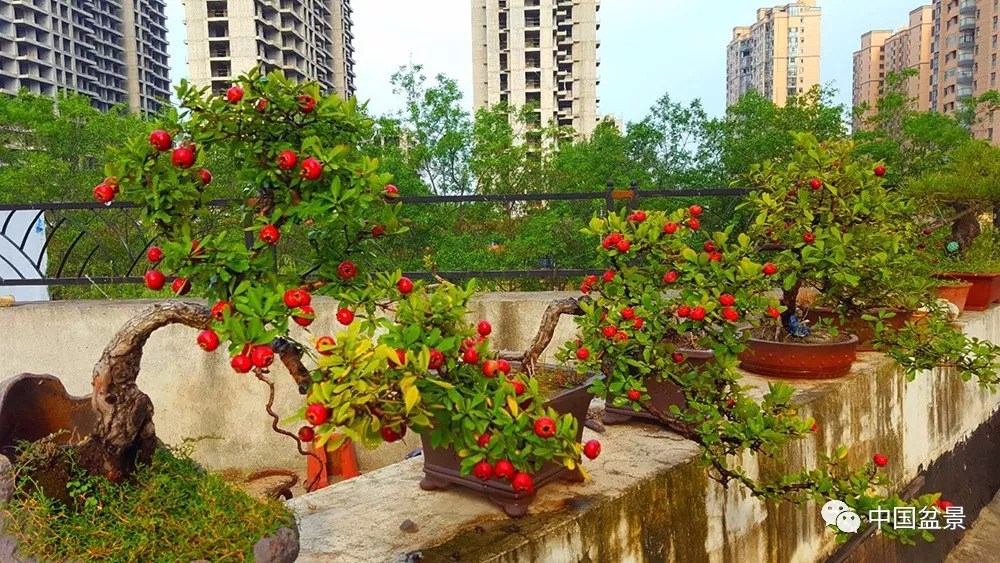
Selected Bonsai by Zang Qi, Zhumadian, Henan
-- Hawthorn Bonsai Appreciation
Original photography | Henan @Langji Tianya
Hawthorn, also known as red fruit, is the ripe fruit of the plant hawthorn (Crataegus pinnatifida) in the rose family (Rosaceae) and the genus Crataegus. Hawthorn is a deciduous small tree in the rose family, 6-8 m tall, and is both a fruit tree and an ornamental plant. The leaves are alternate, broadly ovate or triangular-ovate, with pinnate 5-9 lobes along the margin, serrate, and short pubescence on the veins. The umbel-like inflorescence has 10-12 small flowers, white or pale red, blooming in May. It fruits from August to October; the pome is nearly spherical, about 2 cm in diameter, with deep red skin and pale brown spots.
Hawthorn is a famous fruit tree in China, with more than 3,000 years of cultivation history. Because of its strong adaptability, few pests and diseases, and no need for intensive management, it is cultivated throughout the country, with more in the north than in the south.
Hawthorn is cold-resistant and has strong vitality. After planting, it begins to bear fruit in 4-5 years, producing countless small spherical or pear-shaped fruits with thick flesh and red skin, so that bright red little fruits hang among the green across the hills and fields, very gorgeous. It also has the alias "red fruit." Also known as wild hawthorn.
Hawthorn is produced in Heilongjiang, Jilin, Liaoning, Inner Mongolia, Hebei, Henan, Shandong, Shanxi, Shaanxi, and Jiangsu. It grows at the edges of mountain forests or in thickets. Altitude 100-1,500 m. The type specimen was collected from the suburbs of Beijing. It is also distributed in Korea and Siberia in the Soviet Union.
[Experience Exchange]
Shaping and Care of Hawthorn Bonsai
Original author | Yu Han
(Originally published in Bonsai & Stone Appreciation, Issue 2, 2013; please indicate the source when reprinting)
Hawthorn has a beautiful root spread and an ancient, gnarled trunk. In spring, the new leaves are tender green; in summer, white flowers dot the tree; in autumn, red fruits fill the tree; in winter, the cold branches are jagged. It can be appreciated in all four seasons. Using wild-collected stock, shaping according to the tree and applying techniques according to the material, a variety of uniquely styled ornamental tree forms can be created, and it is deeply loved by bonsai enthusiasts.
Transplanting
Hawthorn, also known as small-fruited wild hawthorn, is in the rose family, genus Crataegus, a deciduous small tree, mostly distributed between the Yangtze and Huai Rivers, commonly seen at field edges and in limestone hilly areas. The best transplanting time is before bud break in spring; the survival rate of digging after bud break is relatively low. Because its root system is well developed, there is no need to bring a large soil ball when transplanting; bare roots are also acceptable. The old trunk of hawthorn does not have obvious bud eyes. When sawing the stock, observe carefully and clearly see the distribution of bud points and the direction in which the buds will grow, and never saw at random, causing the retained buds to be one-sided or the trunk to have no buds, which would affect the future branch position distribution and shaping of the whole tree. After the newly collected stock is sawed and cut to shape, carefully clean the root saw cuts, smooth the saw cuts with a sharp knife, and remove damaged and disabled roots. The initial planting soil should be loose and permeable; do not use coarse granular growing media such as volcanic mud.
Shaping
For hawthorn, the natural large-tree form is best. Because its wood is dense and its growth rate is relatively slow, newly collected stock is best planted in the ground. If there is no condition for ground planting, the capacity of the planting pot can be appropriately increased so that new branches can grow fully in the early stage after planting the new stock.
Starting in the spring of the second year, metal wire or hemp fiber can be used to perform "angle alignment" work on the selected shaping branches, and a reasonable spatial distribution of branches and branch positions should be planned. Note that a certain number of reserve shaping branches should be retained; all other branches outside the design can be cut off entirely to ensure that the retained branches can grow fully. After the branches have grown reasonable multiple levels of branching, the whole-tree shaping can then be carried out mainly by pruning, adjusting the spatial distribution and changes of small branches at any time. Never repeatedly prune in a hurry to achieve a finished viewing shape, lest the branches become too weak and unevenly distributed, ruining the effect through excessive cleverness.
After the shape is formed, the space of branch pads should preferably be sparse. If too dense, the inner branches will receive uneven light, and over time branch dieback will occur, thus destroying the reasonable distribution of branch pads and seriously affecting the shaping of the whole tree.
Care
Hawthorn likes sunlight and is not very shade-tolerant. The placement site should preferably be a sunny, well-ventilated and well-lit place. If placed in too shady a place for a long time, it will grow poorly, the branches will weaken, and it will not be conducive to flowering and fruiting. It likes acid and fertilizer, and grows poorly in alkaline, poor potting soil. In daily care, note that the potting soil should preferably be slightly acidic and loose. During the growing season, combined with fertilization, an appropriately diluted ferrous sulfate solution and other acidic trace elements can also be supplemented. Hawthorn has a well-developed root system, and small and medium-sized bonsai must be repotted once a year.
During the growing season, pay attention to timely fertilizer supplementation. Apply diluted decomposed cake fertilizer water, or purchase granular fertilizer and apply it; either is acceptable, but appropriately pay attention to supplementing phosphorus and potassium fertilizer to promote flowering and fruiting. Because fruit trees generally have "on" and "off" years, after fruit set, according to the distribution of fruit on the whole tree, appropriately thin out part of the fruit, leaving about half of the fruit reasonably distributed over the whole tree, so that there will still be a fairly satisfactory fruit load the following year. It is also possible, after leaf fall in summer, to appropriately remove part of the fruit together with pruning of vigorous branches.
The main pests of hawthorn are aphids and trunk-boring insects, which should be controlled promptly. Decis or dichlorvos diluted 800-1,000 times can be sprayed on the leaf surfaces. In ordinary times, observe the surface of the potting soil more; if insect frass accumulates somewhere, it indicates that a certain branch or trunk has trunk-boring insects. A cotton ball dipped in insecticide solution diluted 50 times can be inserted into the insect hole, and then the hole sealed with mud. When winter arrives, bonsai planted in small or shallow pots should be moved indoors promptly.
(Thanks to @Langji Tianya for providing the above images)
Highlights replay:
Chinese Bonsai welcomes you!
Enjoy any timeappreciateBonsai Exhibition Hall
Promote bonsai culture, exchange bonsai skills!
Appreciate bonsai art, share a happy life!