The white flowers on the water surface are scattered like specks of stars, just like a deep starry sky.
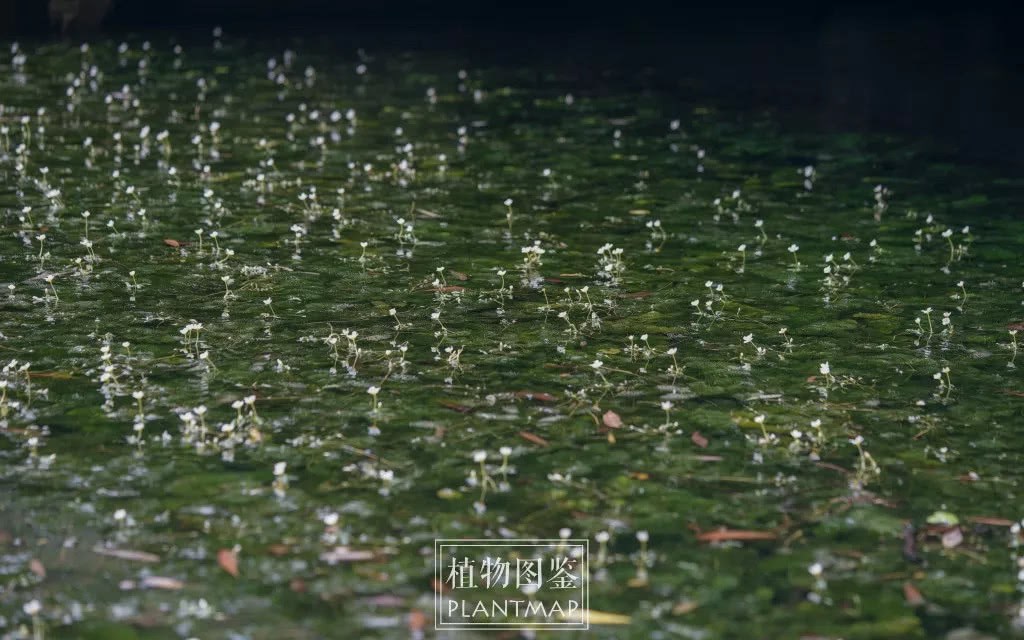
The flowering period of Cabomba caroliniana starts in July and can last all the way into autumn.
[Cabomba caroliniana] Cabombaceae >> Cabomba
It is a submerged plant, but during the flowering period the flowers rise above the water surface.
Flowering aquatic plants like lotuses and water lilies are mostly sun-loving, but Cabomba caroliniana is a submerged plant and does not need much light. Therefore, in fairly shaded places under trees and under bridge arches, Cabomba caroliniana can often occupy a large part of the water area and produce a spectacular display of flowers.
The water surface in shaded places is as deep as a starry sky, and the white flowers of Cabomba caroliniana are scattered like specks of stars, which is very beautiful. In sunny places Cabomba caroliniana also grows quite well, but without the strong contrast of light and shade, it is not as attractive as in shaded places.
I have seen Cabomba caroliniana in quite a few places, at Hangzhou Botanical Garden, Xixi Wetland, in the urban water network, in the water systems of Suzhou gardens, and in fish tanks at flower and bird markets. But after checking the references, I learned that Cabomba caroliniana is not a native plant of China, but is native to areas from the United States to Brazil.
Because it is not native to China, it is not recorded in the flora, and there is no unified Chinese name. Other names for Cabomba caroliniana include white-flowered fanwort, bamboo-jointed water pine, green chrysanthemum, and so on.
In flower and bird markets it is simply called green chrysanthemum, because its submerged leaflets are arranged in a radial pattern, fine, dense, and neat, like little chrysanthemums. Some other people think the leaf arrangement looks like a shield, and that is how Cabomba caroliniana got its name.
The stem of Cabomba caroliniana is divided into nodes, and dense branches and leaves can grow from each node; the whole stem shuttles through the underwater world like a long dragon.
Botanists and ecologists believe that Cabomba caroliniana may become an invasive species as harmful as water hyacinth.
According to the references, this plant was first discovered in China in 1993 in Ningbo, and it was not reported as a new record until 2000, after a specimen with flowers was collected. By 2004, Cabomba caroliniana had already posed a serious threat to some aquatic plant communities in Zhejiang and Jiangsu.
A 2013 paper mentioned that Cabomba caroliniana had already appeared in the water bodies of the Old Summer Palace in Beijing. [1][2][3] It is easy to infer that the appearance of Cabomba caroliniana in Beijing is closely related to sales activities in flower and bird markets.
But on the other hand, like water hyacinth, Cabomba caroliniana has a strong ability to purify water bodies and can be used to deal with water eutrophication.
Back to the small white flowers of Cabomba caroliniana.
The small white flowers have six tepals arranged in two whorls. The base of the perianth is bright yellow. Six stamens surround the pistil. Logically, the pistil of Cabomba caroliniana should also be trimerous, and most photos online also show a three-lobed stigma. But when I checked several photos I had taken, more than half of the flowers had styles that were split in half into two lobes.
[1] Yu Jian, Ding Bingyang, Yu Mingjian, et al. Seasonal dynamics of Cabomba caroliniana invading submerged plant communities [J]. Acta Ecologica Sinica, 2004, 24(10):2149-2156.
[2] Ding Bingyang. A new naturalized genus of aquatic plants in China - Cabomba (Cabombaceae). Acta Phytotaxonomica Sinica, 2000, 38(2): 198-200.
[3] Zhang Jinlin, Meng Shiyong. Cabomba caroliniana found in Beijing waters [J]. Journal of Weed Science, 2013, 31(2):45-46.
Author: Jiang Mousen
Images: Jiang Mousen (unless otherwise noted)
This work is licensed under the (CC BY-NC-ND 4.0) license agreement.
Please retain the above statement when reposting.