Purple Peony and Sempervivum arachnoideum look very much alike; both are Sempervivum succulent plants.
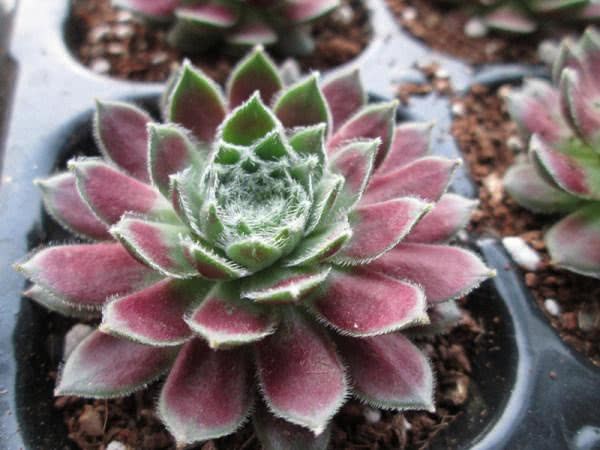
The succulent Purple Peony belongs to the genus Sempervivum and is also a very cold-hardy variety. It looks very much like Sempervivum arachnoideum and is sensitive to high temperatures. During cultivation, attention must be paid to air circulation, as it easily rots in summer. The lower layer of the soil should be humus soil, and the upper layer should be sandy soil, slightly acidic. For propagation, use the offsets produced by the spreading stems; leaf cuttings are also very easy, and hybridisation very readily produces seeds.
During the high temperatures of summer and the cold of winter, the plant is in a dormant state. Its main growing period is in the cooler spring and autumn seasons. During the growing period it requires ample sunlight; if light is insufficient, the plant's shape becomes loose and not compact, affecting its ornamental value, while plants grown in ample light have thick, plump leaves and bright leaf colour.
It likes a well-ventilated environment with ample light. If ventilation is poor, it is especially prone to pests (scale insects). When light is lacking, it turns green and the leaves curl downward; if this lasts too long, it easily dies. As light duration increases, it turns purplish-red and the leaves become compact. Purple Peony has little demand for water; it goes dormant in summer, so water must be strictly controlled. Purple Peony is mainly propagated by division; young plants branch off from the main plant, and simply cutting them off and planting them as cuttings works.
In succulent cultivation of Purple Peony, the main thing to watch is watering. As long as watering is done correctly, Purple Peony will grow wonderfully! Water Purple Peony only when the soil is dry; when watering, water thoroughly. Keeping to this principle can avoid long-term water accumulation in the pot and prevent root rot, but it must not be too dry or watered too little either, otherwise the plant will grow slowly, and the leaves will turn yellow, lose their lustre and lack vitality.
Apply decomposed organic fertiliser or a high-phosphorus-potassium compound fertiliser once every 20 days or so. In winter, the cultivation temperature should be above 5°C, and during the day it is best to keep it above 15°C, so that the plant can continue to grow normally; water it appropriately, fertilise appropriately, and control the amount of water to induce dormancy in the plant.
Purple Peony succulent leaf cuttings are very easy, and hybridisation very easily produces seeds. In the hot, rainy summer season, the plant's dormant state must be ensured. In spring and autumn, Purple Peony growth requires ample sunlight; maintaining ample light can to a certain extent preserve the plant's ornamental quality. Plants grown under light have plump, thick leaves and bright, captivating leaf colour.
This is a gathering place for succulent plant enthusiasts, sharing succulent care tips. You are welcome to follow and exchange ideas.