Jade plant responds fast to 2 things from the kitchen, growing thick bark in 3 months
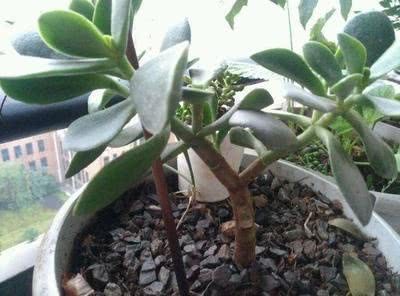
The jade plant (Crassula ovata) is a very attractive foliage plant. Its leaves are thick and juicy, emerald green, and crystal clear, with very high ornamental value. Many people want to grow a jade plant, but they are afraid they will not grow it well, because many people say that before the jade plant becomes woody, it is very fragile and easy to kill. Actually, we do not need to fear these claims. Growing a jade plant is not as difficult as we imagine, and getting it to become woody quickly is not very hard either. Today we will teach everyone a method for cultivating jade plants!
If we want the jade plant to become woody quickly, we also need to start with fertilizer. Only with sufficient nutrients can it be promoted to become woody quickly. A woody jade plant has many advantages. The biggest advantage is that it can grow bark, strengthening the transport capacity for nutrient elements, which can greatly speed up the plant's growth. Secondly, a woody jade plant has very strong disease resistance, lodging resistance, and pest resistance, so it is clear that becoming woody really has many benefits.
These 2 things in the kitchen have a fast effect on jade plants. Used often, they can make a jade plant become woody within 3 months and grow thick bark. What exactly are these two things? Below we will introduce them one by one.
Soybean water, soybean residue
We treat these two materials as one, because both are byproducts of soybeans. Soybeans are rich in protein and contain a lot of nitrogen. We all know that nitrogen can promote the growth of a plant's branches and leaves and speed up growth, so it has a very big promoting effect on the jade plant becoming woody.
The method of use is also relatively simple. After we boil the soybeans, we keep the soybean water. After it cools, it can be used to water the jade plant. The jade plant's roots can directly absorb the nitrogen in the soybean water and supply it to branch growth! Then we can grind the cooked soybeans into soybean residue, dig 5 to 6 small holes at the edge of the jade plant's pot soil, then bury the soybean residue in them and cover it with soil. In the time that follows, the soybean residue will slowly decompose and release a lot of nitrogen, which the jade plant's roots can absorb directly from the soil.
Once the jade plant absorbs enough nitrogen, its branches and leaves will grow explosively. The change in the branches in particular will be very great. At first, they will only change from green to gray, and then slowly grow relatively tender bark. After some time, that bark will grow into relatively thick bark, greatly strengthening its nutrient transport capacity and disease resistance.
Waste oil
There is another thing in the kitchen that is rich in nitrogen, and that is the waste oil in the range hood. When we cook, after cooking oil goes through high temperatures, the volatilized part is absorbed by the range hood. Over time, some accumulated grease will form. This grease actually still contains a lot of nitrogen. We can take this grease out and bury 1 to 2 spoonfuls at the edge of the jade plant's pot soil. The nitrogen in the grease will slowly migrate into the soil and be absorbed by the jade plant's roots, thereby achieving the goal of promoting branch woodiness.
Apply fertilizer this way once every 2 weeks. After about 3 months, the jade plant will grow relatively thick bark. As long as bark has grown and the trunk has completed woodiness, the jade plant's growth speed will rise to another level, the leaves will also become more and more emerald green, round, and plump, and the ornamental value of the whole plant will also be greatly improved. Completing woodiness in three months can be said to be a very efficient speed. If you also grow jade plants, you can give it a try.
That is all for today's sharing. If you are interested in growing plants, you can follow us. We update various tips for growing flowers and potted plants every day, and we hope to help everyone.