Bamboo rats getting heatstroke, being depressed, or not being pretty enough can all become reasons to be braised in soy sauce
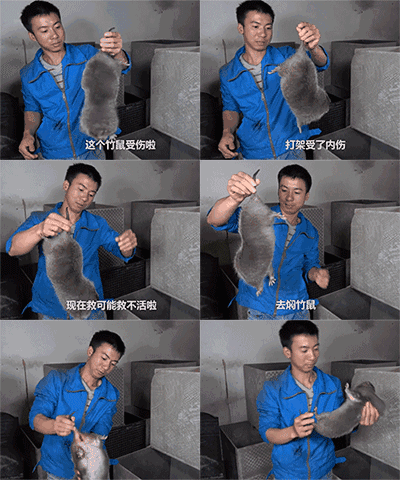
The hottest uploader recently is a pair of guys from Jiangxi who raise bamboo rats. The young man uses excuses like "it got depression," "it got heatstroke," "it got internal injuries from fighting," "it eats too much and I can't afford to keep it," "it's too thin, this won't do" and so on to eat the bamboo rats he raises. His plain yet oddly compelling way of speaking quickly gained him over 500,000 followers, making him a source of joy for everyone.
Bamboo rat: I didn't, I'm not, let go of me. Original image: Hua Nong Brothers
A greedy, chubby bamboo rat
The bamboo rat, also known as the bamboo civet, bamboo weasel, bamboo root rat, thatch root rat, and bamboo grass rat, gets its name from its fondness for eating bamboo. Bamboo rat's degree of preference for bamboomay not even be matched by fellow bamboo enthusiastthe giant panda。
Orange teeth, just loves crunching on bamboo! Image: Khaosok
The bamboo rat is not a single species. In animal taxonomy, it generally refers to animals in the subfamily Rhizomyinae of the family Spalacidae, order Rodentia, class Mammalia.
There are two genera and five species of bamboo rats distributed in China. Among them, the monotypic genus Cannomysthe lesser bamboo ratC. badius isclose to a small mouse in body size, quite different from the bamboo rats we usually picture, and it is fewer in number, distributed only in parts of Yunnan, China (the lesser bamboo rat is more numerous in southern Asia, such as Thailand).
Lesser bamboo rats on the market, looking at first glance like small mice. Image: Roadnottaken / Wikipedia
The genus Rhizomys includes four species: the Chinese bamboo rat R. sinensis, the hoary bamboo rat R. pruinosus, the large bamboo rat R. sumatrensis (also called the red-cheeked bamboo rat), and the dark brown bamboo rat R. vestitus. They are mainly distributed in areas of China south of the Yangtze River, with the most found in Guangxi and the Yunnan-Guizhou region. Most of the ones in Hua Nong Brothers' videos arehoary bamboo rats。
A hoary bamboo rat specimen at the Kunming Natural History Museum of Zoology. Image: Daderot
In Laos, a wild large bamboo rat that was caught is kept in a cage and sold along the street. The large bamboo rat is the largest bamboo rat, characterized by its orange-red furry cheeks. Image: Boiling Water Aquarium's Biology Guy
Who exactly is being eaten in all these creative ways?
Since the 1980s, China has been attemptingartificial domestication and breeding of bamboo rats, achieved success in artificial breeding in the early 1990s, and has now hadmore than 20 years of development history. Currently in southern China, especially Guangxi and Jiangxi, there are several bamboo rat breeding bases of a certain scale. Among artificially domesticated bamboo rats,most are Chinese bamboo rats and hoary bamboo rats。
A Chinese bamboo rat in Tam Dao National Park, Vietnam. Image: Mark Moffett
The Chinese bamboo rat has a plump, round body and a short, hairless tail. Wild adults have a body length of 30-40 cm and a weight of 1.5-2 kg. Under artificial rearing conditions, they can grow to nearly 3 kg. Its head is round and large, its mouth is short and round, and its upper incisors are especially thick. The first pair of incisors are permanent teeth, present at birth and never replaced. Like most rodents, they keep growing throughout life and need to be continuously worn down bygnawing on hard objectsin order tomaintain normal occlusion of the upper and lower incisors. If the front teeth are not worn down, they will grow longer and longer until they pierce the gums, or the lower teeth push through the upper palate, making it impossible to eat, leading to starvation.
Teeth that are too long need to be trimmed. The video shows a pet guinea pig. Source: chennnnnnns / YouTube
Its body color isgray-black, and as it ages, the color of its back fur gradually turns brownish-yellow. Its limbs are thick and strong, with sharp claws, and it is good at digging burrows. The five fingers of its front paws are nimble, allowing it touse its forelimbs to grab, hold, and pick up food. In artificial breeding environments, you can see them holding sugarcane and bamboo while gnawing on them, which is quite amusing to watch.
The dream of a lazy homebody: lying down and eating tasty food every day. Image: Hua Nong Brothers
The hoary bamboo rat is also called the flower-white bamboo rat. Its appearance and habits are similar to the Chinese bamboo rat, but it is slightly larger. In the wild, adults weigh about 2 kg, and under artificial breeding they can reach 3-4 kg. Its furhas a base color of grayish-brown, and the back fur has many white-tipped guard hairs extending above the coat, as if the fur is covered with a layer of white frost. Under light,the white guard hairs reflect lightvery noticeably. To tell whether it is a Chinese or hoary bamboo rat, just look at the fur.
The hoary bamboo rat is larger and is currently the main species in the bamboo rat food market, accounting for about 70% of total artificial bamboo rat breeding. However, since there is no reproductive isolation between these two species of bamboo rats, when they are bred together,hybridization often occurs. Breeders may even use hybrid offspring as breeding stock.
Bamboo rats really do get heatstroke
Bamboo rats are nocturnal animals that prefer cool, dry environments. Wild bamboo rats mainly live in burrows in bamboo forests and shrublands. Theyare good at digging burrowsand will dig a complex burrow to live in. The burrow has several entrances and contains a main tunnel, nest chamber, feeding chamber, and refuge chamber, with depth, number, and complexity varying according to terrain. The main tunnel is 30-80 cm from the surface, and the nest chamber is lined with dry grass, bamboo leaves, and other materials. They are verycleanlyand will not defecate in the nest chamber where they rest, but will go to another side chamber used specifically for excretion.
Wild bamboo rats feed on bamboo, bamboo roots, miscanthus stems, reeds, and the roots, stems, tubers, and root tubers of other shrubs and plants. They have a broad diet and tolerate coarse food.They generally sleep during the dayand come out at night to move about, forage, play, and mate. From dusk to early morning is when they are most active.
The bamboo rat'shearing and sense of smell are very keen, and it can smell food from within the soil. However, because it has long lived a burrowing life, it depends little on vision, so its eyesight is not good, and it is not adapted to direct sunlight during the day. Theyare rather timidand will hide in their burrows at the slightest disturbance, but when there is nowhere to hide, they may stand upright and make a huffing, puffing sound to show aggression.
The bamboo rat'slifespan is relatively short, around 4-5 years. Adult bamboo rats can be identified by observing and touching above the anal area; if there is a pair of protruding testicles, it is male. The time from birth to sexual maturity is between half a year and one year, and the female's gestation period is one and a half to two months. Newborn pups have no hair on the body surface and their eyes are tightly closed. After one month, they gradually wean and begin learning to forage on their own.
Bamboo rats tolerate cold but fear heat. They lack sweat glands and have dense fur, making it hard for body heat to dissipate, and their ability to regulate body temperature is poor. The environmental temperature they can tolerate is 5-35°C, and the most suitable environmental temperature for growth, development, and mating is 18-28°C. When the environmental temperature stays above 35°C for a long time, theyare extremely prone to heatstroke and death。
So it wasn't just a random excuse after all? Image: Hua Nong Brothers
In Hua Nong Brothers' videos, they say that when a bamboo rat has just gotten heatstroke, it can be buried in moist cool sand to save it, but after too long there is nothing that can be done. Hua Nong Brothers also described the symptoms of heatstroke: a bamboo rat with heatstroke is listless, weak all over, often lying on its side motionless, and when you touch its body you can feel that its temperature is noticeably elevated, with a burning sensation. As for bamboo rats beyond saving, they have only one way of handling them - into the belly.
Bamboo ratmeat is delicate, delicious, and tasty,fur is thick, soft, and glossy, making it a good raw material for fur products and giving it high economic value. Moreover, after artificial selective breeding, bamboo rats may produce sometame, unusually colored individuals (such as albinos) that can be kept as pets。
Having a white, chubby bamboo rat like the young man's is not a dream! Image: Hua Nong Brothers
You can't just casually be Hua Nong Brothers
However, bamboo rats are not something you can just raise however you like. They are China's"three-have" protected animalsand are also key protected terrestrial wild animals in Guangxi and other provinces (the protection level listed by each province varies). To raise bamboo rats, you need to apply to the local forestry department in accordance with relevant laws and regulations, and only after obtaining a "Domestication and Breeding License" can you keep them. If buying, selling, or preparing and selling them as food is involved, you also need to obtain a "Business Utilization License."
As a side note, if you see a bamboo rat in the wild,do not catch it casually. Although they look adorably cute in videos, in fact most wild individuals are not docile in temperament and will fight back when they feel their lives are threatened. Their long, sharp incisors are their most powerful weapon. Moreover, as thePenicillium marneffeimain host, bamboo rats may cause immunocompromised people who come into contact with them to become infected with penicilliosis. (Editor: Xue Li, hopelessly addicted to bamboo rats)
This article is a special contribution to Species Calendar, from Species Calendar author @Boiling Water Aquarium's Biology Guy.
Meet the internet celebrity
Calendar Girl's avatar today
Muridae, European lemming