The 9 Handscrolls with the Highest Achievements in Chinese Calligraphy
"Pingfu Tie" (Recovering from Illness), ink on ivory-colored hemp paper, 9 lines and 84 characters. "Pingfu Tie" was written in the Western Jin Dynasty and is the earliest surviving model calligraphy by a renowned master, as well as the first calligraphy ink trace in history with a documented chain of transmission. It enjoys the reputation of being the "ancestor of model calligraphy." It has been appraised as a "national treasure." The author wrote it with a worn brush on hemp paper, and the ink color is slightly green. The brushwork is gentle and graceful, the style plain and unadorned, and the script is cursive clerical script. Lu Ji (261-303), courtesy name Shiheng, was a great literary figure from Suzhou in the Western Jin Dynasty.
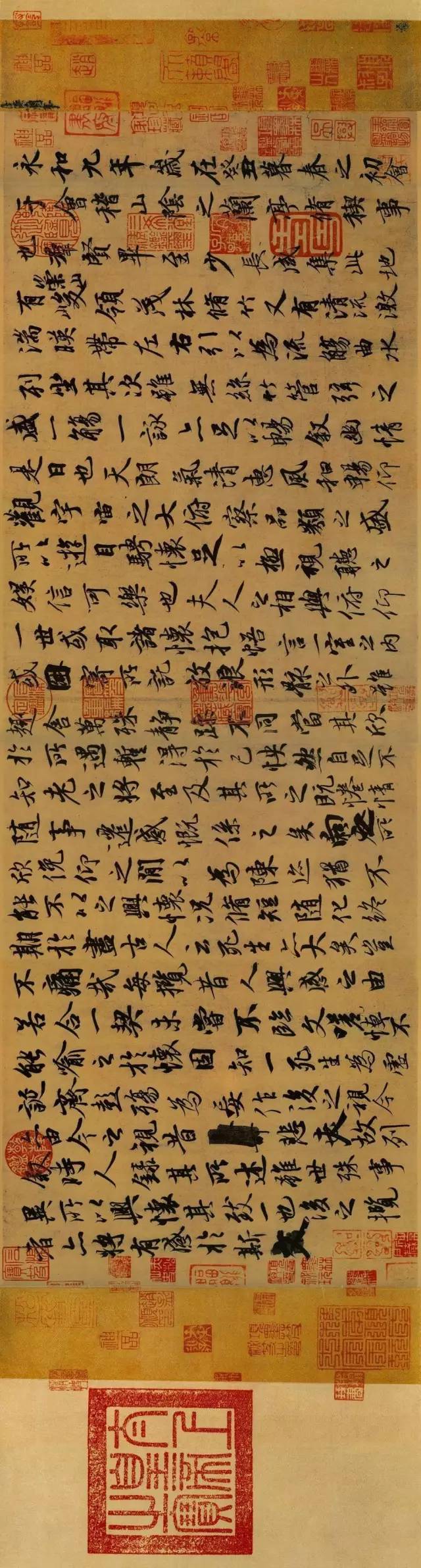
Wang Xizhi's "Lanting Xu"
(Known as the finest running script under heaven)
The famous Eastern Jin calligrapher Wang Xizhi gathered with various literati and refined scholars at the Orchid Pavilion in Shanyin, Kuaiji. Everyone took up their brushes and composed poems, which were collected into the "Lanting Collection." The original authentic work remains lost.
Yan Zhenqing's Draft of a Eulogy for His Nephew
(Known as the second finest running script under heaven)
"Draft of a Eulogy for His Nephew," together with "Lanting Xu" and "Huangzhou Cold Food Observance," are collectively known as the "three greatest running scripts under heaven." Its full title is "Draft of a Eulogy for His Nephew, Bestowed upon the Grand Master of Admonition Ji." It is a running script on paper created by the Tang Dynasty calligrapher Yan Zhenqing in the first year of the Qianyuan era of the Tang Dynasty (758). It is now collected in the National Palace Museum in Taipei, China.
Su Shi's Huangzhou Poetry Scroll
(Known as the third finest running script under heaven)
"Cold Food Observance" is also known as "Huangzhou Cold Food Observance Poetry Scroll" or "Huangzhou Cold Food Observance." It was composed and written by Su Shi, ink on plain paper, 34.2 cm wide and 18.9 cm tall, running script in 17 lines, 129 characters. It is now collected in the National Palace Museum in Taipei, China. It was written during the Cold Food Festival in the third year after Su Shi was demoted to Huangzhou because of the largest literary inquisition of the Song Dynasty.
Zhang Xu's Four Ancient Poems
(Represents the highest achievement of wild cursive script)
"Four Ancient Poems," ink on five-colored paper, wild cursive script, totaling 40 lines and 188 characters. Attributed to Zhang Xu of the Tang Dynasty. Throughout the entire work, the brushstrokes are full and robust, with absolutely no delicate or slick strokes. The writing surges and dips, with movement and stillness interwoven, the whole paper like clouds and mist swirling around, truly a pinnacle work of cursive script. At the end of the scroll are colophons by Ming Dynasty figures Feng Fang and Dong Qichang.
Huang Tingjian's Pine Wind Pavilion
An ideal realm of classical Chinese calligraphy, concealing strength within softness, soft on the outside and firm within.
Song Dynasty calligraphers valued expressiveness. The so-called "Song people value expressiveness" means that on the basis of established methods, the various masters of the Song Dynasty each sought to stand out with their own innovations, placing greater emphasis on the free expression of artistic individuality. Huang Tingjian was among the most creative of these calligraphers. His running-cursive script is uniquely styled and had a profound influence on later generations.
Huang Tingjian (1045-1105), courtesy name Luzhi, born in the fifth year of the Qingli era of Emperor Renzong. He was a poet and calligrapher of the Northern Song Dynasty. He passed the imperial examination as a jinshi in the fourth year of the Zhiping era of Emperor Yingzong (1067). In the third year of the Xining era of Emperor Shenzong (1070), Wang Anshi served as prime minister, and the implementation of the new laws met fierce opposition from the conservative faction led by Sima Guang. Later, the struggle between the old and new parties grew increasingly intense and continued until the fall of the Northern Song Dynasty. In this struggle, Huang Tingjian stood on the side of the old party. Although he did not actively participate in the struggle, his entire life was caught up in its vortex.
Mi Fu's Tiaoxi Poetry Scroll
A running script calligraphy work created by the Northern Song calligrapher Mi Fu in the third year of the Yuanyou era (1088). It is now collected in the Palace Museum in Beijing.
The variations in brushstroke thickness constitute the beauty of Mi Fu's calligraphy, so that every character has a new method. Although the strokes are the same, under Mi Fu's brush, the same character possesses a peerless beauty, and the overall construction and arrangement of the layout are astonishing. It greatly reveals the literati's inner independence and pursuit of elegance as one's own duty. "Tiaoxi Poetry" is a work from Mi Fu's middle years. It was written in the third year of the Yuanyou era (1088), when he was already 38 years old. At that time he was traveling through Suzhou and Wuxi, and this scroll was written before he set out to visit Wuxi. Although he had already reached middle age, the characters are nonetheless full of innocent spirit, infused throughout with the beauty in his heart, and the entire calligraphic style is astonishing.
Zhao Mengfu's Former Ode on the Red Cliff
A calligraphy work created by the Yuan Dynasty literatus Zhao Mengfu in 1301. "Former and Later Odes on the Red Cliff" are famous masterpieces composed by Su Shi during his demotion to Huangzhou. Zhao Mengfu's "Former and Later Odes on the Red Cliff" is a long running script scroll, with practiced and exquisite brushwork. In brush technique, it directly inherits from Wang Xizhi, mainly characterized by flowing elegance and vigor, with lines warm and condensed, outwardly beautiful and inwardly firm. The spacing and arrangement of this scroll are relaxed and unhurried, the brushwork rounded and forceful, graceful and flowing, with inner strength and an ethereal spirit, fully capturing the lingering charm of Wei and Jin elegance.
Zhao Mengfu's Later Ode on the Red Cliff
Mi Fu's Shu Su Tie
"Shu Su Tie" is a work by the famous Northern Song calligrapher and collector Mi Fu, now collected in the National Palace Museum in Taipei, China. "Shu Su" refers to fine-quality silk fabric made in Sichuan during the Northern Song Dynasty, with black silk grid lines on it. Because the patterned silk is rougher than paper, it is slow and difficult to write on, and it neither absorbs nor bleeds ink, so no calligrapher without deep skill would dare to wield the brush on it.
The Shu silk used in this scroll is an extremely precious silk fabric, made in Sichuan during the Qingli era of Emperor Shenzong. Mi Fu's characters were most deeply influenced by Wang Xianzhi, possessing a kind of outstanding and refreshing spirit. Among the four great masters of the Northern Song Dynasty, Mi's brushwork and speed are the most nimble and varied. Although this scroll was written within black silk grid lines, the brushwork flies and rampages freely, vivid and lively, not constrained by the format in the least. "Shu Su Tie" was treasured by famous collectors such as Xiang Yuanbian, Dong Qichang, and Wu Ting in the Ming Dynasty, fell into the hands of Gao Shiqi, Wang Hongxu, and Fu Heng in the Qing Dynasty, and later entered the Qing imperial household. It is now in the National Palace Museum in Taipei, China.
Highlights replay:
Chinese bonsai welcomes you!
Enjoy at any timeadmirethe bonsai exhibition hall
Promote bonsai culture, exchange bonsai techniques!
Appreciate bonsai art, share a happy life!