Appreciate miniature bonsai, and be grateful to everyone who appears in your life
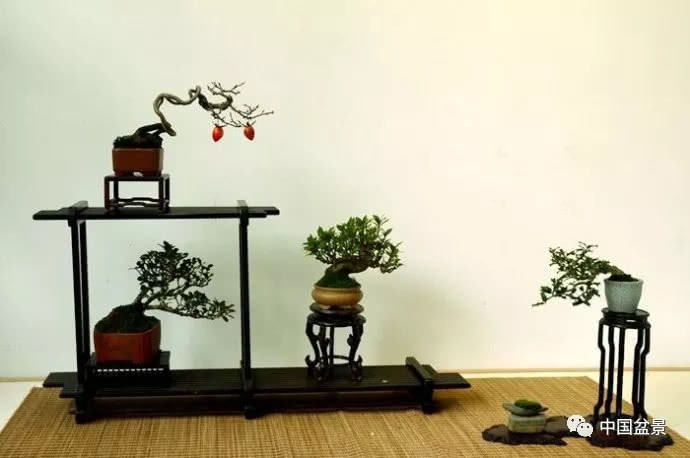
[Bonsai Enthusiast's Reflections]
Text | Xiamen, Fujian @Zhou Yingzhi
How much you let go, that much you will gain. Shede, shede - letting go is gaining, and gaining is letting go. To gain something, you must have let go of something. Shede is like the black-and-white pattern in the Taiji diagram: the circle remains eternal and unchanging, but when black is more, white is less, and when white is more, black is less. If you let go, you will not fuss over black and white, more and less, gain and loss. In truth, black and white, more and less, gain and loss are merely illusions of the heart.
Between people, mutual encouragement is the rarest sincerity! The one who applauds others also fuels their own life! Life is an echo: give your best to others, and you will receive the best from them! When we learn to appreciate and be grateful, we possess happiness and joy! A good fate is not as good as good habits; cultivate the habit of gratitude, and you will benefit from it for a lifetime! A person who knows gratitude can always understand the hardships of others. Be grateful to everyone who appears in your life!
Appreciation of some works from the unforgettable miniature bonsai exhibition at Guozhuang, Hangzhou
- Key points for miniature bonsai care that must be remembered
Photos and text | Hangzhou Daily reporter Bian Xiaodan, correspondent Pan Gaosheng
Nowadays, more and more ordinary people are adding a new favorite to their desks, balconies and windows - the miniature bonsai.
Guozhuang in Hangzhou, Zhejiang, a famous classical garden of Jiangnan, held an exhibition of Zhejiang-school bonsai works from December 1 to December 11, 2016, displaying miniature bonsai works for the first time, and in a considerable number, as many as over a hundred pots, condensing the majestic mountains and beautiful waters, ancient trees and famous species of nature into a tiny space. They were arranged in groups, paired with stands full of antique charm, and dotted with mountain flowers and wild grasses, setting each other off beautifully and creating yet another distinctive appeal. Experience the charm of traditional Chinese landscape freehand works!
For miniature bonsai care, you should learn these methods
The miniature bonsai is the smallest type of bonsai, winning people's affection with its exquisiteness and compactness. However, though the scenery is small, every tree and stone still follows nature as its teacher. A delicate little tree, with twisted trunk and gnarled branches, has both form and spirit; a tiny landscape scene shows every peak and makes every ravine distinct. Enjoying a miniature bonsai is enough to let one see the great in the small and let the eyes roam while the heart expands.
But miniature bonsai are often displayed indoors, where they cannot see sunlight for a long time, which easily leads to poor growth and development. Therefore, a home care location should meet two basic conditions: first, sufficient light; second, good ventilation. Balconies, windowsills, courtyards and sun terraces can be chosen as places to keep the bonsai.
A home care location for miniature bonsai should meet two basic conditions: first, sufficient light; second, good ventilation. Balconies, windowsills, courtyards and sun terraces can be chosen as places to keep the bonsai. In order to make better use of limited space, miniature bonsai can be shallowly buried in the spare surface soil of medium and large bonsai pots, which can also create a humid microclimate.
Making a simple sand bed yourself is also a good method. First fill a shallow basin with wet sand, then set the miniature bonsai in it, which likewise has a moisturizing effect. However, drainage holes must be made near the bottom around the sides of the shallow basin to facilitate smooth drainage after watering and on heavy rainy days.
The care of miniature bonsai is rather special and requires greater precision and care. The following are six methods for miniature bonsai care:
1. Handling branch clusters
For a miniature crown, fewer branch clusters should be kept so as to reveal as much of the trunk's elegance as possible, and the retained branch clusters should be appropriately shortened to make their proportion to the trunk suitable.
2. Preventing leaves from turning yellow and falling off
Because miniature bonsai have small pots and little soil, in summer water is often in short supply, so leaves easily become scorched yellow and fall off. To avoid yellowing and leaf drop, besides leaving a rim when potting and paying frequent attention to watering and misting in hot summer, you can also place a brick in a large or small basin or a shallow water pool, add water until it just covers the brick surface, and then place the small bonsai on the brick to grow.
3. Timely prevention and control of pests and diseases
Miniature bonsai plants grow in limited pot soil, so their ability to resist pests and diseases is weaker than that of the same plants grown in the ground, and prevention should usually be emphasized. Once pests or diseases occur, they should be thoroughly treated according to the principle of "treat early, treat small." If damage from various leaf spot diseases, aphids, red spiders, scale insects and other pests and diseases is found, manual removal or spraying for control should be carried out immediately. In short, the daily care of miniature bonsai must be stricter, more careful and more patient than that of ordinary bonsai.
4. Give appropriate light
Miniature bonsai are often displayed indoors, and long-term lack of sunlight easily leads to poor growth and development. Therefore, in midsummer, as long as care is proper, it is not necessary to shade them all the time. If the grower leaves early and returns late, then appropriate shading is needed to prevent the bonsai from dehydrating. At the same time, a fine-holed spray bottle should often be used to spray leaf-surface water all over the plant. In winter, a homemade plastic film cover can be used for insulation. Apart from particularly cold-hardy species such as pines and cypresses and warm-winter regions in the south, in severe cold periods miniature bonsai should be moved indoors to avoid freezing damage. When placed indoors, some potted trees should also be sprayed with leaf-surface water at appropriate times to maintain a certain humidity.
5. Water and fertilizer should be moderate
Lack of water in miniature bonsai easily causes leaves to scorch yellow, but too much watering easily causes root rot, so watering should be moderate. If fertilizer is applied excessively, small branches will grow leggy and the tree shape will be ruined, but severe fertilizer deficiency will make the leaves poor, pale and lusterless. Therefore, one must "apply thin fertilizer frequently" and pay attention to moderation.
6. Timely pruning and repotting
Newly grown long branches should be shortened in time to maintain an appropriate proportion with the trunk. Repotting is safest when carried out in early spring or late autumn each year. The frequency of repotting should be determined by different tree species and the strength or weakness of the tree's vigor, and should be handled flexibly. Deciduous tree stumps should be repotted at least once a year, while pine and cypress stumps should be repotted once every one or two years.
Repotting should be done after the pot soil has dried slightly, so the tree stump is easier to remove. Try to take out the tree soil, discard 1/2 or 2/3 of the old soil, and prune the roots; if the root system is well developed, prune more, otherwise prune less or not at all. Rotten roots and overly long old roots must be cut off.
Wonderful replay:
Chinese bonsai welcomes you!
Enjoy at any timeappreciatethe bonsai exhibition hall
Promote bonsai culture, exchange bonsai skills!
Appreciate bonsai art, share a happy life!