How long is it appropriate to sun your succulents? Master these basics and they will get more and more beautiful the more you grow them
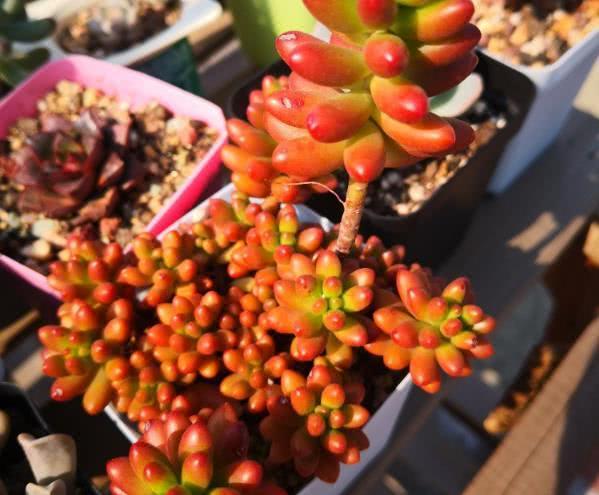
Most succulents love sunlight, and basking for 6 to 8 hours a day is ideal, but for those of us with just a balcony, managing 2 to 3 hours a day is already good. If they can get more than 6 hours of sun a day, the colors of the succulents will become exceptionally beautiful and exceptionally lovely, but Haworthia-type succulents should not be casually put out in the sun; for example, the succulent Haworthia cooperi is suited to diffused-light care, that is, backlit care.
Some people say that using wet soil is better, that wet soil makes them grow faster and root faster. Actually, I personally think wet soil or dry soil does not matter much; it still depends on the air humidity. If the air humidity is sufficient, even dry soil will lead to root growth and sprouting. Red clay pots have excellent breathability, so you can water more. Ceramic flower pots and other holeless tin pots need less watering; once you water too much, it will accumulate at the bottom and cause the succulents to rot at the roots. A fairly good watering method is to spray the surface of the succulents with a spray bottle every night between 8 and 10 p.m.
In summer, beware of high temperatures and prolonged exposure to the sun; the tissue cells of succulents are thick and release heat slowly, making them very prone to sunburn on the leaves. In other seasons, full sunlight helps the plants grow. Many plants that need shade, such as Haworthia and the like with tender green translucent leaves, need to be protected from sunburn. Use the "water when dry, stop when wet" method for watering, which both satisfies the water these plants need to grow and ensures the oxygen needed for root respiration, helping the plants grow robustly.
The more common pests on succulents include aphids, common scale insects, and root mealybugs, three types. Common scale insects are white with small fine hairs on the surface. While sucking the sap from the leaves, they also release a kind of sticky secretion, and this sticky secretion can cause diseases such as sooty mold. When removing pests, you can spray with a Huahushen (a type of pesticide) solution. Aphids generally attach to succulents that have flowers, because the honeydew secreted by the flowers attracts them. When an aphid infestation occurs, the most direct method is to cut off the flower stalk, then clean the leaves with a water-moistened cotton swab.
Generally speaking, the soil most people can readily find around them is either mud soil or garden soil. What you casually dig up by the roadside is usually mud soil, characterized by clumping together like mud after watering and then easily compacting once dry, with no breathability, so it is not suitable for succulent growth. Garden soil can be understood as the soil used for growing vegetables, or soil where other plants have already been grown for quite a long time (such as soil in a forest). Its advantages are that it is rich in nutrients and can be considered loose and breathable, but its drawback is that it may contain some pathogens and insect eggs.
The most fundamental reason there are ants on succulents is that the succulents have food the ants want; as long as there is nothing the ants want, naturally there will be no ants.
This is a gathering place for succulent lovers, sharing succulent care tips; you are welcome to follow and exchange ideas.