As a childhood snack, it turns out to be a precious medicinal herb that dispels wind-dampness and has therapeutic effects on liver disease
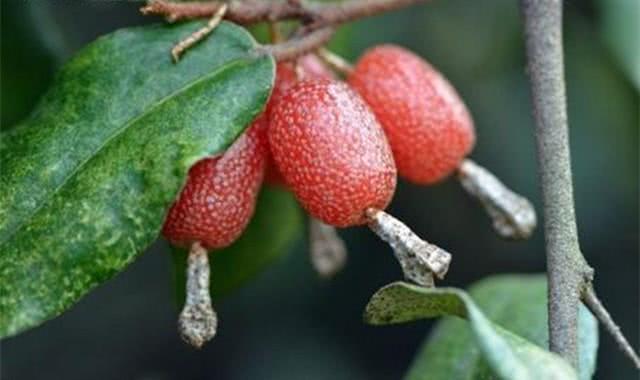
In childhood, in the rural mountains and wilds, there were many wild fruits. Since there was almost no entertainment at that time, many children, during their holidays, loved to climb trees in the mountains to pick and eat this wild fruit. These experiences are our precious childhood memories, and children today cannot experience the happiness we felt back then! Among them, one wild fruit left a very deep impression on us. It looked like today's Golden Finger grapes, was especially sweet, and had lots of juice. We called it "milk fruit" (niunai zi) in our area.
As children we treated "it" as a snack, and only now do we know it is actually a precious medicinal herb that can dispel wind-dampness and also has therapeutic effects on liver disease! The scientific name of the milk fruit is Elaeagnus pungens (thorny olive), a type of berry that grows on sunny slopes or roadsides below 1000 m in altitude. The fruit is oval-shaped, 12-14 mm long, and turns an enticing red when ripe, with some small white spots. It is very cute and looks quite appetizing!
It can be said that Elaeagnus pungens is a treasure from root to tip. The roots, leaves, and milk fruit berries all have medicinal value and can be used in medicine, with good effects for aiding digestion and relieving dysentery. Through some modern clinical trials, it has been found that Elaeagnus pungens also has a good effect in dispelling wind-dampness and has a certain therapeutic effect on hepatitis and other liver diseases! At the same time, it also has good therapeutic effects on gynecological conditions such as abnormal uterine bleeding and abnormal vaginal discharge in women. It can be seen that this plant is truly a very good traditional Chinese medicinal material with a wide range of therapeutic effects.
The Elaeagnus pungens plant is not very tall. It is an upright shrub, and a mature plant is only about 1.5 m in height. Its branches have small thorns that are very sharp, so when picking, be careful not to get your hands pricked. This plant blooms from September to November and bears fruit from April to June of the following year. Although this plant is not large in size, its fruit yield is very large. If the growing environment is relatively good, with sufficient rain, fertile soil, and plenty of sunlight, its branches can be covered with fruit, and the weight of the fruit can bend the branches. A bright red expanse, very beautiful!
The fruit of Elaeagnus pungens is somewhat like the teats of cattle and sheep, so it is called milk fruit. The fruit is a very beautiful red, with white cotton-like streaks on it, round and juicy, and very sweet. It was one of our favorite wild fruits to eat as children! Because it is a wild plant, its adaptability is very strong, and it has very few pests and diseases. Now some cultivated varieties have also appeared, and some people even grow Elaeagnus pungens as a potted plant. It not only has very high ornamental value but can also be eaten, achieving two things at once!
If everyone wants to grow this plant, there should be seedlings of this plant available online. I personally think it should look quite nice as a potted plant, especially when it bears fruit; the ornamental value must be very high, because the milk fruit is just too beautiful! Moreover, this plant is relatively easy to grow in pots, with extremely strong vitality. It is drought-tolerant, tolerant of poor soil, tolerant of waterlogging, and has very few pests and diseases. It can almost be grown well with no management at all!
Have you seen this "milk fruit" in your own hometown? Do you still remember the taste from childhood?
Alright, that is all for today's rural plant sharing. If you like it, just click follow. We update topics about rural plants every day, and I hope everyone will be interested!