What kind of orchid is Qijian Baimo? With Cymbidium sinense pictures and an analysis of whether it is fragrant
What kind of orchid is Qijian Baimo? Qijian Baimo belongs to Cymbidium sinense, and is a well-known cultivar within Cymbidium sinense. It is one of the four traditional cultivars of Cymbidium sinense, a precious mutated cultivar of Cymbidium sinense with an oval pseudobulb. It has a cultivation history of several hundred years and has been passed down to this day, with no fewer than a dozen cultivars. Its leaves are lustrous and smooth, its bearing elegant, its fragrance quiet and far-reaching, and its disease resistance strong. It blooms at the beginning of the year, so it is also called the white-flowered Lunar New Year orchid.
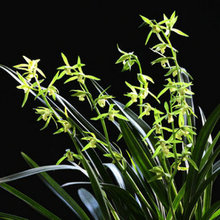
The characteristics of Qijian Baimo: its pseudobulb is plump and oval; the bracts are small, and the base has water pores. The sepals are pale white in color, and the petals are relatively short and broad, extending forward, positioned above the column. The lip hangs down and curls back at the tip, the three lobes are not obvious, and it is pale white. The flower stalk is tall and upright, with a majestic and powerful bearing, and the scent is quietly fragrant and far-reaching. The flowers are jade-white plain flowers, fragrant, on tall flower stems. Qijian Baimo has long had the saying “the ink-dark is not white, the white is not ink-dark; the ink-dark is its name, the white is its reality; ink-dark yet able to be white, others turbid while I am clear”, from which one can grasp the meaning of “near vermilion one turns red, near ink one turns black”.