Bee socializing is such a waste of energy
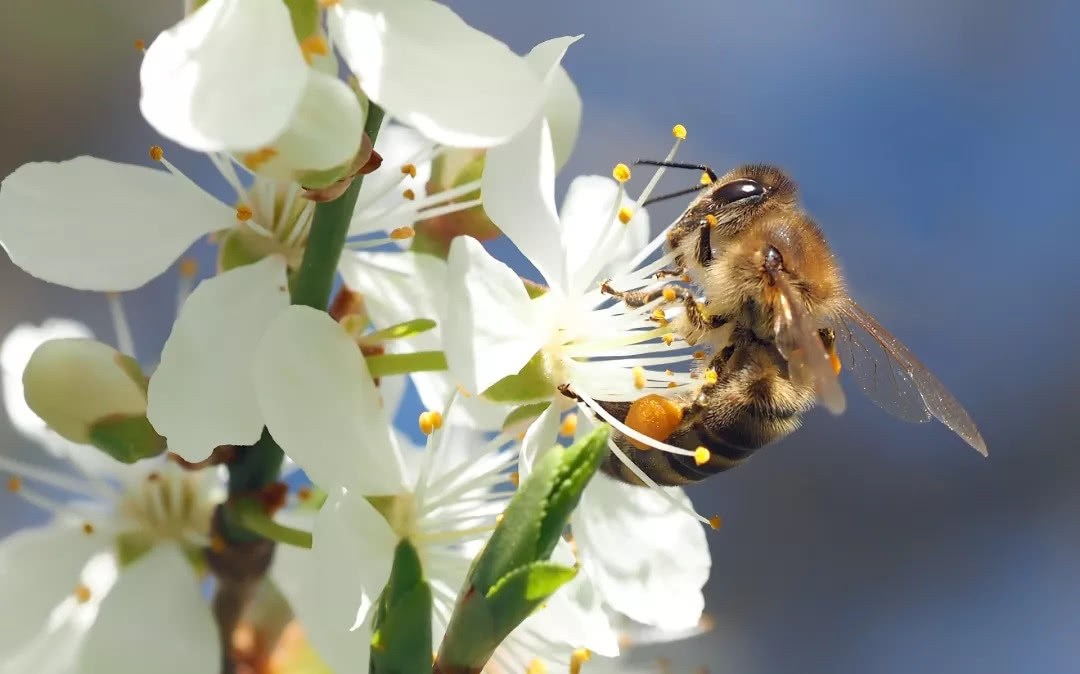
To us, bees and humans are very similar, both being highly cooperative social species. However, just as there are solitary people in human society, are there antisocial individuals in the bee world too?
Can there be unsociable individuals among social bees? Image: Pixabay
The social complexity of beesis evident from their intricate hives. They have a fine division of labor: some are responsible for defending against predators, while others coordinate resource collection, and so on. Humanity's success can also largely be attributed to this kind of communal division of labor. Clearly, in the animal kingdom, socializing has its benefits: certain neurons make us hate being alone. If you consider complex social organization to be the pinnacle of evolution, or at least one of its pinnacles, that is entirely reasonable.
However,among the twenty thousand known species of bees, only a few are social. Some species of bees have even abandoned social behavior and chosen to live alone. Why is that?
Socializing is just too exhausting
First, introverts all know very well thatsocializing requires a great deal of energy. Highly complex insect societies require a large amount of chemical and physical signals to guide colony behavior.
Compared with bees that live alone, social bees have more developed exocrine glands, while solitary bees of the family Halictidae have fewer sensory hairs on their antennae than their social ancestors. Solitary and social Halictidae bees also have different odor systems, a system that is very important in the communication and recognition of social bees. As the environment imposes new demands, and as the colony's genome adapts to the new environment, these traits may no longer be worth retaining.
An orderly colony life consumes a great deal of energy. Image: Pixabay
Socializing affects independence
On the other hand,socializing may hinder the growth of bees, and sometimes bees must grow quickly in order to survive.
Researchers at Whitman College in Washington found that newly hatched antisocial orchard mason bees (Osmia lignaria) have a brain region responsible for foraging that is just as well developed as the corresponding region in bees with rich foraging experience.Antisocial behavior encourages self-sufficiency.Orchard mason bees must take care of themselves, and they know how to forage from birth. For social bees, however, at any given time only a portion of the bees in the colony need to go out foraging.
A solitary orchard mason bee. Image: Brian Buckner
Where does antisocial behavior come from?
How did solitary species that arose from social species evolve these advantages? After all, antisocial behavior appearing alongside other stressors could mean the disintegration of the entire colony. Why? In that case, the colony needs more social bees to sustain itself, and the number of bees the colony can stably support also decreases. In other words,an increase in antisocial bees can no longer allow the colony to survive sustainably. Therefore, antisocial bees are not entirely advantageous.
The many facets of social behavior are one possible answer. The sweat bee (Halictus rubicundus) is an insect attracted to sweat, and its ancestors were social bees of the family Halictidae. In Europe, sweat bees include both solitary species and social species. Bees living in different environments behave differently: in warm climates, sweat bees prefer to form colonies; in cold environments, they prefer to act alone.
A female sweat bee. Image: linsepatron / Flickr
Facts have also shown thateven within a highly cooperative colony, antisocial individuals still exist, and the other bees in the group seem to tolerate them as well. If some solitary bees find that isolation is an advantage in their new environment, such as when the growing season is very short and bees need to act without task assignment, then an antisocial species will rise.
Changes in host plants can also cause social bees to revert to solitary behavior. Bees have different living environments and needs; in the colony state, collecting pollen from a single plant is usually more advantageous, and the entire activity of the colony can be coordinated around a constant resource.Solitary bees are usually generalists, moving among various plants.
Collecting from a single plant is more advantageous than collecting from multiple plants. Image: Pixabay
Sociality is not the pinnacle of evolution, just another outcome of the evolutionary process.Solitary bees and other solitary species do very well, sometimes even better than they do in the social state. Clearly, social behavior has its advantages and can potentially increase the survival chances of species and populations.
Butsocializing is not the only thing that benefits the group. Sometimes, when you act alone, everyone benefits. (Author: Silvia Golumbeanu; Translation: Sun Runsong; Proofreading: EON)
This article is authorized for reprint from I Am a Scientist iScientist.
I Am a Scientist
iScientist
id: IamaScientist
"I am a scientist, and I do science communication."
If we are talking about true social animals
they cannot go unmentioned
Calendar Girl's avatar for today
Apidae, Kashmir bumblebee
This article was first published on Guokr.com's I Am a Scientist iScientist