Succulent Leaf Cuttings: 4 Tips You Cannot Ignore Even One Of
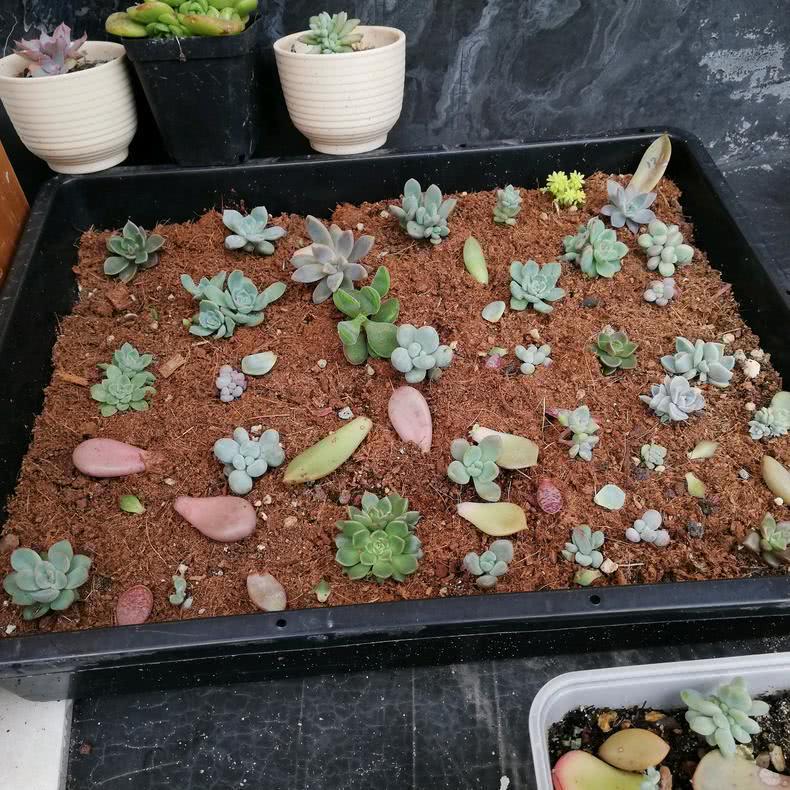
Autumn is a great season for succulent cuttings. Many succulent lovers, in order to expand their succulent collection, like to take the leaves that fall off their succulents and use them for leaf cuttings, and the succulents that eventually grow out are especially beautiful.
In fact, succulent leaf cuttings involve many things that need attention, and not just any leaf will do. Today, Gu Niang will tell everyone a few tips on how to make leaf cuttings fill out a pot successfully.
Tip One: Choose Robust Leaves
From healthy succulent leaves, pick out the better ones and gently cut them off. The leaves should be chosen a little on the thick side, as only then are they easily rooted, because thick leaves themselves are relatively full of nutrients and can provide themselves with a longer survival time to sprout and grow roots. If the succulent has grown a flower stalk, you can also take leaves from the flower stalk, and the success rate will be much higher. You must take healthy and intact leaves to ensure the new succulents are healthy, so be very careful. The cut leaves are best placed in a dry, ventilated place for about 1 to 3 days, mainly to let the wounds dry out.
Tip Two: Loose, Nutritious Soil
For the soil used in leaf cutting propagation, you can choose a special nutrient soil, or use a loose, breathable soil. Whether or not to spray water all depends on whether the ventilation is good; generally, the soil just needs to be slightly damp. In places with higher air humidity, you can choose suitable dry soil for leaf cuttings; in environments with lower air humidity, damp soil is suitable for leaf cuttings, and you can also cover with film to maintain humidity. Generally, autumn is a very suitable season for leaf cuttings. At this time, the temperature and humidity are both very suitable, leaf cuttings grow roots and sprout quickly, and the success rate is also high.
Tip Three: Leaf Cutting Position
There are three commonly used leaf cutting positions: flat placement, slanted placement and upright. Each of the three methods has its own pros and cons. The more commonly used ones are flat placement and slanted insertion. The flat placement method roots and sprouts more easily than slanted insertion, but after rooting, the roots need to be gently buried in the soil. Although the rooting and sprouting rate of slanted insertion is not very high, after the roots grow out, we do not need to deal with them again, which is a bit more convenient.
But as long as they touch the soil, there is a certain chance of turning black, turning to water and rotting. This is also related to the health of the leaves and the variety, but the chance of these injuries is very, very small. With good control, it can be reduced a great deal, so it can be ignored. Also note that after leaf cuttings, if roots have already grown, you can appropriately supplement nutrients by diluting nutrient solution 500 times and watering it at the roots.
Tip Four: Light and Ventilation
After all the leaves are inserted, place them in a spot without direct sunlight, or with weak sunlight, and wait for them to sprout. Since the leaves themselves contain a large amount of water and nutrients, there is no need to water before sprouting and rooting. Afterward, you can just water a little for care. Ventilation is beneficial for leaf cuttings, but note that ventilation does not mean using a fan or strong wind; slight air movement is ventilation.
Today, I am sharing these four little tips with everyone. I hope all your succulents can be beautiful after leaf cuttings!