Peach Eggs change a lot in early autumn, and succulents are about to become beautiful
Foreword
Follow the encyclopedia, meet beauty (WeChat ID: duoroubaike)
The main text begins:
Thanks to the author [Jingye] for theoriginal contributionsharing
Edited and compiled by: Encyclopedia Jun
Location: Dalian, Liaoning
Although it is the beginning of autumn, the weather has not cooled down much, especially this year, which is hotter than any usual year. Every day I am drenched in sweat, and my appetite is not very good either. If people are like this, how much more so the cute succulents?
After a summer of baking and water control, the succulents are already very weak. It is good enough if they can survive; I really did not expect them to become beautiful right away or anything.
Who knew that my little Peach Eggs would begin to collectively become beautiful impatiently.
Originally, the balcony light in summer was insufficient, and the eggs baked under grow lights had a color that was a bit unnaturally dark.
Who knew that after a summer of water control, some had even turned the long-desired egg-yolk milk color...
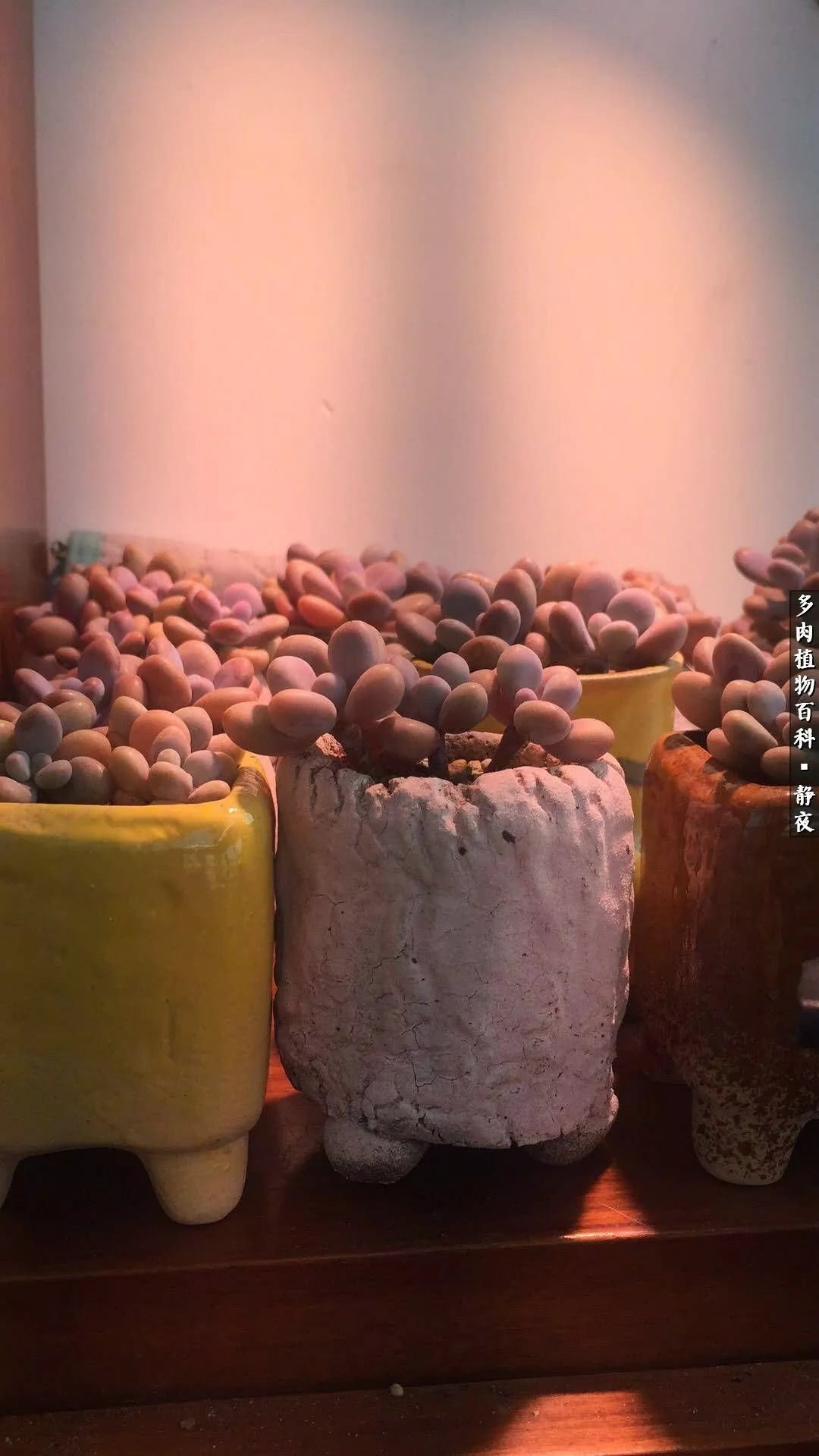
In the sunlight they look like this, and the second one was even mistaken by someone for Xiangshui... haha, my photography skills are high, nothing I can do about it.
At night they look like this
One day it was raining outside, and the eggs on the rainy day actually had a hazy, pearl-like luster
Who knew the wind and clouds would suddenly change, and before I had cherished them for two days, the eggs' leaves began to fall off at the slightest touch. Some of the beautiful eggs above were almost becoming bald.
This old-stem Peach Egg could not escape either...
Not only Peach Eggs; some of the other succulents were even worse off...
Laura
Egg Beauty
The worst was Berkeley Variegated; its leaves were almost all gone. I pulled it out to look, and it seemed it had never really established roots in the pot. I do not know whether it can survive like this. This one is truly delicate and hard to grow, no wonder its price has never dropped...
After a summer of high temperatures plus water control, some succulents have really become extremely weak. When nutrients cannot be supplied, the leaves fall off. Turning milk-yellow is actually also a sign of Peach Egg weakness, not a healthy state. Losing leaves is also the succulent's self-protection; with fewer leaves, it does not need as many nutrients.
Now that autumn has come, the succulents have begun to wake up, and their condition is recovering little by little. As long as they are still alive, there is a chance for a comeback and for them to become beautiful. At the growth points where leaves have fallen, small heads may still sprout, and they might even be more beautiful in shape than before. Only after a summer of tempering can woody stems be developed, taking another step toward becoming an old stem.
Looking at friends posting photos in Moments, some harvested a whole balcony of bald eggs, while some kept each other company and were not lonely, haha.
The matter was not over yet... A few more days passed, and the Peach Eggs started acting up again.
First, I happened to notice this egg's center had turned transparent? It did not look like it was about to turn to water, and why did it look a bit familiar...
Is it not a bit like the deceptive chemically variegated plants sold in flower markets?
Could my egg have become variegated on its own?! Happiness came too suddenly again... I quickly posted in the group to show off and let everyone see.
Who knew that after they looked, they all calmly told me that this is seasonal variegation, unstable, and it will fade in a few days. Their Peach Eggs had also become variegated.
Ah, so that was how it was. I got happy for nothing.
Then I looked more carefully at my other eggs. Wow, almost all of them had variegation; there were hardly any without it...
Even the few good leaves left on the baked egg had turned white...
Burnt outside and tender inside, and still not forgetting to become variegated... I am really speechless!
Not only Peach Eggs, even the White Dew that I had not looked at properly all summer came out to join the fun, with a few leaves in the middle showing a different color...
And Pink Rabbit too, even after being baked, still did not forget to become variegated...
Variegation in succulents is very rare. So many succulents becoming variegated at the same time must be related to the season, that is, seasonal variegation.
In order to understand what seasonal variegation is, I specifically looked it up online.
Peach Egg variegation has two types: edged variegation and seasonal variegation.
This is Peach Egg's edged variegation. Almost all the leaves show striped fading, and the fading is relatively orderly, not in patches here and there. This kind of variegation is stable and can be propagated. After leaf propagation sprouts, it will also have a certain heredity.
Peach Egg's seasonal variegation is relatively common. Especially due to reasons such as seasonal changes, changes in factors such as temperature, humidity, and light easily produce seasonal variegation.
My balcony had almost no sunlight in summer. These past few days, since autumn began, the morning sunlight fills the whole balcony. It may have been caused by the change in light.
Although I now know the variegation will fade, I am still very happy. After all, it was once variegated... I do not ask for forever, but I hope to have once had it, haha.
Seeing Peach Eggs, I have to mention the grow lights everyone cares about. My indoor balcony barely gets any sunlight in summer, so I added a ring of grow lights, and most of my succulents are in acceptable condition. When the temperature was hottest this year, it reached 38°C. A few Peach Eggs that had just been watered, for fear of root suffocation and black rot, I put in an air-conditioned room for a few days, and their color worsened, all turning greenish. Later, when the temperature was a bit lower, I took them back under the lights to bake, and within a few days, the color became pink again.
It can be said that grow lights have an excellent effect on coloring Peach Eggs and preventing leggy growth. If the succulents are not beautiful, create the conditions to make them beautiful!!
All your efforts will ultimately be repaid by the succulents with their most beautiful selves.
Reward notice
This article is purely for sharing. The author has not enabled rewards. After reading, do not forget to give the author a little like at the bottom right corner of the article to encourage them!
This article has beenexclusively authorizedby the author to WeChat public account: Succulent Plant Encyclopedia (ID: duoroubaike). The content of the article does not represent the views or stance of the public account! The encyclopedia has signed with a third-party internet copyright enforcement company and opened whole-network rights protection. Unauthorized reproduction by other platforms is strictly prohibited! If unauthorized reprints are found, infringement liability will be pursued! Netizens are welcome to report!
Advertisement ADVERTISEMENT
The culture of succulents needs us to promote it! Remember to share good articles more, so more people fall in love with succulents! Use the power of plants to influence and heal the people around us!!!