Bonsai creation should emphasize realism and spiritual resonance, learning from nature.
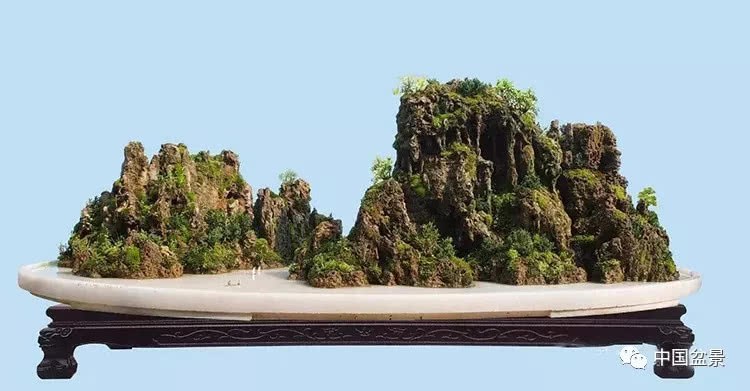
Han Qi Landscape Bonsai - Lishan Spring Dawn
Moon Reflected in Two Springs
Centenary Commemorative Album
Abing
00:00/05:12
The essence of bonsai creation lies in realism and the pursuit of spiritual resonance, following the way of nature.
Original author | Han Qi
To create a good rock landscape bonsai, one must carry forward tradition and highlight individuality. Grasp the characteristics of the geographical environment, blend one's emotions into the pot, seek resemblance in form while valuing the artistic conception of realism, and seek simplicity within complexity. The art of bonsai originates from nature yet rises above it; the key is the skillful use of simplification techniques, shrinking the dragon to a inch, seeing the vast in the small, which is the embodiment of seeking ease within simplicity. Concise and clear, with a transcendent artistic conception. It gives people a sense of beauty and rich associations.
Landscape bonsai can quite well display the essence of Chinese culture, and also allow a panoramic experience of the refined pleasures of life. My hometown is in the northern Anhui Plain, flat and boundless. As a child I had heard of mountain scenery and bonsai, but had never seen them. As a youth I loved reading geography books, loved depicting mountains and rivers, and loved trying to shape mountain forms with yellow clay. Only after starting work did I travel through remote mountains and wild forests, experiencing real scenery firsthand, and then had the opportunity to shrink the green mountains and beautiful waters of nature into a pot.
Creating landscape bonsai requires an aesthetic eye and rich emotions. Mountains rise from flat ground, and scenery is born from mountains; this is seeing scenery and giving rise to emotion. The famous landscape painter Huang Binhong said: On Chinese soil, there is no mountain that is not beautiful, no water that is not elegant. Shrinking natural landscapes proportionally and expressing them with superb skill in a pot, this is landscape bonsai.
I use whole mountain-shaped stones collected over many years to create landscape bonsai. The stone texture is naturally weathered and grand in momentum, with strong integrity, looking not fragmented and full of charm. Especially for hard-stone landscape bonsai, composed of multiple pieces of mountain stone, it must have a sense of integrity; one must not simply think of viewing the top and viewing the foot, making the mountain foot cluttered. Many enthusiasts see stone materials and think it a pity to discard them, so they put as much as possible into the pot, resulting in a top-heavy appearance and a fragmented picture. Some are not single whole stones; it is best to achieve seamless joining, one stone reaching the sky without joints, the mountain top not too pointed, the mountainside not too fat. Control the proportion of top and bottom well, and prevent the mountain foot from being scattered. Landscape bonsai also has changes of solid and void. The upper part of the mountain is solid and should have spiritual character; the lower part is void and should be lively and varied, forming a sharp contrast and balance between top and bottom. In hard-stone layout, one cannot accumulate the small into the large; first principal, then secondary; first large, then small. The mountain foot should achieve more with less, reaching the supreme beauty where one more is too many and one less is not enough. When arranging, pay attention to the interlocking of positions, avoiding monotony, rigidity, and static composition such as trapezoidal arrangement, pointed small ends facing up, arithmetic symmetry, and pyramid-style composition.
For nearly 40 years I have persisted in innovative exploration of landscape bonsai, accumulating several creative experiences through realistic techniques, to discuss together with people inside and outside the field.
One, Waterfall Making (Elegant and Winding)
Carve uneven stone water lines from white marble and insert them into cracks in the mountain stream. Stones without cracks can be cut by machine, carved into water lines, inlaid with white stone, then washed with hydrochloric acid, and they will be white as water.
Apply moist white cement to the mountain stone, then stick glass on top, forming a shimmering water path. Even if no live water is poured in, it still looks as if it is pouring down with a sense of flow.
Two, Pool Water Making (Clear, Not Cloudy)
Use a white marble basin, cut thin green stone pieces as the bottom surface, selectively lay them on the basin bottom, then pour in clear water, and the feeling of green water and blue mountains is formed.
Use iron oxide green or iron blue, mixed with a small amount of cement, adjusted to a water-green color, apply it to the basin bottom; after 24 hours, pour in clear water and it will not become cloudy, reflecting gloriously with natural lakes (avoid mixing pigments with water, because it is not transparent).
Three, Ice and Snow Creation (Spring Snow Not Yet Melted)
Generally use natural-colored real stones, such as cloud-and-mist stone, sea-mother stone, snowflake stone, and Xuancheng stone.
For stones of different colors (such as black stone, brown stone, etc.), to create an ice-and-snow effect, first sift white cement with a small sieve so that it falls onto the stone and pot body, then use a small mist spray bottle to wet this area, then sift white stone powder so that it falls onto the white cement. After the cement and white stone powder solidify, they will not fall off, closely resembling ice and snow.
Four, Sand Mountain Making (Harmony of Hard and Soft)
It is best to use yellow stone blocks. For the surface, use iron oxide yellow mixed with a small amount of dry cement. The theory and the second method of making ice and snow are the same, integrating with the original desert in the same color.
Five, Drilling Holes in Mountain Stone (Weathered and Natural)
Many healthy whole stone mountains have no depressions and cannot be planted with plants. In shaded areas of the mountain stone, use emery mixed with water to drill holes, which neither damages the stone surface nor fails to maintain the natural shape. First, open a small hole from above, use a machine to swing left and right to enlarge the stone hole. On the back of the stone, use a diamond drill to chisel a small hole that can drain water, plant flowers and grass, mix cement to a color close to the stone, and apply it around the hole edge. While the cement is still soft, attach small stone pieces according to the grain onto the cement, so that the surface shows wrinkles consistent with the texture of real stone; after the cement solidifies, it will have the same grain and color as the original stone.
Six, Changing the Color of Mountain Stone (Weathered and Lifelike)
Specific method for changing the color of real stone: it is best to use acrylic paints, combine various colors, mix and use them, add a small amount of water and adjust until similar to the color of the real stone. Then, using unmixed acrylic according to the texture of the real stone, lightly draw and outline the vein lines of the real stone with a brush tip, and it will be lifelike and natural. Because after acrylic dries, it does not fade or change color.
To change color with cement, match according to the color of stone you want to make, use different colors of iron oxide mixed with cement, and after the cement solidifies, use acrylic in the same way as with real stone.
Seven, Disintegrating Mountain Stone (Natural Cracking)
In making landscape bonsai, there are also many hard stone materials, such as petrified wood, axe-cut stone, etc. How to break the stone? Support the stone with a steel frame, place it directly above a coal fire and roast for about 1 hour, douse the stone with cold water, and roast at a distance of 10-20 cm for about half an hour. After roasting, tap lightly a few times with a hammer, and it will crack naturally. Then use a fire balloon and hydrochloric acid water to apply and transition it, and the cracks will leave no trace.
For joining stones, it is best to use cement of 400# or above, because it bonds firmly, dries quickly, has strong water resistance, and does not easily fall off.
Whole stones in water can also be adhered with AB glue or glass glue; after gluing, wait 24 hours before adding water for use. But these two glues cannot be used to join stone pieces.
Ancient Charm of Strange Peaks
The work uses petrified carbon stone as the main material, with strange peaks standing in forests, mountains and water connected, solid and void reflecting each other, trees and grass green and secluded, peaks rising in clusters from the ground, vigorous and upright, majestic and precipitous, piercing straight into the clouds. Between the main peak and accompanying peaks, low mountains stretch continuously, steep cliffs hang in the air, the modeling is lifelike, combining movement and stillness, with magnificent momentum. It embodies a scene of steep and serene stone forest elegance.
Divine Peaks Competing in Beauty
This potted work uses the high-distance method of composition, elegant in the Imperial Brush Peak of famous mountains, beautiful among famous mountains and clear waters. The inspiration comes from the combination of two insights: the stone forest of Zhangjiajie in Hunan and the stone forest of Lunan in Yunnan. It has the elegance of Zhangjiajie's stone forest with strange peaks standing in forests, and the unique appearance of Yunnan's stone forest rising from the ground with huge stones on top, peculiar and magnificent. The layered ridges are rich and steady, the mountain peaks overlap clearly, reaching straight into the blue sky, mountain ranges connected, clear water reflecting each other, high and distant, majestic and vigorous, deep and winding with secluded beauty, profound and lasting. Rich in pictorial and poetic quality.
Spring Returns to the Earth - Joy Reaches the Forest (A Small Stream, Flowing Water, and a Home)
This forest-style work was created by the author using natural sand-accumulated stone, planted with multiple wild, aged boxwood stumps of varying sizes (tree ages 20-50 years). The mountain forest is densely shaded, gentle and grand, with the ancient wild charm of nature. On the wild forest hill slopes, the small fishing village and green grass are lush and flourishing. A winding stream flows murmuring out from the deep valley and beautiful forest, the water clear as a mirror, falling straight into a pond, a pool of blue water, full of greenness, quiet and elegant, full of nature and a deep, secluded atmosphere.
Forest and Spring Scene
The work draws its meaning from Guo Xi's "Lofty Message of Forests and Streams" of the Song Dynasty. It is a water-and-dry wild-island style work, composed of turtle-vein stone, four large Osaka pines, and mixed trees and tiger-thorn. The green grass is secluded, the crown naturally connects as one body, scene and emotion blend, land and water reflect each other, giving people a leisurely pictorial feeling of dancing pines.
Feelings of Wu Gorge
This work uses a naturally whole turtle-vein stone with an antique color and aged form, paired with a small turtle-vein stone. This stone is now extremely rare. By cutting and grinding the bottom flat, it is made according to the direction of the mountain stone. Wu Gorge has long been known as the Great Chivalrous Gorge. Magnificent and deep, handsome and elegant, it is famous throughout the world. The gorge is long and the valley deep, strange peaks jut out, ridges overlap layer upon layer, clouds surge and mist wraps around, the river flows in twists and turns, winding a hundred times. Sailing through it is like entering a magnificent gallery. The author shrinks the beautiful scenery of nature proportionally into the pot, full of poetic and pictorial charm. (This scene is collected by the Hefei Museum, August 8, 2018)
Commanding View of the Yuan River
The main mountain of the work is created with a large whole turtle-vein stone, a material that is now hard to find, paired and skillfully combined with small mountain-shaped stones. It is just right for creating the scenery of the Yuan River. The Yuan River originates in Guizhou Province and flows into Hunan Province, with a unique natural environment. It endows the Yuan River with naturally beautiful mountain and water scenery. The scenery differs in spring, summer, autumn, and winter, and has its own mood in clear or rainy, windy or snowy weather. The northeast is marsh and reed islets; across the whole area there is now three parts polder fields, three parts islets, three parts water surface, and one part hills, the characteristics of the Hunan landscape. Along both banks of the river the scenery and climate are pleasant. The author shrinks it proportionally, blending the beautiful rivers and mountains into a tiny pot. (This scene has been designated for collection by the Hefei Museum)
Strange Mountains and Beautiful Waters
The main mountain uses a whole natural turtle-vein stone, paired with small natural stones. The large whole stone cave resembles a heavenly gate, just right for creating strange, beautiful, and grand mountain-and-river scenery. This is a cliff-and-river style landscape bonsai with realistic techniques. It fully embodies the majestic and weighty posture of rivers, and artistic features such as steepness, beauty, strangeness, and seclusion. It organically integrates natural beauty and artistic beauty into one. It makes viewers gasp in admiration. (This scene was exported to Japan on August 8, 2018)
Green Mountains and Blue Waters
This dolomite main mountain is perfect as a whole, paired and grouped with a small natural stone. The mountain stone forms are strange and varied, the stone colors interact naturally in light and dark, the changes are reasonable, and the colors are all the same and consistent. The layout has mountain ridges rising and falling with connected veins, green water reflecting each other, the current rushing, the momentum majestic, grand and unrestrained. The artistic conception is deep and secluded; viewing this scene gives people an enjoyment too beautiful to take in all at once. (This scene was exported to Japan on August 8, 2018)
Fish Song of the Great River
The work uses a whole natural Nine-Dragon Wall stone paired with small mountain-shaped stones, recreating the momentum of great mountains. The author without hesitation brings forth the most beautiful gorge-and-river scenery from the mind, achieving the supreme beauty of humanity and nature merged into one, showing the elegant splendor of the gorge-and-river scenery.
Dangerous Cliff Emerging from the Peak
The main peak of this work is created from a large dolomite stone, arranged with a combination of gorge-style deep seclusion. On the right, small mountain-shaped stones are used to pair in harmonious unity. Placed in a good position, the overall effect looks strange, elegant, and natural, clear and distinctive. Majestic and vigorous, hardness and softness in harmony, green water reflecting each other without losing pictorial quality. It gives people pleasure in their field of vision.
Rippling Waves of Gulang
This work is a scattered-stone island using three whole Nine-Dragon Wall stones of different sizes, paired with small reef stones as accents. Gulangyu was anciently named Yuanzhouzi; because reef caves on the southwest seaside were struck by waves, sounding like beating drums, it was renamed Gulangyu in the Ming Dynasty. On the islet, Longtou Mountain, Shengqi Mountain, and Jimu Mountain stand side by side. Ridges rise and fall, blue waves, white clouds, and green trees reflect one another, giving people a clean and quiet feeling everywhere. Gulangyu is a small island in the sea familiar in life; the scenery in the pot gives people a kind of grand realm, a plain and unadorned natural realization.
Painting Mountains and Waters on the Riverbank
The main mountain of this work is a whole Nine-Dragon Wall mountain-shaped stone with the wild, open spirit of a great mountain, the best choice for making landscape bonsai. The author creates river-island scenery based on the conception of this mountain stone. The work chooses materials ingeniously, and the lines of the oval pot match the lines of the mountain stone. In the distance, several low rows of small mountains are arranged as a distant view; the pot edge cannot be seen, giving a kind of elegant, tranquil, soft, and gorgeous beauty.
Gorge River Winding Around the Cliff
The main scene, this whole cliff Qian stone, is elegant and clear-aged, used to make cliff-style landscape bonsai, expressing the waterside cliff scenery of nature: majestic, dangerous, strange, and with steep precipices. It has the characteristics of dangerous mountain stone, strange mountain forms, and spectacular scenery, and is one of the most dynamic forms among hard-stone landscape bonsai, deeply loved by bonsai enthusiasts. The work has a river-style picture that is concise, with an expansive artistic conception. The nearby mountain posture is towering, strange, and beautiful; the distant mountain outline is continuous and graceful. The entire work vividly embodies the poetic and beautiful scene of "a lone sail's distant shadow vanishes into the blue sky," leaving endless aftertaste.
Spring Dawn on the Beautiful River
This mountain-and-river style work uses Nine-Dragon Wall stones, whole stones of different sizes combined. The composition has an expansive, open artistic conception, lively and beautiful. It is a level-distance style work describing the present era. In the scene, distant mountains are arranged low and continuous, with clear layers, mixed trees sprouting in clusters, reasonable structure, strong overall feeling, and grand rivers and mountains. With skilled technique, the author composes steadily. Using elegant, moist lines to perfectly express the rivers and mountains, it looks as if it has a transcendent spirit, a majestic, unrestrained, and open beauty.
Deep River, Secluded Feeling
This scene is high-depth style landscape, used to express majestic and upright, cliffs a thousand fathoms high, and magnificent mountain-and-river scenery. This is one of the most common forms of expression in our country's landscape bonsai, with the characteristics of lines both hard and soft, deep and secluded forms, strong integrity without fragmentation, and broad and magnificent gorges.
Rising Sun Reflecting the Cliff
This cliff-style landscape bonsai, made with a natural whole Nine-Dragon Wall stone paired with small natural stones, reflects the thrilling appearance of cliffs and precipices in nature, symbolizing an unyielding spirit of striving forward. The main mountain is clearly cliff-shaped, placed on one side of the pot, overhanging toward the middle, with a natural spirit of a huge stone above the head.
Feelings of the Yellow River
The Yellow River is China's mother river, with surging waves, rolling sand, and rushing into the sea. For thousands of years, countless poets have recited and sung of it: "The waters of the Yellow River come from the sky." This work uses a whole Nine-Dragon Wall stone, with the mountain stone form wild and ridges emerging from peaks; on the right, small ridges echo one another. Yellow stone sand is used to treat the landform, piled into dune-like forms. Natural and lifelike without losing truth. Along the Yellow River slope and canyon inner bank, more than ten camels are dotted, lined up in neat formation, advancing with an indomitable spirit, transporting grain and forage. Recalling this scene, the feeling flows smoothly, reproducing the work's sense of movement, expressing the author's love and praise for the mother river.
Spring Tide Surging
There are two kinds of Nine-Dragon Wall stone, mountain stone and water stone. In the pot, this stone is Nine-Dragon Wall mountain stone, a level-distance style picture. The stone quality is harmonious as a whole. In landscape bonsai modeling, unequal-sided triangular composition is often used; when the overall unequal-sided triangular layout is reasonably and properly matched, it produces a sense of steadiness, integrity, richness, and weathered grandeur. The accompanying peak is a whole small triangle; the long slanted sides of the two triangles face each other, making the central picture open and profound. In the depths, hazy sail shadows show the surging of the great river's spring tide.
Towering Peaks
A large whole stalactite mountain formation looks like a great sacred mountain style, with peaks rising in layers. The author repeatedly conceived the work and named it "Towering Peaks," because it is a whole stone mountain range paired with multiple small reef stones as accents, with a form natural and lifelike, ingeniously formed by nature.
Famous Mountains and Beautiful Waters
The main mountain is a natural whole Nine-Dragon Wall stone, combined with small whole stones, recreating the famous scenery of Putuo. Putuo Mountain is located in the Zhoushan Archipelago in the East China Sea, long known as "the splendor of sea and mountain" and "the Buddhist kingdom of sea and sky," and is one of China's four great Buddhist mountains. Its long-standing cultural and geographical landscape has conquered countless literati and poets from ancient times to the present, and Buddhist sounds and Dharma attract millions of monks and believers sincerely devoted to Buddhism. The work truly reproduces the beautiful scenery of Putuo Mountain with clear mountains and waters, winding roads and steep slopes, and ancient pagodas and temples arranged in picturesque disorder, harmoniously unifying cultural landscape with the uncanny workmanship of nature.
Full of Spring Vitality
Using natural sand-accumulated water-absorbing stone, paired with small natural water-absorbing stones, the mountain posture is steady, overall natural, peaks echo one another, blue water connects, solid and void reflect each other, grass and trees are green, fresh and beautiful, the scenery is deep and secluded, with a feeling of solidity, richness, and weathered grandeur.
September 09, 2018
Wonderful playback:
Chinese bonsai welcomes you!
Enjoy at any timeAppreciatethe bonsai exhibition hall
Promote bonsai culture, exchange bonsai techniques!
Appreciate bonsai art, share a happy life!