Succulents grow offsets in autumn; repot in time and one plant becomes many
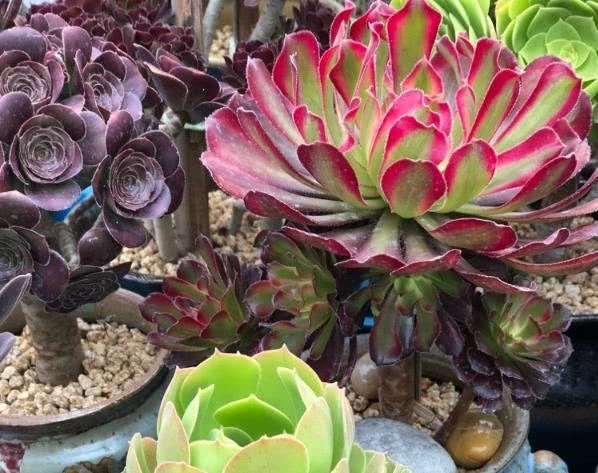
Recently a gardening friend asked: his succulent plants at home grew offsets after the start of autumn, and the leaves above were blocking them, so he did not know what to do. Generally speaking, during the spring and autumn growing seasons, most succulents have a chance to grow offsets at the base, while some stems that are already extremely old are less likely to do so. At this time, just let them grow; succulents know better than you how to handle their little offsets. Of course, for aesthetic reasons, you can also choose to keep them or not, or guide them to develop in the direction you want.
We can choose to change to a larger pot and keep it in a spot with diffused light. When the temperature is high, most succulents do not like harsh sun exposure; when planting, avoid bright, direct light. If you want to get many plants, it is recommended to pull the offsets off and insert them in soil to continue growing. Offsets with roots can be planted directly; for offsets without roots, let them dry for 1~2 days, and after the wound dries and heals, plant them in pots. For newly planted specimens, do not water too much, to avoid rot, and after new roots grow, return to normal care. In addition, when planting, note that succulents generally like a cool, semi-shaded environment, and dislike high temperature, humidity and harsh sun exposure.
The gardening friend asked: why do some succulents love to grow offsets, while others always remain solitary? For example, my Echeveria 'Xiyang' and Echeveria 'Qingshengjin' were already multi-headed when I bought them, and later the heads became more and more crowded, so in the end I had to remove them. Also, the clustering succulent Haworthia cooperi var. pilifera 'Zibao' later grew several offsets. But other succulents were single plants when bought, and afterward remained single plants, with no offsets appearing.
Succulent propagation is through small offsets growing from the roots, so it is very normal. Actually, thick-leaved rosette succulents are relatively hard to produce offsets, while others are fine. For example, normally shaking the leaves will encourage the growing point to sprout offsets. Some varieties need attention: regarding the issue of Haworthia cooperi growing offsets, if you want to get a clustering Haworthia cooperi, it is recommended not to pull them off, then change to a larger pot and keep it in a spot with diffused light. Haworthia cooperi does not like harsh sun exposure; when planting, avoid bright, direct light, and care in a diffused-light environment is enough.
For watering succulents, in summer the best time is early morning, in winter it should be done before noon on a sunny day, and in spring and autumn either morning or evening is fine. Under normal circumstances, do not pour water from the top, otherwise over time the body will have ugly spots, the hairs of hair-column types are easily soiled and matted, and water accumulating at the growing point of plants such as Haworthia cymbiformis can cause rot.
It should be noted that pond water poured on the plants easily breeds algae, making them look as if covered in moss, which is very ugly. Under normal circumstances, watering must be thorough, and for this reason the soil must be loosened often so that the potting soil can evenly absorb enough water. For winter-growing and intermediate-type plants that are growing, keep the potting soil moist but not waterlogged; water thoroughly after the soil dries, neither waterlogged nor too dry. Summer-growing types can be watered a little appropriately, but not excessively. If there is rainy weather or the temperature suddenly drops, stop watering.
This is a gathering place for succulent lovers, sharing succulent care tips; you are welcome to follow and exchange ideas.