The color of dayflowers fades easily, yet longing never shifts
Near the end of summer, one evening after dinner I took a walk near the art museum with a friend. The Dongsi area belongs to the old city; passing through dim alleys, we came to a brightly lit antique shop at the end, and we walked in. The shop was very quiet, and among the antique-style furniture there were occasionally two or three hydroponic green plants. Looking closer, they turned out to be Asiatic dayflowers! The dayflowers were kept in water bottles like cut flowers - something I had never seen before.
1.Name explained: Wild Bamboo Grass and Blue Cicada Flower
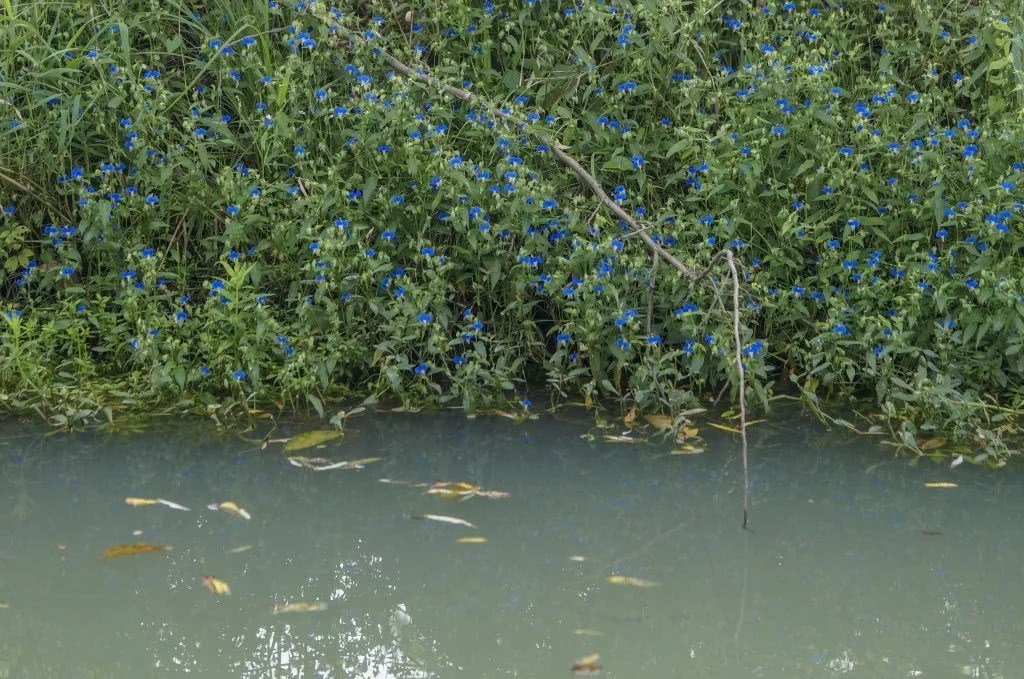
Asiatic dayflower (Commelina communis) is an annual sprawling herb in the Commelinaceae family, genus Commelina, a common wild grass from childhood in the countryside, mostly growing in waterside wetlands and blooming in summer and autumn, when no one knew what they were called. Later, looking at illustrated guides, I learned its name, but this name is truly puzzling: "zhi" [zhí] means sole of the foot, yet neither the flower nor the leaf resembles a duck's foot. One explanation says that ducks like to eat their leaves and frequent them often, and the footprints they leave on the muddy ground are somewhat similar to the leaves of the Asiatic dayflower, both resembling bamboo leaves.
Asiatic dayflower by the water
The name "Asiatic dayflower" first appears in Tang dynasty Chen Zangqi's "Supplement to the Materia Medica" [1], also called Chicken Tongue Grass, Earring Grass, and Nose-Cutting [zhuó] Grass; because its leaves resemble bamboo, it is also called Blue Bamboo, Light Bamboo Leaf, and so on. According to Xia Weiying's "Explanations of Plant Names," "duck" and "wild" and "zhi" and "bamboo" are phonetically close, so "Asiatic dayflower" is actually a corruption of "wild bamboo grass," whose original meaning is "a grass growing in fields like bamboo." [2]
Besides the above names, the Asiatic dayflower is also called Blue Cicada Flower. The "Shaanxi General Gazetteer" compiled during the Jiajing period of the Ming dynasty records its names as Cui'e Flower, Cui'e'er, and Green Butterfly, named for the shape of its flowers: two blue petals spread out like wings, and the protruding anthers and style resemble the legs and antennae of a moth. In "Complete Song Poetry" there are 27 seven-character quatrains on flowers written by Yang Xunzhai, and the first, "Blue Cicada Flower," captures its moth-like appearance:
Spreading blossoms rustling beside the sparse fence, thin wings unfold in green, poised to fly.
Several times a fair lady nearly struck them with her fan, only then knowing she had mistaken them and wasted her effort.
Names like Blue Cicada Flower and Green Butterfly are more beautiful, more vivid, and more in keeping with the small, fresh style of the Asiatic dayflower's blooms than "Asiatic dayflower," but medical books through the ages all use "Asiatic dayflower" as the entry heading, and modern plant taxonomy also uses it as the name of this family and genus.
Asiatic dayflower among rocks
2.Dyeing: sheepskin lanterns, rouge, and kimono
Although the flowers of the Asiatic dayflower are small, the two blue petals are delicate, small, and dazzlingly bright, and people in ancient times used them for dyeing very early on. The late Southern Song poet Dong Sigao [gǎo], in "Blue Cicada Flower": "Especially of one sky-and-water hue, only this recipe is known to dyers." "Compendium of Materia Medica" records: "Skilled craftsmen gather its flowers, take the juice to make painting colors (that is, pigments) and colored sheepskin lanterns, blue-green as dai." (Herbs section, volume 16) Sheepskin lanterns originated with the grassland peoples; sheepskin can shield against wind and rain, and because the skin is thin, it works well as a lantern cover and transmits light well. The blue petals of the Asiatic dayflower become patterns on sheepskin lanterns. If a candle is lit on a night cool as water, the orange-yellow glow shines through, and the blue-green on the sheepskin shade turns blue-black, just like the dai eyebrow makeup of ancient women.
Gao Lian, a famous Ming dynasty composer, in his health treatise "Eight Discourses on the Art of Living," records: "Light bamboo flower, blooms with two petals, its color the most green and blue; country people collect it with silk, and sell it for painting lanterns, using the blue and also breaking green, and so on." This shows that people of the time used silk floss to collect the flower juice to preserve the pigment.
This method was also used to make rouge, and the Asiatic dayflower is therefore also called Blue Rouge Grass. In the late Ming, the famous scholar Fang Yizhi, in "Tongya," records: "One kind is called Asiatic dayflower, that is, blue rouge grass. In Hangzhou, silk is used to dye its flowers, making rouge, for night color." (Volume 42)
The Hangzhou "night color" recorded here is a kind of silk-floss rouge. Hangzhou people soaked thin sheets of silk floss in the flower juice, waited until it fully absorbed the dye, then dried it. When it was needed later, they cut off an appropriate amount of the silk-floss rouge and soaked it in water; the resulting rouge water could be used for makeup.
The dazzling blue petals actually have one more transparent petal hidden behind the stamens
In another encyclopedic work, "Wuli Xiaozhi," Fang Yizhi also mentions this rouge: "Hangzhou night color: for red, use double-dipped rouge; for blue, use blue cicada blue rouge. Cinnabar and dqing are both heavy, and cannot be used to make night color." (Volume 6) "Double-dipped rouge" is dyed with safflower juice, and "blue cicada blue rouge" is dyed with blue cicada flower, that is, Asiatic dayflower.
According to Meng Hui's "The Imperial Consort's Red Sweat," the specific method for Hangzhou "night color" rouge is: "First soak double-dipped rouge in water to obtain a red liquid, soak white silk floss in it to make it red, then in the same way soak out the colored liquid of blue cicada blue rouge, adding blue to the red floss." [3] Red and blue blended together make purple. Cinnabar and daqing are too heavy in color and cannot be used to make night color, which shows that "night color" rouge is a slightly lighter purple.
According to the Qing dynasty writer Chen Haozi's horticultural work "Flower Mirror": "The local people use silk floss, collect its blue juice, and sell it for painting lanterns; the night color is even bluer." [4] Here "the night color is even bluer" means that "night color" rouge leans toward blue? If so, we might infer that this rouge called "night color" is a bluish light purple. This inevitably calls to mind the sky on a clear late autumn day, when the sun sets in the west and dusk rises. The ancients naming this rouge "night color" was truly subtle and romantic, and stirs the imagination.
Xuande Emperor Zhu Zhanji (1398-1435, the fifth emperor of the Ming dynasty): detail of "Five Cats" handscroll; the blue Asiatic dayflowers in the painting were probably colored with mineral pigments such as lapis lazuli, and remain vivid to this day
The technique of dyeing with Asiatic dayflower was introduced to Japan before the Tang dynasty. [5] In Japan, the Asiatic dayflower is also called dew grass and moon grass, and the color dyed from it is dew-grass color. Probably because its flowers open most fully in the early morning, and people were accustomed to picking them in the morning, with dew soaking their clothes, it was named dew grass.
Dyeing with Asiatic dayflower was quite popular in Japan, and very important. Many documents record people gathering Asiatic dayflowers to make "blue flower paper." The monk Yokoi Kinkoku (1761-1832), born in Omi Province (present-day northeastern Honshu, Japan), wrote in "Record of the Deeds of Monk Kinkoku" about the bustling local flower gathering and dyeing: "In the villages around here, in the seventh and eighth months everyone picks dew grass flowers to dye paper, and then sells it to various provinces. This is called blue flower. Since the beginning of the seventh month, even little cats have to help gather flowers, let alone the people busily leaping about?"
Illustrated Materia Medica. By Iwasaki Kanen
The famous Edo-period herbalist Iwasaki Kanen (1786-1842), in "Illustrated Materia Medica" [6], also records: "It is cultivated in Yamada Village, Kurita District, Omi, as well as in Yamato. The seedlings and leaves are large, two or three shaku tall, upright. The flowers are double those of the ordinary variety. In the early morning this flower is picked and its juice squeezed to dye paper. Dyers use it for drafts, or for lanterns and other painting tools." (Volume 17) [7]
Dyeing blue flower paper with Asiatic dayflower, like our use of silk floss to collect its blue juice, is all for storing the pigment. When it is time to use it, soaking this blue flower paper in water yields the dye liquid, just as I once soaked red paper used for writing couplets in water to obtain red ink. On this, Iwasaki Kanen's teacher Ono Ranzan (1729-1810), in "Introduction to the Compendium of Materia Medica" [8], gives a detailed record: "...(blue flower paper) when used is cut open and put into water, releasing blue juice, used to paint clothing patterns; cover it with paste, and the dye all disappears. It is also used on fan faces; although the color is vivid and beautiful, once it touches water it disappears in an instant. Used on imported sheepskin lanterns, it shines brightly in firelight." [9]
Song dynasty, Li Di (960-1279), "Autumn Flowers and Insects," now in the collection of the National Palace Museum, Taipei
This document also tells us the main reason this pigment was "used by dyers for drafts": it fades easily. Precisely because of this, in the traditional Japanese kimono dyeing method, Yuzen dyeing, the Asiatic dayflower played an important role: painters soaked blue flower paper dyed with Asiatic dayflower in water, and the resulting dye liquid was used to draw the preliminary sketch; during the formal dyeing, the traces of the sketch on the fabric faded away very easily.
This characteristic of the Asiatic dayflower was discovered and used by people very early. In the "Man'yoshu," Japan's first anthology of waka completed in the 8th century, several poems mention the Asiatic dayflower, mostly using its tendency to fade as a metaphor for a lover's fickleness. One of them says:
In the deep palace perhaps it is so; my heart is not moon grass.
Moon grass fades easily, but longing does not shift.
The dye from the Asiatic dayflower fades easily, and its flowers are delicate and fragile, with a single flower blooming for only a very short time, so its English name is Common Dayflower Herb ("Chinese Materia Medica"), that is, a flower that generally blooms for only one day. However, the overall flowering period of the Asiatic dayflower is quite long, and it seems it can bloom from late spring all the way to late autumn.
Last time at Peking University I attended a concert of Hayao Miyazaki anime music. When they played "My Neighbor Totoro," a scene flashed on the screen: Asiatic dayflowers in the rain, with their green bamboo-like leaves and blue butterfly-like flowers extremely easy to recognize. At the time I was very curious: such an ordinary wild grass, and Miyazaki actually painted them into his work? I even confirmed with my companion whether it was an Asiatic dayflower. It is said that Miyazaki's other work "The Secret World of Arrietty" also features them. It seems Miyazaki has feelings for this wild grass; he painted such an ordinary wildflower so beautifully!
"The Secret World of Arrietty"
3.Purple heart: an introduced ornamental plant in the same family and genus
Returning to the Asiatic dayflower arrangement mentioned at the beginning, on reflection, I have done something similar too, using purple heart, which happens to be in the same family and genus as the Asiatic dayflower.
The stems and leaves of "purple heart" are somewhat similar to those of the Asiatic dayflower, except the leaves are thicker and fleshy. Because the whole plant is purple, it is also called "purple dayflower." It is native to Mexico and is not included in the "Flora of China," but I have seen it on middle school campuses in the south and university campuses in the north.
Purple heart
In the ninth grade, there was a large pot of purple heart on the balcony of my homeroom teacher's home, extremely lush, blooming small purplish-red flowers. The homeroom teacher lived in the family housing building behind our dormitory, and every time I passed by there while cleaning, I would stop and look for a couple of moments. At the time, the teacher's daughter was my classmate, and she told me that purple heart could also take root and bloom in water. I was very surprised and asked her to pick a few sprigs for me. It was an early summer evening, just after the rain had cleared, with very beautiful clouds in the western sky. Before evening self-study, she walked over to my seat and quietly handed me a bunch, tied with a hair elastic and still bearing flower buds. I was especially happy and immediately ran back to the dormitory to find an empty jar to keep them in, and later they really did bloom, also growing quite a few roots. The flowers were purplish-red, with three petals, small and lovely. It is said that purple heart likes sun, and the more sunlight, the deeper the purple of the stems, leaves, and flowers, and the thicker the leaves. No wonder the homeroom teacher kept them on the south-facing balcony.
The year I retook the college entrance exam, I rented a place outside. The landlord's home also had a pot of purple heart by the door. I broke off two sprigs and put them in a glass bottle on the windowsill. After lunch, the bright autumn sun shone in through the window and fell on the purple flowers. Watching the flowers and leaves of the purple heart carefully, I felt the whole world quiet down.
Later, when I attended university in the north, the library was close to the faculty family housing, old-style residences from the 1970s and 1980s, and the open ground outside the first floor had been fenced by someone into a small garden. During those cold and hot seasons when I was writing papers in the library, I often went there for walks after dinner, and once I saw several clumps of purple heart, planted on the grassy, weed-overgrown ground outside the small garden. After many years, seeing this familiar plant again in a foreign place gave me an inexplicable surprise and an especially warm feeling. So after evening self-study, taking advantage of the dark and windy night, I secretly broke off a few sprigs and brought them back to the dormitory, and like in middle school, put them in a glass bottle, hoping they would take root and bloom small purplish-red flowers.
Autumn has arrived, and Beijing has entered the most beautiful season of the year. Asiatic dayflowers and purple heart are both still in bloom now. It is just that where I now work and live, it is hard to see Asiatic dayflowers, and I rarely see purple heart either. I write this article in commemoration.
Autumn 2018 at Puhuangyu
[1] (Qing) Wu Qijun, edited and annotated by Zhang Xianrui et al.: "Annotated Edition of Textual Research on the Names and Reality of Plants," Traditional Chinese Medicine Antiquarian Books Press, 2008 edition, p. 268.
[2] Xia Weiying: "Notes on the Explanation of Plant Names," Agriculture Press, first edition, December 1990, p. 102.
[3] Meng Hui: "The Imperial Consort's Red Sweat," Nanjing University Press, January 2011, p. 387.
[4] (Qing) Chen Haozi: "Flower Mirror," Agriculture Press, first edition, December 1962, p. 270.
[5] Zheng Juxin: "Survey of Traditional Dyeing and Printing Crafts in Zhejiang," "Literature and Art Studies," 2002, issue 1.
[6] Iwasaki Kanen's "Illustrated Materia Medica" totals 56 volumes, 92 fascicles (published 1830-1844), containing about 2000 kinds of herbaceous and woody plants, arranged according to the classification in the "Compendium of Materia Medica," illustrated throughout with color plates, exquisite and accurate, showing the characteristics of Western botanical illustration, and taking 20 years to complete. See Liu Keshen, "On Herbalism in Japan's Edo Period," "Knowledge of Medical Ancient Prose," May 15, 1998.
[7] Here "the flowers are double those of the ordinary variety" should refer to a variety of Asiatic dayflower, the large-flowered Asiatic dayflower. According to Su Zhentshu, "The West Wind Blows Open the Blue Cicada Flower" ("Southern Metropolis Daily," September 29, 2014): "And in Kusatsu, Shiga, Japan, there is still 'blue flower paper' made from a variant Asiatic dayflower. Makino Tomitaro (1862-1957), editor of 'Illustrated Flora of Japan,' like Iwasaki Kanen (1786-1842) in 'Illustrated Materia Medica,' includes two species in the genus Commelina: 'dew grass' (Asiatic dayflower) and 'large-cap flower' (large-flowered Asiatic dayflower). What has been cultivated and used for dyeing in Kusatsu since ancient times is the latter. But the nine entries listed under Commelina in the 'Flora of China' do not include this species, so it may be cultivated only in Japan." The Japanese documents mentioned in this article all come from this piece, and I thank the author here.
[8] Ono Ranzan was called "the Linnaeus of Japan" by Western scholars. Born in Kyoto, at 13 he studied herbalism under Matsuoka Joan, and at 26 founded the private school Shuhoken, beginning a 46-year career in herbal teaching. He wrote the plant illustrated catalog "Flower Collection" (eight volumes) and "Introduction to the Compendium of Materia Medica" (48 volumes). In addition, he devoted himself to organizing Chinese herbal classics, such as "Brief Survey of Insects, Plants and Trees" (Song dynasty, Zheng Qiao) and "Revised Rescue of Famine Materia Medica." "Introduction to the Compendium of Materia Medica" was compiled from Ono Ranzan's herbal lectures and is the crystallization of his research on the "Compendium of Materia Medica," first published in 1802. See Liu Keshen, "On Herbalism in Japan's Edo Period," "Knowledge of Medical Ancient Prose," May 15, 1998.
[9] Here "imported sheepskin lanterns" should be the sheepskin lanterns recorded in the "Compendium of Materia Medica." "Shines brightly in firelight" can add to our imagination of sheepskin lanterns.
About the author: Jianghan Tangtang, corporate employee / art museum public education volunteer / freelance writer, currently living in Beijing.
Text and image editing: Jiang Mouren
This work is licensed under the (CC BY-NC-ND 4.0) license
Please retain the above statement when reposting