Is an online-purchased formaldehyde meter reliable? After checking countless sources, nothing beats trying it yourself.
A couple of days ago, Fox wrote an article titled "9 Ways Japan Removes Formaldehyde,"
At the time, after the Ziroom formaldehyde apartment incident,
Mrs. Fox was badly frightened,
and kept asking: We've been having health problems for the past two years - could it be because of our rented apartment?
To be honest,
for people relying on their youth to struggle in big cities,
how could their bodies possibly be free of any sub-health issues?
Formaldehyde has become so hot in the past two years,
mostly because these health problems are hard to explain clearly.
Fox quickly promised: "Having studied home furnishings for so long,
I will definitely not let my family be harmed by home furnishings."
So the formaldehyde needed to be tested clearly,
and then we could see whether it would actually harm the family's health.
The only thing with legal effect is
a CMA-certified air quality monitoring agency,
issuing a "report stamped with the CMA seal."
The cost is generally about 300 yuan per point,
if you test 5 rooms,
that's 1500 yuan.
So what Fox had in mind was,
whether renting or buying, first use an instrument to test,
and if a problem shows up, then find an agency to issue a legally effective report.
First, the conclusion:
Fox tested formaldehyde self-test kits, an imported sensor formaldehyde meter, and a Japanese Riken formaldehyde meter,
testing the 5 most important places at home.
The conclusion reached was that "for home use,
using a several-hundred-yuan electronic formaldehyde meter
is not as good as using a several-yuan self-test kit."
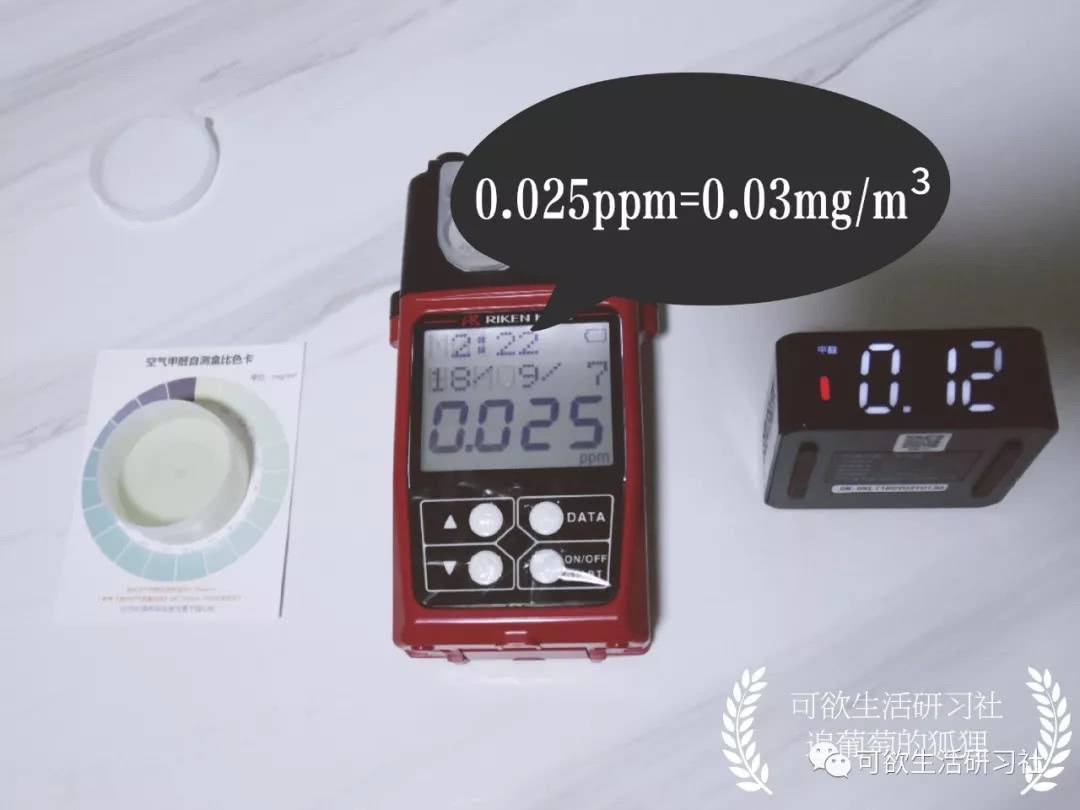
The formaldehyde monitoring devices Fox tested this time, from left to right, are:
1. CMA-certified formaldehyde self-test kit, final price 39.9 yuan for 10 boxes,
which works out to 4 yuan per box.
2. Japanese Riken FP-31, rental price 199/day,
plus consumables 40 yuan/piece x 5 pieces = 200 yuan.
(Market price 13,000; generally considered the most reliable among small formaldehyde meters)
3. UK DART sensor formaldehyde monitor,
although domestically made, the manufacturer is the only officially DART-certified partner in China,
if this machine is unreliable,
then other domestic instruments using the DART sensor,
as well as instruments using sensors inferior to DART,
need not even be mentioned.
Price 299 yuan, final price 229.
Fox originally wanted to just use the Riken and that would be enough,
after all, renting it was already not cheap.
But considering that many readers' first reaction might be to buy a formaldehyde meter,
it was a good opportunity to do a comparison test.
Fox also found that there are actually quite a few horizontal reviews of formaldehyde meters online,
and didn't want to steal the rice bowl of review agencies,
but those reviews are generally completed in laboratories,
so are they effective for the complex air environment at home?
For example, the smell of bread and alcohol in the kitchen,
the glue smell of oil-proof stickers,
will all interfere with formaldehyde meters.
After Fox tested for half an hour,
the result was that,
the Riken formaldehyde meter's result was 0.03, up to standard,
while the online-purchased formaldehyde meter's result was 0.12, not up to standard!
(The national standard is
The two results are inconsistent,
as for Fox, I would believe the Riken result,
because this Riken formaldehyde meter uses the photoelectric photometric method stipulated by the national standard,
and the self-test kit uses phenol reagent, whose principle is also largely consistent with the photoelectric photometric method.
Whereas online-purchased formaldehyde meters under 1000 basically all use semiconductor or electrochemical methods,
"neither of which is a testing method recognized by the national standard."
Next, what was tested was the study.
Some people might say,
electrochemical formaldehyde meters need to "avoid alcohol gas and gas produced by cooking,"
and once avoided, they'll be accurate.
Not to mention there are so many gases at home,
the aromatherapy essential oils at the bedside,
the snacks and mosquito repellent spray in the living room,
the deodorizer in the bathroom...
exactly how many things need to be avoided?
Secondly, there were already none of these gases in the study,
but it was still inaccurate!
Next is the secondary bedroom where the elderly live,
which is also the most important place in Fox's test this time.
The elderly have the habit of opening windows,
and the air purifier is also kept on 24 hours a day,
so no formaldehyde component was detected in this bedroom.
Looking at the earlier results, some people might still say,
although the above data are all inaccurate,
the actual data are all one-fourth of the online-purchased formaldehyde meter,
so after measuring, dividing by 4 would also work, right?
But the formaldehyde in the secondary bedroom measured with the online-purchased formaldehyde meter
was actually higher than all the previous ones!
When Fox saw this data, I was already speechless.
Next is Fox's master bedroom.
Because the formaldehyde meter must be more than 70cm above the ground when testing,
if placed on the bedside table for testing,
it may be inaccurate,
so Fox placed it on the headboard.
By the way,
before testing, doors and windows need to be tightly closed for more than 12 hours,
so strictly speaking, the earlier test with windows open was not compliant,
please do not imitate it.
The master bedroom was tested after doors and windows were properly closed for 24 hours.
The bed, bedside table, and the wardrobe next to them are all new furniture,
all using composite panels,
so it was a bit higher than the kitchen and study,
but it was not as serious as the online-purchased formaldehyde meter showing more than 2 times the standard.
The formaldehyde self-test kit couldn't fit on the headboard in the master bedroom,
so it was placed on the bedside table for measurement,
and the result was slightly higher than the formaldehyde meter's test.
To be honest, the user experience of the formaldehyde self-test kit is not particularly good,
because most of the lighting in Fox's home is orange-yellow,
there will be color differences, and the color temperature also needs to be adjusted.
In addition, visual identification will more or less have errors,
for example, the self-test kit on the right in the master bedroom,
saying it's below 0.1 works, and saying it's above 0.1 also seems reasonable,
it is exactly on the critical line of exceeding the standard,
which is a bit troublesome.
However, if you compare it with the self-test kit in the kitchen,
it is not hard to find that the kitchen is more yellow,
and it is not hard to judge that the formaldehyde in the kitchen did not exceed the standard.
This point is better than the online-purchased formaldehyde meter.
This is the self-test kit in the study.
Although the shooting light is different,
there is no way to compare the self-test kits in the kitchen and the study,
Still, it is not hard to see that the study did not exceed the limit.
In the end, Fox hesitated over whether to test the wardrobe or the living room.
Since the sealed study and kitchen were both fine,
there was certainly no need to test the living room.
So in the end, the wardrobe was tested.
In the sealed wardrobe,
as expected, the highest formaldehyde reading in the whole home came out at 0.06mg/m3.
Online-bought formaldehyde meters are not entirely useless,
at least after several tests,
each time they showed that the formaldehyde level in the wardrobe was the highest.
But when it came to whether the limit was exceeded, they always gave frightening data.
Finally, let me introduce the DART sensor used in this online-bought formaldehyde meter.
Whenever an online-bought formaldehyde meter mentions the "electrochemical method",
it must use an electrochemical sensor,
and the best-known electrochemical sensor at present is the British DART.
The official retail price of the DART sensor is 150 yuan,
(wholesale is certainly a bit lower),
so formaldehyde meters using this kind of sensor generally have an official price of around 300.
It is just that, in China, the DART sensor is currently somewhat over-mythologised,
in fact the Chinese market accounts for more than half of DART's sales,
so internationally it really does not have that kind of status.
Of course,
although Fox's test this time strictly followed the testing principles of the national standard,
it was "not a strict laboratory test",
and it does not mean that other online-bought formaldehyde meters using similar sensors will all produce the same results.
The above results are for everyone's reference only,
and readers are also welcome to share reliable formaldehyde monitoring methods.
In short,
the result of Fox's monitoring this time is that the formaldehyde at home did not exceed the limit,
and I also wish everyone, like Fox, "only a false alarm",
not fooled by unreliable online-bought formaldehyde meters,
and then spending a large amount of money and effort on formaldehyde removal products.
This article is original by Keyu Life Study Community,
please indicate the source when reposting.
Follow Keyu Life Study Community,
to learn more storage tips and Japanese-style lifestyle proposals.
Fox will subsequently share the several formaldehyde testing products used this time
on the Keyu Life mini-program.
What other formaldehyde testing or formaldehyde removal products do you know, and are they effective?
You are welcome to click on the Keyu Life mini-program,
to take part in shopping cart exchange and share and discuss together.