Prune with a firm hand: one branch can bear 10 flowers, and a full, bursting pot is not hard to achieve
Camellia
Cut away overly dense branches
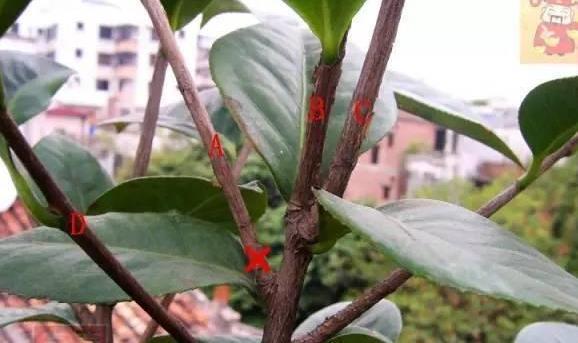
▼The spacing between branch A and branches B and D is fairly tight, so consider cutting away branch A. Branches B and C run parallel and close together, so consider cutting away one of them.
▼The branches at the top are very dense, so consider cutting away some of them; the x marks show where to prune. Keep the cut as close to the node as possible.
After pruning
Garden shears, specially for cutting thick branches. Try not to use ordinary household scissors; they not only blister your hands but also leave an oversized cut, which affects later healing. Cut away dead or diseased branches
▼The terminal bud is dead, so cut back the branch: first, this conserves nutrients and reduces wasteful consumption; second, it frees up space for the later growth of branches. The positions shown by the double arrows are where to cut back.
Before-and-after pruning comparison
Cut away the low-hanging branches
▼A and B are low-hanging branches and are weaker in vigour (than branch C); leaving them would consume too much of the plant's nutrients, so they should be cut away. Keep the cut as close to the node as possible.
▼The parts marked with a red x are also low-hanging branches and are weaker in vigour (than branches A and B); leaving them would consume too much of the plant's nutrients, so they should be cut away.
Cut away overlapping branches
▼Overlapping young shoots sprouting on the main trunk can be cut away to conserve nutrients and reduce wasteful consumption. The parts marked with a red x show where to prune. You can prune at the positions shown by the double arrows.
▼The denser branches at the top can be thinned out; the branches marked with a red x show where to prune; the arrow points to an axillary bud, which should also be removed.
Before-and-after pruning comparison
▼Leaf buds that cannot grow normally should be cut away; the positions shown by the double arrows are where to prune.
▼Leaf buds growing downward or sideways should be removed; the leaf bud shown by the arrow is growing downward and cannot receive enough light, so it can be cut away directly.
▼The arrow points to a lateral (secondary) bud, which should be removed; if buds are not removed in time, parallel, thin, weak branches will grow.
If they are not removed, they will eventually grow into what is shown below: the thinner, weaker one on the left is the branch grown from the lateral bud, while the stronger one is the branch grown from the main bud. At this point, the thin, weak branch on the left should also be removed. The lateral buds on the strong branch should also be removed.
Before-and-after pruning comparison
▼Overlapping horizontal buds after flowering should be cut away, namely the bud the arrow is pointing to.
▼Branch A is a short branch that bore flowers that year; keeping it after flowering would consume too much of the plant's nutrients, so it should be cut away. The branches marked with a red x show where to prune. The arrow points to an axillary bud, which should be removed.
Gardenia
Many gardeners do not prune the gardenias they grow, thinking natural growth is best. If you do not prune, first, the tree shape is unattractive and it tends to grow leggy; second, the branches are not thick or strong, so no matter how you prune later they cannot support the plant; third, there will be very few flower buds the next year; fourth, pruning is what forces the lower branches to mature, and only mature branches will form buds, so there will be more flower buds the next year. So pruning is very important.
Pruning gardenias is very important; here is a step-by-step guide on how to do it
As shown:
① Small-leaf gardenia
② Large-leaf gardenia
Thin out branches and cut away weak ones
The small buds on both sides of the flower bud will compete with the flower bud for nutrients, so they can be cut away as appropriate.
Cut away spent flowers. When pruning, do not just pick off the spent flower; you can cut from the second node below the flower.
The small buds on either side of the flower bud are best cut away before the flower bud opens; if you forget to prune, you can also cut them when you cut the spent flowers.