If a succulent does not grow or send out roots after planting, it has to do with the soil
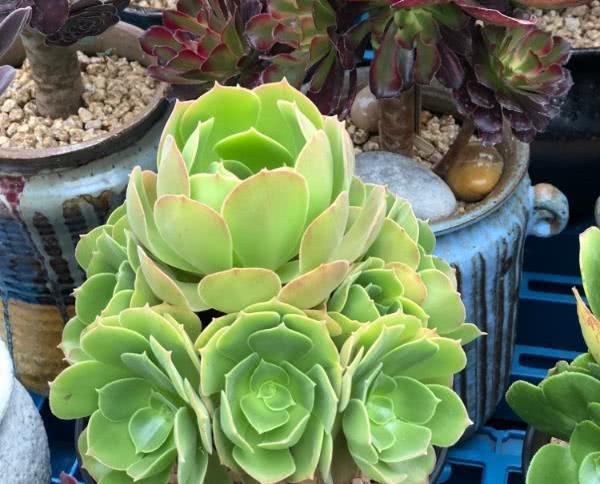
Many flower lovers have said that their succulents withered not long after being potted, with no sign of settling in. Even more puzzling is that such succulents had already put out small white roots, yet showed no sign of gripping the soil. So what exactly is causing succulents to delay gripping the soil and not grow?
It may be that the surface soil particles are too large. This creates too much space between particles, so they cannot fit tightly against the succulent's roots, preventing the succulent from gripping the soil. Another issue is the care environment. A freshly potted succulent is actually not suited to being placed directly in an outdoor growing environment, because an outdoor environment has good air circulation and the surface soil tends to stay dry. This dry state is unfavorable for a shallow-rooted succulent that has not yet settled in.
Generally, after potting a succulent, wait at least a week before watering. Water until water flows out from the bottom. The first time, you can also water a little less, watering along one edge until water flows out. When watering, do not be too rough, and do not let the surface soil wash away. After that, water again when the potting soil is almost completely dry. If it is not a rare variety, you can water 2-3 days after the surface soil is completely dry.
For a normally growing succulent, in summer with good ventilation and good shade, the vast majority of varieties can tolerate temperatures below 45 degrees, and a few cactus types can reach 60 degrees. In winter, it is best to keep them above 5 degrees. Generally, staying above 0 degrees is no problem. Never let them go below -2 degrees. At the same time, if the temperature is below 5 degrees, they must be moved indoors and not exposed to cold wind from outside. Once wind blows and moisture evaporates, heat is lost, and the plant will freeze and be damaged.
As for succulent pots, an open-mouthed pot itself is not bad. It is just that in a windy, coarse-particle outdoor environment, when the succulent's roots are relatively shallow, using an open-mouthed pot will speed up the drying of the surface soil, making it very hard for the succulent to grip the soil. As for the type of pot, it depends on your own preference, but the size must be suitable. In principle, a pot with a diameter about 2-3 cm larger than the diameter of the succulent is enough. For tree-shaped succulents.
It is best to first lay some large-particle stones at the bottom of the pot, or tear foam board into small pieces and put them in. If the hole in the pot is relatively large and you are afraid of soil leaking out, lay a piece of window screen mesh over the hole, then add soil. When planting a succulent, be sure to use a granular soil suitable for succulents to secure the succulent firmly before top-dressing it. The top dressing does not have to be thick; as long as it can hold up the succulent's leaves and separate them from the moist soil below, that is enough.
This is a gathering place for succulent lovers, sharing succulent care tips. Welcome to follow and exchange ideas.