It looks strikingly like a wildcat, is commonly known as the "night wanderer," contains a valuable fragrance material, and farmed specimens sell for 600 yuan each.
I remember that as a child in the countryside, I often went up into the hills to play, and back then you could occasionally still see small animals like wild rabbits and wild pheasants. Living conditions in the countryside were not so good then, so the adults would often go into the hills to hunt some wild game and bring it back to eat, and wild rabbits, wild pheasants and the like became the targets. Of course, besides these wild animals, there were plenty of other wild animals too, but not all of them could be eaten; some wild animals had other value and were nationally protected animals.
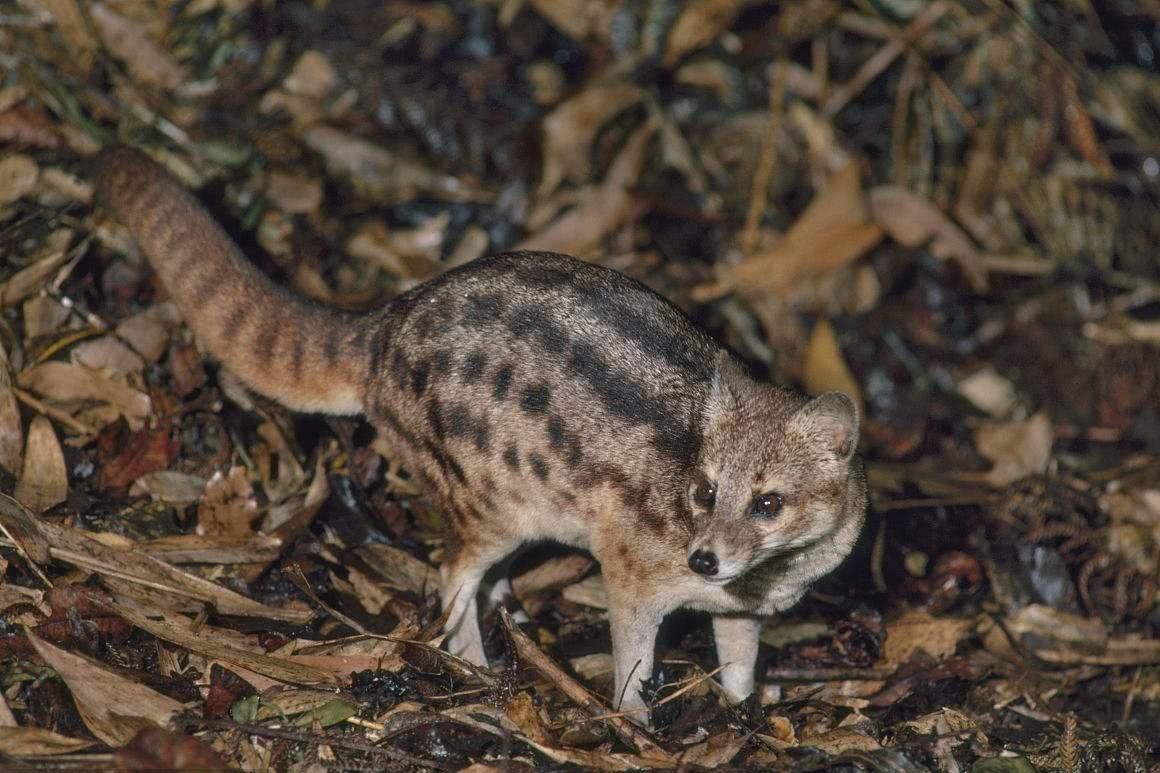
Today I will introduce one kind of wild animal, and that is the small Indian civet. The small Indian civet looks somewhat like a wildcat. During the day, to avoid human activity, it always hides in tree hollows or caves to rest, and at night or in the middle of the night it begins to come out foraging, so among the people it is also called the "night wanderer." The small Indian civet usually eats rats, termites and similar insects in the mountain forests, and sometimes also eats wild fruit from the trees. What draws the most attention is its long tail, which can reach half the length of its body, and most importantly, the small Indian civet has scent glands on its body that can be refined into a valuable fragrance material. It is precisely because of the scent glands on the small Indian civet that people began to pay attention to it.
The small Indian civet likes to live in a clean, hygienic environment, so it always likes to leave scent in its own territory to indicate that this is its domain. The civet musk unique to the small Indian civet is a very precious fragrance material. In order to obtain this fragrance material, people began to hunt and kill small Indian civets on a large scale, and now wild small Indian civets are very hard to see again. Later, scientists successfully domesticated the small Indian civet, that is, farming it artificially, and now the small Indian civets we see all come from artificial breeding.
People farm small Indian civets in order to obtain civet musk, but the yield of civet musk is very low; one small Indian civet produces about 30 grams of musk per year, so the price is also very expensive, and it is sold by the gram, with one gram costing several hundred or even over a thousand. Civet musk is mainly used as a medicinal ingredient, and secondly for industrial purposes such as making high-end perfumes. At present, some farmers in our country are farming small Indian civets, with one priced at around 600 yuan; if it is a breeding cat, the price is even higher, 4000 yuan to 8000 yuan per pair. Although civet musk is very expensive, farming carries risks; the farming of small Indian civets and the process of extracting the musk are cumbersome, and without experience it is not recommended to farm them on a large scale.
Besides civet musk, the small Indian civet's fur is also a very good fur material. This animal really can be considered to be covered in treasures from head to toe. Have you all ever seen a small Indian civet? If you see a wild small Indian civet, please do not disturb it; it is a national second-class protected animal and needs our careful protection.