Choose the right soil mix for succulents and they will root and sprout quickly
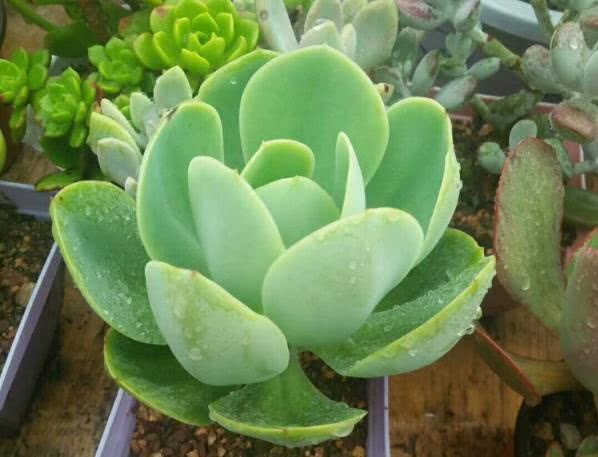
Every beginner who has just started growing succulents always wants to find the most perfect or ideal succulent soil mix. In fact, there is no such thing as the most perfect soil mix, only the one that suits you best. As long as it is loose and breathable, drains well, has a certain crumb structure and is sterile, it will generally be suitable for succulent growth. Of course, different varieties of succulents have slightly different requirements for soil mixes, but as long as you grasp the main principles, there generally will not be much of a problem.
Soil mix for mesemb succulents: The soil for mesembs is similar to that for sedums. If conditions allow, the proportion of coarse sand can be appropriately increased to 20%, to recreate the soil conditions of their native habitat. A general mix is 20% peat + 30% coarse sand + 50% granules. Pumice is a high-quality growing medium that is breathable and water-retentive, and it can also effectively prevent the soil mix from compacting. Of course, its good water-absorbing effect also ensures the moisture the plants need.
You can choose coarse sand from river sand. Coarse sand is generally used in a relatively large proportion, and a size between 3-5mm is most suitable. According to some experienced experts, when river sand makes up more than 50% of the mix, the succulents grown turn out superb (lower cost, but greater hardness). For small succulent seedlings and leaf-propagated succulents, vermiculite-based growing soil is generally better, with good water permeability and breathability and sufficient nutrients. Succulents generally like light, so placing them in a bright, well-ventilated spot on a balcony is fine. They are very drought-tolerant and need little watering, and they fear waterlogging.
Diatomite is an excellent soil mix improver and can have a very good moisture-retaining and water-retaining effect in potting soil. Its pH is mainly neutral, and it can also promote the growth of succulents (moreover, the physical and adsorption properties of diatomite can also help plants kill pests in the potting soil).
In soil mixes for Haworthia, apart from Haworthia cooperi, Haworthia maughanii, Haworthia retusa and Haworthia truncata, which get 10-20% peat soil added during the seedling stage, the soil used for Haworthia maughanii, Haworthia retusa and Haworthia truncata is all granular soil, and the granules can be varied. Generally 3-5 kinds are used, and the ratio can be 1:1:1. The granules cannot all be large granules; large and small granules need to be mixed together. The smaller the seedling, the smaller the granules that can be used. The granules can be any several of akadama, green zeolite, hyuga pumice, volcanic rock... But two things must be added, and they are carbon granules and slow-release fertilizer.
The most money-saving and simplest soil mix solution is undoubtedly coconut coir plus perlite. Coconut coir bricks are all pretty much the same coconut coir bricks, and perlite is more or less the same stuff too, so just go for the cheapest. When mixing, a ratio of coconut coir to perlite of about 2:1 to 3:1 is fine, because perlite itself does not retain water very strongly, and this ratio is already breathable enough. If the ratio reaches 1:1, this problem will appear: the compatibility between perlite and coconut coir is not good enough, and a large amount of perlite will float to the surface after watering.
This is a gathering place for succulent lovers, sharing succulent care tips. Welcome to follow and exchange ideas.