This fire became the second death they were forced to endure
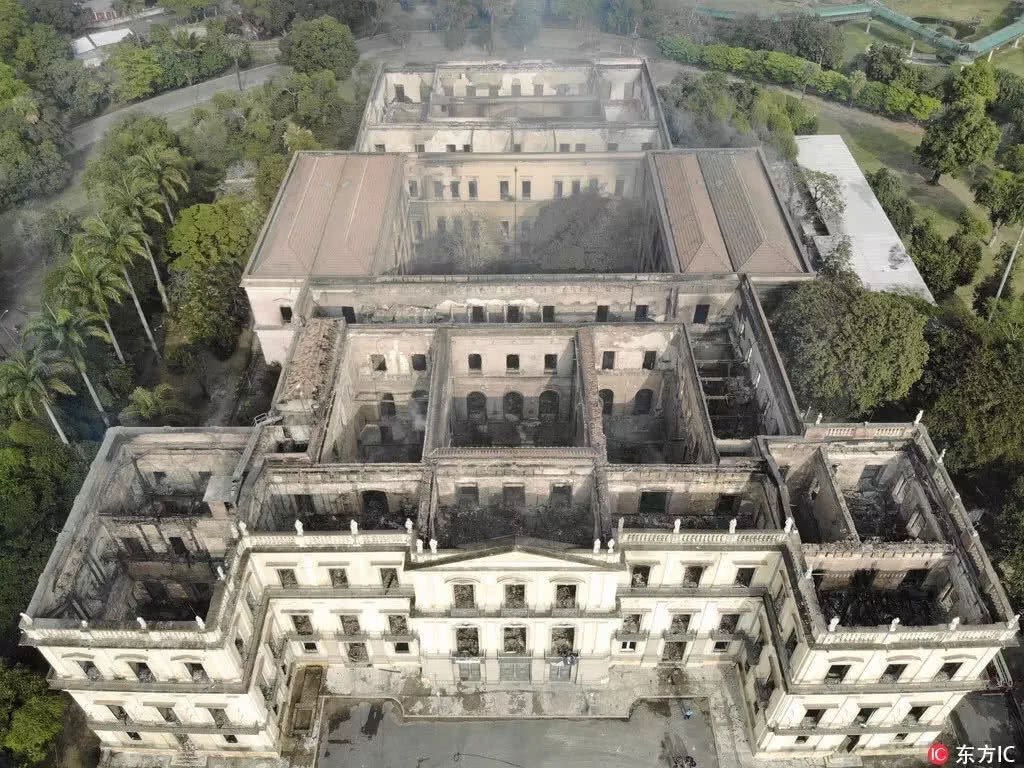
A fire in Brazil has touched the hearts of countless scientists and natural history enthusiasts - the blaze that broke out on Sunday night consumedthe National Museum of Brazilalmost the entire collection of the main building,20 million specimens reduced to ashes, including a large number of type specimens.
This was once the largest insect specimen collection in South America, and now only ruins remain. Many grief-stricken researchers say the disaster reminds them of the Library of Alexandria - built in the 3rd century BC, once the largest library in the world, it was destroyed in two fires.
The National Museum of Brazil after the fire. Image: Oriental IC
Beyond display, what can museums do
Museums are not just institutions that display collections; they are also important centers for academic collection and research.
What museums open to the public is only the tip of the iceberg,the backstage with massive collections is the real treasure trove. In museums with long histories, the storerooms hold vast collections and research materials accumulated by generations of scientists over hundreds of years.
A corner of the invertebrate specimen storeroom at the National Museum of Natural History in the United States. Image: Shenshan Chongyin
People often think that those who discover new species are all field explorers, but that is not the case. In fact, many new species are born among old specimens in museums.
However, the number of specimens a scientist can study in a lifetime is limited, and museums have large numbers of precious specimens in their storerooms that have not yet been studied. Especially in this era of rapid species extinction,the traces of many unknown species' existence on this planet may survive only in some museum storeroom; in addition, past research was limited by technical means and often classified multiple species as one, thus creating "cryptic species." When today's researchers use the most advanced technology to re-study old specimens, they often make different discoveries each time.
These wren [jiāo liáo] specimens were once identified as the same species, but new research split them into two. Image: Shenshan Chongyin
Among all biological specimens, the most precious and irreplaceable aretype specimens, and this is also the most devastating aspect of the loss at the National Museum of Brazil.
What is a type specimen
Regarding type specimens, everything begins with the system of species naming and research methods we have built over centuries.
When scientists discover a new species, one or severalmost typicalspecimen individuals are selected as type specimens, becomingthe objective carrier of the scientific name, that is, the "name-bearing type." If it is later found that they are actually more than one species (such as the earlier batch of wrens), the species of the type specimen remains unchanged, while those different from it receive new scientific names and new type specimens are established.
The single type specimen used by researchers when describing a new species is calledthe holotype, and it is the most important and irreplaceable; if there are multiple type specimens, one of them is selected as the holotype and the rest are paratypes. Unlike the holotype, paratypes are not name-bearing types and are less important than the holotype.
The holotype of a certain species of boots butterfly (Agrias phalcidon phalcidon); generally holotypes have a red label marked "Type," while paratypes have yellow labels. Image: Notafly / wikmedia
In addition, there are some special specimens, such as allotypes (specimens of the opposite sex used together with the holotype in describing a new species), syntypes (when a new species is published, not a single specimen but a series of specimens is used, often occurring before standardized type specimen rules were established), and so on.
In many cases, newly discovered species are so rare that there is only one specimen - this is especially common with paleontological fossils - so that specimen naturally becomes the holotype, even if it is incomplete.
The incomplete type specimen of Parasaurolophus walkeri. Image: missbossy / wikmedia
The importance of type specimens is difficult to replace; they are the carriers of scientific names, the"without a doubt this species"specimens, and the identification characteristics of the species must be based on the type specimens.
If one wants to publish a new species, one must first review the holotypes of known species in that group to ensure that the new species has indeed not been described before. Some researchers with less rigorous practices have published new species without checking the holotypes, bringing considerable confusion and errors to academia.
Type specimens are the most important treasures among museum biological collections,receiving the best preservation conditions, open only to specific personnel, and generally not lent out. If someone wants to conduct taxonomic research or revision of a certain group, they often have to go examine the type specimens, even if it means crossing oceans. Well-known museums that preserve large numbers of precious type specimens, such as the Natural History Museum in London and the National Museum of Natural History in the United States, receive many researchers every year who come to examine type specimens.
Specimens collected by James Bond (the source of the name of the 007 protagonist) and his academic work "Birds of the West Indies." Image: Shenshan Chongyin
Irreparable loss
If people find that a new specimen A differs from specimen B of a known similar species, is it a new species? Or is specimen A the true appearance of this species, while specimen B was misidentified (especially common with old specimens), or even B is the hidden new species? Previously, after checking the type specimens, this problem could be readily solved. But now, the difficulty has greatly increased.
The reduction of large numbers of type specimens to ashes is undoubtedly a disaster for scholars studying biological taxonomy.
The brown woolly spider monkey (Brachyteles arachnoides), endemic to Brazil. Image: National Museum of Brazil
So, have we really lost all knowledge of these species and the ability to identify them?
There are still some remedial methods.
Researchers need to carefully and rigorously review written records and select a neotype from surviving specimens of the same species. Selecting a neotype is a very strict and troublesome process, and it is uncertain how long it will take to clean up the mess this fire has left for academia.
For common species that have been thoroughly studied and have large specimen holdings, this step is relatively manageable. But for extremely rare species with very few surviving specimens, or even only one, the loss is difficult to repair -those specimens were damaged before research even began, and the knowledge related to them will forever disappear into the darkness。
The scene of the fire. Image: Oriental IC
This is the second death forced upon them
Spinosaurus aegyptiacus was one of the largest terrestrial carnivores ever to walk the Earth, a star that drew worldwide attention, and its holotype previously kept in Munich was destroyed during World War II. But Spinosaurus aegyptiacus was also fortunate. Researchers successively sought new proof of its existence, and its specimens received enough attention before being destroyed, which allowed illustrators to leave accurate portraits of it.
However, this time, the holotype of Oxalaia sp., a close relative of Spinosaurus aegyptiacus, has very likely been swallowed by the flames along with other precious fossils. The tragic protagonists also include 5 million "neglected majority" insects and other arthropods.
A painting of the holotype specimen of Spinosaurus aegyptiacus. Image: Ernst Stromer / wikmedia
Now, the National Museum of Brazil is seeking photos from visitors to help them carry out reconstruction work.
It is certain that for the vast majority of specimens in the storerooms, no one ever photographed or painted them, or even had time to study them. Some species may not yet have been discovered, while the habitats of their wild populations have already been leveled along with the tropical rainforest, turned into rubber plantations, mines, or luxury homes. The proof that they existed has dissipated with the smoke,forced to accept a second death。
This disaster occurred in Brazil - a country with extremely high biodiversity and an extremely fast rate of rainforest loss - destroying research materials accumulated over a century. This is a catastrophe for all human knowledge.
"200 years of history, 20 million collections, reduced to ashes." Image: Lu Brito / wikmedia
After this fire, people may pay more attention to the digitization of museum collections. But for biological specimens,digitization still cannot replace the physical objects. Photos cannot reflect all the details of specimens, and many museum specimens, especially the vast sea of invertebrate specimens, are difficult for ordinary equipment to photograph and record; even photos taken with expensive microphotography equipment cannot replace the physical objects.
This is even more true for this museum, which has been abandoned by the local government and does not even have the money to repair its firefighting equipment.
Digitization is only the icing on the cake; it cannot save museums. What can truly save all of this is government and social support for academic institutions that appear to produce no direct profit, and humanity's desire for and respect for knowledge.
This article is a commissioned manuscript for Species Calendar, from Species Calendar author @Shenshan Chongyin.
You may also want to know
Calendar Lady's avatar today
The National Museum of Brazil before the fire