Both pothos and Christmas cactus have growth points, and once activated, they grow more and more vigorously.
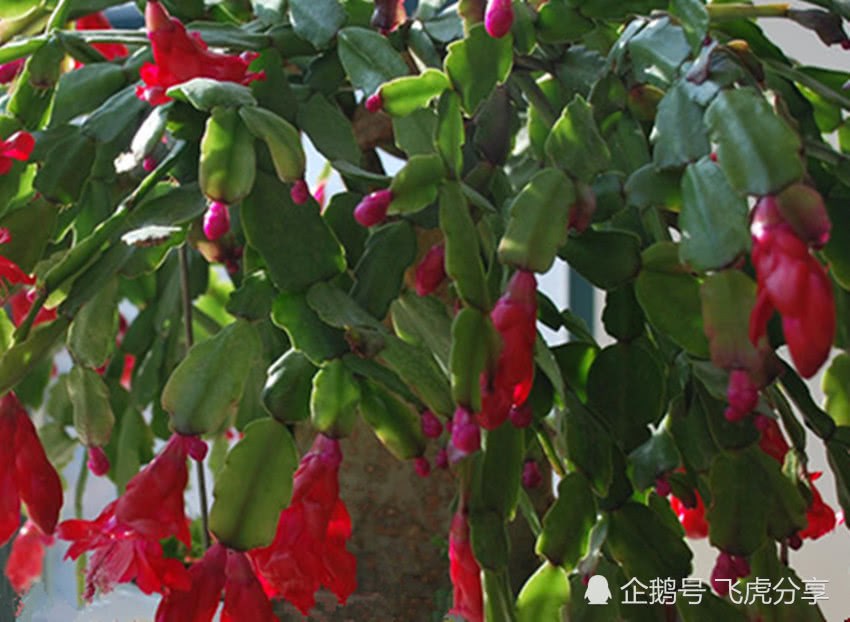
Many flower enthusiasts have grown pothos and Christmas cactus, but some enthusiasts always say they grow slowly, with thin leaves, small leaves, and even yellowing. Truly experienced enthusiasts know that pothos and Christmas cactus are different from other flowers and plants. They are born with a growth point, and it is this innate growth point that gives them vigorous growth power. But many people may not have noticed this growth point; some simply do not know about it at all, and some do not take it seriously at all.
Careful growers may notice that on the vines of pothos, near the leaves, there are more or less fine hairs. And on each stem segment of the Christmas cactus, there are also many small fine hairs, but these fine hairs are not ordinary fine hairs. They are actually their growing roots, called aerial roots. Do not underestimate these tiny roots; they play a key role in the plant's growth. Normally, these aerial roots rely on absorbing moisture and nutrients from the air to sustain the growth of the branches and leaves. Once the environment becomes dry, they can only rely on the main roots in the soil to supply water and nutrients to the branches and leaves, and the aerial roots will dry out and shrink. Therefore, activating the aerial roots is the most effective way to promote rapid growth of pothos and Christmas cactus and make the leaves larger and thicker.
So how can they be activated? Actually, the method is very simple. In daily care, you can use a spray bottle every few days to spray water on the branches and leaves to maintain a moist air environment so that the aerial roots can absorb enough water and nutrients. When spraying, you can first add a few granules of granular fertilizer or liquid fertilizer, etc., to the water. Do not add too much; just a little is enough. Over time, you will find that the aerial roots on the branches gradually become longer, thicker, and more numerous, the branches grow much faster than before, and the leaves also become larger and thicker than before.
Well, after reading the above introduction, I believe everyone knows now. Therefore, when growing flowers, you must learn to observe carefully. At the beginning, do not be afraid of not growing them well; what is really feared is not being careful. Growing flowers is actually not difficult. As long as you are good at observing, learn more, look more, and ask more, there is no problem that cannot be solved.