Companioned by pale scree and icy white snow, it blooms alone and proud
About the author: Ye Zhengrong, a student at Shandong Agricultural University, passionate about nature observation, with knowledge of identifying insects, birds, plants, and mosses. Of course, he loves growing flowers most of all. Personal WeChat public account: This Realm of Nature
On the day the Angsai Nature Observation Festival was nearing its end (July 23? The draft was delayed so long I have forgotten), we decided to go look for plants on the scree slope. In the car, we started talking about the beauty of this scree slope - Delphinium tangkulaense.
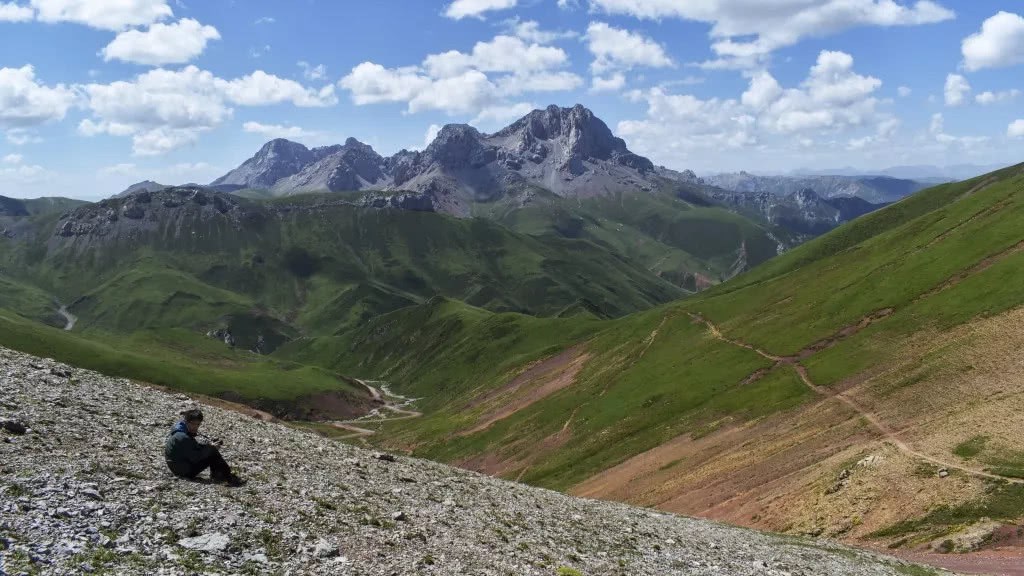
Looking up from the scree slope into the distance, there seemed to be little sign of life.
That is me
At an altitude of over 4,000, plus the steep mountain slope, the climb was especially difficult. What was gratifying was that all kinds of plateau flowers were scattered among the rocks, including star plants of the scree slope such as snow lotus and Arenaria.
Only near the summit at almost 5,000 did we encounter Delphinium tangkulaense, the ice and snow fairy of the scree slope.
This was my first time seeing this flower. The plant grew close to the ground from among the stiff, cold rocks, sending out small emerald-green, fan-shaped leaves.
In my impression, garden delphiniums and delphiniums from lower elevations all have deep blue flowers arranged in many-flowered inflorescences. But Delphinium tangkulaense is an oddity in the family: a single flower stalk bears one huge flower, the front of the flower pure white, matching the surrounding scree. The back of the flower is full of blue-purple veins, and perhaps this is where its enchanting temperament lies.
The general appearance of low-elevation delphinium, blue, with long inflorescences
Delphinium tangkulaense, large flowers, one branch standing alone
If there is anything that truly gives it the most characteristic feature of the delphinium family, it is the long spur extending from the upper sepal. This spur was already present when it was still a bud. Do you think a bud dragging a long spur looks just like a big tadpole?
Besides its high beauty, what also caught my attention was the structure at the center of the flower - the petals. Do not misunderstand, the blue-white parts are not petals, but sepals. The shape and color of the petals are very interesting, much like a bumblebee gathering nectar.
Do the furry petals not look very much like a bumblebee?
The low temperatures on the plateau can no longer allow honeybees to survive, so the important task of gathering nectar and pollinating is left to bumblebees. Even at an altitude of more than 5,000, their figures can still be found. Delphinium tangkulaense is also not like some orchids that rely on the trick of getting something for nothing to deceive insects' trust. In the spur there is nectar to reward the pollinating bumblebees.
The peculiar structure of the petals may perhaps be a conspicuous signal telling bumblebees that there is nectar inside.
The spur is full of nectar
Only when we went down the mountain by another path did we discover that, although only twenty meters away, the roadside was covered with Delphinium tangkulaense.
They keep company with pale scree and icy white snow, one branch standing alone, proudly blooming in the rocky wilderness, giving people a sense of solitary loneliness. But one should also feel fortunate that such a harsh environment means no one will come to intrude and take their lives; only admirers like us come to seek their beautiful figures.
Author: Ye Zhengrong
Images: Ye Zhengrong
This work is licensed under the (CC BY-NC-ND 4.0) license agreement
Please retain the above statement when reposting