Should a TV really be mounted on the wall? Someone with experience sums up 6 practical tips
In the internet age, we always need a network to keep our lives connected. Phones need a network to receive notifications, computers need a network to work, and even TVs need a network, so they can be competitive and have a market.
That's right, basically all modern appliances need a network. Huahua has heard that the future will enter the AI era, and what the AI era cannot do without most is still the network. Ever since the TV at home got the ability to connect to the internet, many videos that could only be watched on a computer can now also be watched on the TV. It really is very convenient!
As an essential appliance at home, even if it is not usually used, a TV placed in the living room still looks the part. No wonder people in the past always insisted when getting married that the man's family must have a TV.
Older TVs had a thick bulky shell and looked clumsy and heavy. Now our TVs not only pursue ultra-thin designs, but can also be mounted on the wall. The earliest TVs were black and white, with obvious snow-like static on the screen. Today's TVs are not only in color and high definition, but have also been made smart enough to connect to the internet.
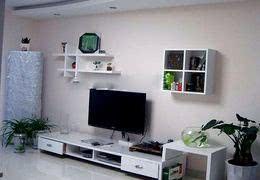
Many friends encounter a problem when buying a TV and renovating: is it better to mount the TV on the wall, or place it on a TV cabinet? On this question, Huahua, in the spirit of helping everyone out, offers a few immature suggestions:
1. Mounting the TV on the wall makes the whole living room look clean and tidy. It is best to have a TV wall in a suitable style, and the effect will be even better.
2. Mounting the TV on the wall usually requires drilling holes and inserting anchors into the wall. If the layout at home needs to be changed, the drilled spots will need something to cover them up.
3. Wall-mounted TVs also require considering safety. The safety hazard of the TV falling off the wall cannot be ruled out, especially in homes with children who like to play around. If it really falls, it could hit a child. Even if it does not hit a child, falling to the floor will also damage the TV.
4. A TV placed on a TV cabinet also requires buying a TV cabinet as support, which can also be considered added value.
5. A freestanding TV is easy to move, and renovations or modifications are all very convenient.
6. There will be many cables for the TV power cord or other set-top boxes, and mounting it on the wall inevitably looks less attractive. A TV placed on a TV cabinet is much better; if organized well and hidden behind the TV, it will look much tidier.
All right, Huahua has given these few suggestions. Overall, wall-mounted and freestanding TVs each have their own advantages. Comparatively speaking, a freestanding TV will be a bit higher than a wall-mounted TV in both safety and stability.
Compared with freestanding models, wall-mounted ones look more modern and smarter. Both have their own advantages, and I hope everyone considers it carefully.