The eight most poisonous plants in the world - keep your distance if you see them
They say the more beautiful something is, the more poisonous it is, and the same goes for plants. Today we will introduce the eight most poisonous plants in the world.
1. Castor bean
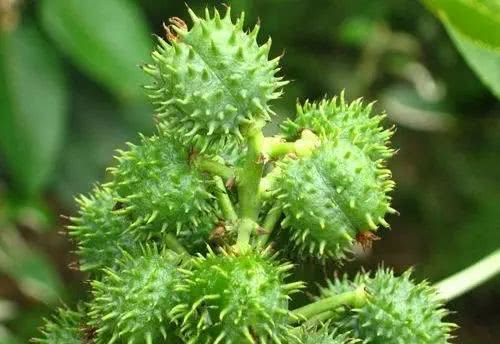
The castor bean plant, or castor oil plant, is a widely cultivated plant from which castor oil can be extracted, and it can also be grown as an ornamental plant. Neither of these uses would ever lead you to conclude that this plant contains a deadly component: ricin.
The ricin content in castor beans is relatively low, and it is mainly concentrated in the seed coat. Seed poisoning is rare; sometimes children or animals come into contact with it, and once they do, it can be fatal. Its seeds are brownish green, and just three seeds are enough to kill a child who swallows them.
2. Gelsemium elegans
Gelsemium elegans has small yellow flowers that are particularly fresh and elegant, similar to honeysuckle, and many people mistake it for honeysuckle and end up poisoned.
The whole plant is highly toxic, with the roots and young leaves being especially toxic. This plant has been listed as a toxic drug in Chinese materia medica through the ages, extremely poisonous and able to cause rapid death. It is generally not used medicinally, but some regions still use it to treat difficult conditions such as rheumatic arthralgia.
3. Rosary pea
The rosary pea, also known as love bean or jequirity bean, is a poisonous plant in the genus Abrus of the legume family, distributed throughout the tropics. The seeds it produces are very beautiful, oval in shape, with two-thirds of the seed red and the top one-third black. The seeds can be used for decorative purposes and are often made into jewelry, loved by many people.
The seeds of the rosary pea contain a protein called abrin, which is highly toxic. If eaten by mistake, it causes poisoning, and in severe cases can even be fatal.
4. Oleander
Oleander is a small shrub, with many branches on the main stem and twigs, and the smallest twigs are green. Oleander flowers are fragrant. The flowers grow concentrated at the tips of the branches, clustered together like an open umbrella. The shape of the oleander flower is like a funnel, with overlapping petals, in two colors, red and white. Among them, red is its natural color, while "white" is a new variety created through long-term artificial cultivation.
Oleander's poison is so powerful that in fact, even people who eat honey made by bees that have collected oleander flowers can be poisoned. Oleander is an attractive plant, and despite its deadly reputation, people still like to grow it for decorative purposes.
5. Datura
Datura is also called mandala. It is an herbaceous plant, 1-2 m tall, with an upright stem and oval leaves. It blooms in summer, with tubular flowers and funnel-shaped corollas.
The whole datura plant is poisonous, with the fruit and especially the seeds being the most toxic, followed by the young leaves; dried leaves are less toxic than fresh leaves. Datura poisoning generally shows symptoms half an hour after eating, as quickly as 20 minutes, and no later than 3 hours, with symptoms mostly disappearing or basically disappearing within 24 hours. In severe cases, after 24 h the person enters a state of stupor, convulsions and cyanosis, and finally falls into a coma and dies.
6. Water hemlock
Water hemlock is an upright-growing wild plant with small white flowers that are beautiful and alluring, and purple streaks on the leaves. The roots of water hemlock are white, and sometimes people mistake it for parsnip because of this. In fact, it is listed by the United States Department of Agriculture as "the most toxic plant in North America."
Water hemlock contains cicutoxin, a toxin that can destroy the central nervous system. Water hemlock averages 0.6 to 1.3 m in height and can grow to 1.8 m tall. It has an unpleasant smell, is poisonous, and its toxicity is even greater than that of poison hemlock.
7. White snakeroot
White snakeroot is a poisonous plant that grows in the grasslands and pastures of North America, and one of the most poisonous plants in the world. Every part of it contains tremetol (an unsaturated alcohol that can cause muscle tremors in livestock and ultimately kill them). When animals eat this plant, for example when cattle eat it, it can trigger a disease called "trembles." Drinking milk from cows that have eaten white snakeroot can cause fatal "milk sickness." Nancy Hanks, the mother of former U.S. President Lincoln, died of this disease.
8. Sea mango tree
The sea mango tree is a plant that grows in the southwestern region of India. Its fruit is highly toxic, and this fruit is often used as a tool for suicide, so this tree is also called the "suicide tree." When it blooms, its flowers have white petals and give off a jasmine scent. The sea mango fruit is green and looks like a small mango, so many children, seeing sea mango fruit for the first time, mistake it for a mango and eat it, ultimately dying as a result.