I have plenty of time to quietly admire a small flower
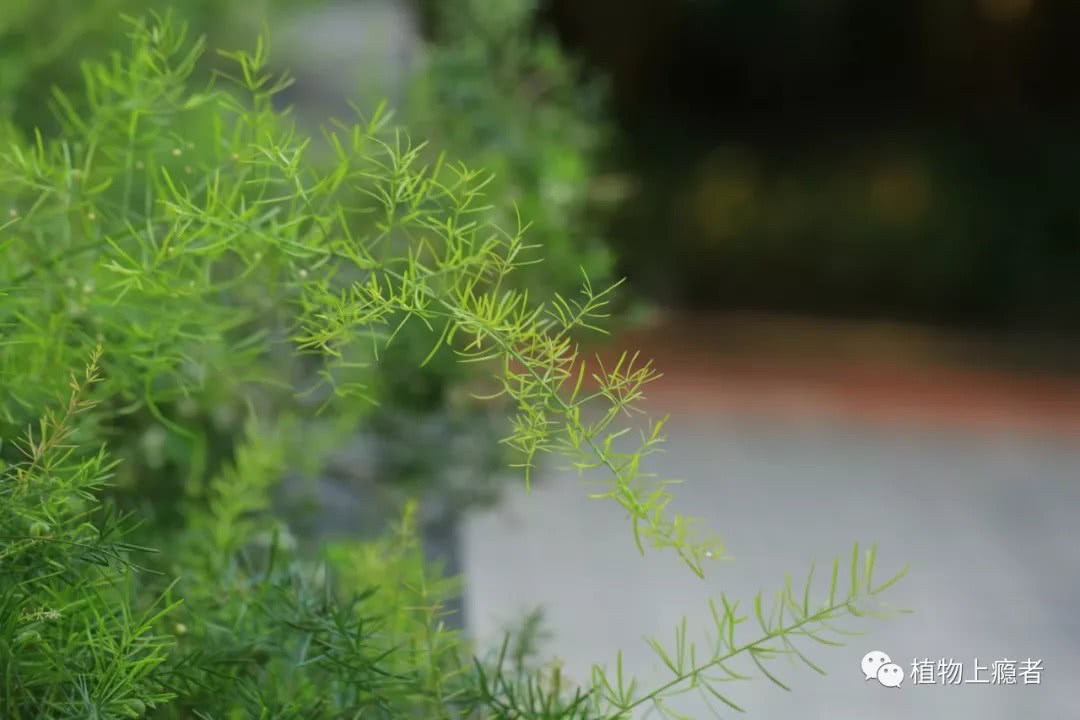
Asparagus densiflorus "Sprengeri"
Asparagus densiflorus "Sprengeri"
Alias: African asparagus fern, evergreen
Asparagaceae, Asparagus genus
Subshrub
Don't be intimidated by the long and aloof name "Asparagus densiflorus 'Sprengeri'" - actually this is an utterly ordinary subshrub in urban landscaping, with a slightly climbing habit.
Usually, it is always overlooked, like most hedges, a silent background character for a thousand years. In autumn, when its round berries ripen, pure bright red, slightly larger than a pea, it finally makes its presence felt for the first time. Peel away the not-too-thick exocarp, and inside is a large, glossy black seed, a favorite food of birds.
Berries about 1 cm in diameter, green when unripe, red when ripe
Asparagus densiflorus "Sprengeri" has a fairly long flowering period, spanning the entire summer. How many people ever notice its flowers? Axillary racemes hang down from the glossy green "leaf clusters," with small white flowers concealed within, very inconspicuous.
Racemes axillary
But I have enough time to gaze at this small flower. The flower is only half a centimeter in diameter, with six white petals, like a miniature lily. The tips of the petal backs are slightly green. Most striking are the six short stamens, opposite the petals, with anthers of a special color - orange-red. Usually, people describe this color as "not quite red," but it is the exclusive signature of Asparagus densiflorus "Sprengeri."
6 tepals
6 stamens, anthers orange-red
Gently shake the flowering branch, or touch it lightly with your hand, and the small flowers easily fall off. This situation usually suggests there is a joint on the pedicel, just like with Liriope. Looking carefully, I indeed found inflorescences with only pedicels remaining, a sense of vicissitudes.
Small flowers fall from the joint, leaving only the pedicel
There is nothing new under the sun, but the plant world runs counter to this - passion endlessly renews, and first encounters happen now and then. Did you notice that when I mentioned "leaf clusters" above, I put them in quotation marks? Because they are not true leaves, but branchlets that have grown into a leaf-like form, technically called "cladodes," also known as "cladophylls." This is the most unique feature of the entire Asparagus family.
The cladodes of Asparagus densiflorus "Sprengeri" grow in clusters of 1-5, most commonly 3, flat and slender, with sharp tips, slightly hard to the touch, with a glossy sheen. In other words, the cladodes are the most prominent presence of this plant.
Young branches
Cladodes in clusters, 1.5-3.5 cm long, 1-2 mm wide
So where have the true leaves gone? The description in the Flora is "Asparagus... leaves reduced to scales," which, at least from the eye's perspective, amounts to nonexistence. This is the second shared feature of the Asparagus genus.
As the name suggests, this plant is native to Africa and has thorns on its body. These thorns grow at the junction of the main stem and side stems, 3-5 mm long.
Thorns on the main stem 3-5 mm long
In the Asparagus genus, China has more than 30 species, yet the most commonly seen one happens to be a foreign species. Two species in this genus are familiar: one is Asparagus setaceus, often kept as a small bonsai, and the other is asparagus on the dining table, botanically called Asparagus officinalis.
What a coincidence - the flower arrangement at the company front desk this week included one that looked quite like a miniature pine tree, but I quickly noticed short thorns between its stems, exactly like those of Asparagus densiflorus "Sprengeri." Could it be that heaven knew I was studying Asparagus this week and specially sent this one? Sure enough, a flower friend told me that this one is called "Penglaïsong" in flower shops, with the proper Chinese name Songye Wuzhu (Asparagus macowanii), also a species of Asparagus native to Africa.
Asparagus macowanii, the flower arrangement at the company front desk
"Wuzhu" is named in contrast to "Wenzhu" (Asparagus setaceus). The alias of Asparagus densiflorus "Sprengeri" is African Wuzhu, also called evergreen. Asparagus densiflorus is a very popular landscaping plant, with multiple horticultural cultivars. Asparagus densiflorus "Sprengeri" is the most popular one; another is foxtail asparagus, also called Myers' African asparagus (Asparagus densiflorus "Myers"), with shorter cladodes, named for its fox-tail-like shape.
Foxtail asparagus, image from the internet
It is said that the flower language of Asparagus densiflorus is "the recluse poet," which reminds me of an article I read yesterday"Hai Sang: Loneliness Takes on a Sexy Look". When I read the line "fallen leaves have long been swirling within my body," I was instantly moved. In an era of information overload, with fast food flooding everywhere, I had not read such heartfelt and plain writing for a long time:
Between the field ridges, as soon as she sees wild greens
My wife forgets the peach blossoms
She runs over, she crouches down
This is shepherd's purse, that is shepherd's purse
This one is a dandelion that can fly
Waiting to bloom small yellow flowers
My wife's spring is edible
It leaves a fragrant taste in the mouth
It is she who makes days beget days
And lets the children grow up day by day
-- Hai Sang, "My Wife's Spring"
Hai Sang's experience confirms a saying by Japanese writer Ko Nakadaka Kenichi,"Only through life's hardships do we feel the true texture of being alive."He has a poem called "I Have Enough Time to Eat an Apple," which I like very much, and I borrowed it as the title of this piece.
After sharing this article to Moments, an old friend said, "There is still a place for poetry in your life..." Looking back, my relationship with poetry has gone through several stages.
When I was young, I was passionate about reading poetry, playing the literary youth, starting a literary club with classmates - in truth, it was a typical case of youth not knowing the taste of sorrow, forcing melancholy for the sake of new verses. Later, as my energy was increasingly consumed by reality, I once felt that poetry was useless, that "literary youth" was practically synonymous with being unreliable, and I consciously drifted away and drew a clear line.
Even later, I don't know from which moment, poetry quietly returned to my life. Not deliberately sought, but there is always a line or two that, when read, enters the heart, like ordinary trivial moments being highlighted. Poetry refines the trivial and mundane days. Like frosting on a cake, it is a drop of sweetness chiseled from hard stone.
Among my friends, some are seasoned poets, but more have lives and careers completely unrelated to poetry. However, recently I've noticed that quite a few who casually post on Moments have a poetic quality. This fully proves that poetry is not in some distant place, but in everyday life.
The recluse poet
Name explanation
The genus name Asparagus comes from the Greek word asparagos for Asparagus officinalis, and the species epithet densiflorus means "densely flowered." The cultivar name sprengeri is named after Herr Sprenger, who was employed in the late 18th century by the Italian seed company Dammann to collect plants in Natal Province, South Africa.
The article and plant photos (unless otherwise credited) are all original by the author
Your shares and appreciation are my greatest support
Plant Addict
WeChat ID: plantfiend
Discovering the unique beauty of every plant