Essential knowledge for beginners growing succulents, master the techniques to easily fill a pot
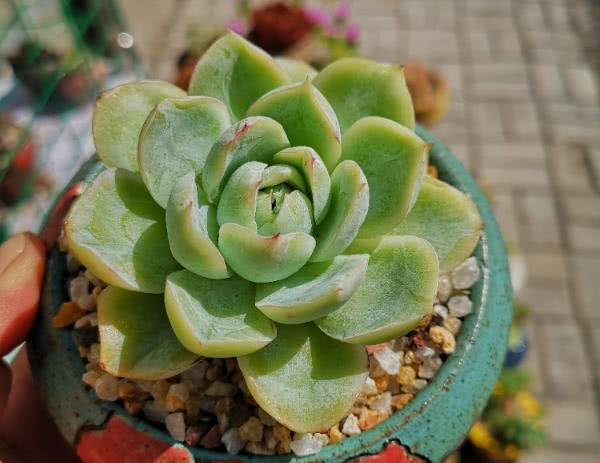
First, let's talk about watering succulents in early spring. After the long winter, almost all succulents are rather weak. When spring returns to the earth and the spring rain falls continuously, plant lovers can easily not resist giving water to the succulents that have been thirsty all winter. Although a small amount of water is also given in winter, after all, that bit of moisture is meant to keep the plants from directly drying out their roots due to excessive lack of water in winter.
Watering at this time becomes especially important, because the temperature difference in spring is large and the temperature is unstable. The usual practice is to mix water with carbendazim and give a little water at the edge of the pot, depending on the size of the pot, so that the moisture can slowly seep into the roots. If at this time you water heavily or soak the pot, it is very easy to cause the leaves of some varieties to fall all over the ground with a clatter, or to rot directly from the roots to the leaf core. By the time you notice it, the stem of the plant has already all turned black, and at this point there is really no way to save it; it feels like it rotted in an instant.
A small number of succulents have habits that make them suitable for being moved in and out. For example, cactus grape: as long as there is sunlight, it can be moved out during the day and moved in at night, making the agate-red color it presents more transparent. Special care for succulents has commonalities and also individual characteristics. Care aimed at the individual side is special care. For example, the special care for jade pendant bell is pruning, to make it grow colorful new leaves. And the special care for lotus palm is frequent repotting, letting only one lotus palm grow large and beautiful.
For succulents in summer, when the temperature reaches above 35 degrees or even higher, many succulents will completely stop growing, which we call the "dormant period." After entering the dormant period, the growth rate of succulents becomes very slow, and the roots' demand for water is relatively reduced. Combined with the high-humidity environment of summer, root rot is extremely easy, and even the entire plant may die. During the dormant period, do the following three things well: sun protection, ventilation, and water control.
Sun protection: that is, preventing direct sunlight, and placing the plants in a place with sufficient scattered light. Ventilation: ceramic is relatively breathable, the soil (substrate) must be breathable, and the placement environment must be ventilated. Water control: when the temperature reaches around 30 degrees, begin to reduce the amount of watering, giving only a very small amount of water each time. When the temperature exceeds 35 degrees, cut off water directly. When the temperature stabilizes below 35 degrees, water appropriately. Doing this, succulents will inevitably dry up a few leaves, but I think it is convenient and relatively safe.
For succulents whose growing season is in summer, watering amount and frequency of spraying should be appropriately increased in summer. When the remaining light is too strong, shade appropriately, but be careful that the shading time should not be too long, otherwise it will affect leaf color and gloss. For succulents that are in dormancy or semi-dormancy, a cool and dry environment must be maintained at this time, and they should be placed in a semi-shaded and well-ventilated place. Stop fertilizing and strictly control watering.
This is a gathering place for succulent lovers, sharing succulent care tips. Welcome to follow and exchange ideas.