Look at how others propagate roses from cuttings - why do yours always turn black?
How do you propagate roses from cuttings, and why can others do it successfully while yours always turn black?
For potted roses to grow into a full, bursting pot, management is actually very important. Many people want to grow roses but are troubled by not having a "bulging" wallet, so they come up with an idea: using rose cuttings can save us a lot of money on seedlings, and you can also learn a lot of knowledge in the process.
But when it comes to propagating roses from cuttings, why can others achieve every single one surviving, while yours all turn black as soon as they sprout? Then you may have overlooked these points.
Water flooding the pot, root rot
Watering heavily over the long term - right after taking cuttings, many people think that since there are no roots, they should water more. This idea is wrong. When taking cuttings, you cannot water heavily; you only need to maintain a certain level of humidity.
This situation is what everyone calls "too much water smothering the roots," which is why they turn black as soon as they sprout. For beginners growing flowers, when propagating roses from cuttings it is still better to water by the principle of "dry before wet."
Wrong soil, sprinkling salt into the wound
If you want to grow a full, bursting pot of roses but are unwilling to buy seedlings, and you say you will propagate roses from cuttings yourself, then you definitely have to cut branches, and the branches will definitely have wounds. When the soil chosen has a high nutrient concentration, the exposed wounds will be directly harmed.
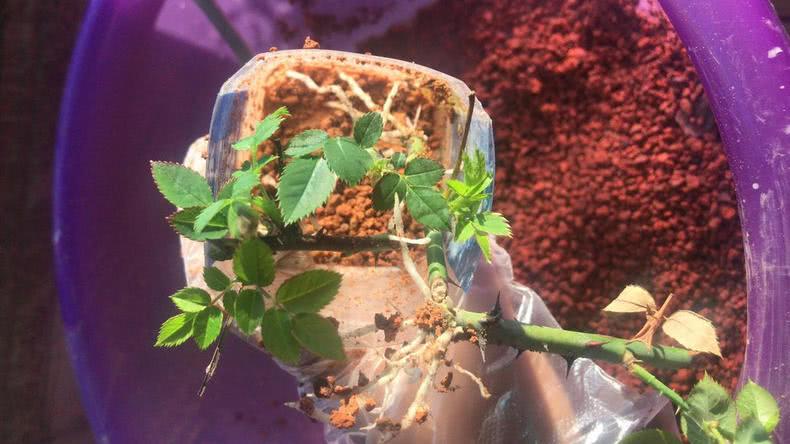
I don't believe that if you had a wound on your hand and then sprinkled some salt on it, you would still say it feels comfortable. People are like this, and roses will naturally feel uncomfortable too. Then fewer roots form. Although they sprout, because there is no nutrient transport, they easily turn black. So for cuttings I suggest choosing granular top-dressing stone for succulent plants - the effect is good. Pure is fine; one disposable cup can hold one cutting.
Fertilizing before temporary planting is undoubtedly adding frost to snow
When propagating roses from cuttings, basically no fertilizer is applied before temporary planting. What is temporary planting? It is when roots have formed but the plant has not yet been potted up, but before potting up there still needs to be a transition period - this time is temporary planting. A rose with few roots is like a baby; you cannot feed a baby plain rice, after all. The same principle applies to roses.
When it reaches the temporary planting stage, you can apply some good nutrient solution and slowly condition it, which can promote root and sprout formation. It can accelerate growth and allow earlier potting up, which helps with growing a full, bursting pot. Just dilute 500 times and water, once every 5 days.
Choosing the right soil for potting up gets twice the result with half the effort
If the soil is chosen well, it can promote rose sprouting, roots grow well, and nutrient absorption is also faster. Then nutrients are converted into leaves and sprouts faster. Only a rose with luxuriant branches and leaves has a chance of bursting into a full pot and blooming. You have never seen a bald rose burst into a full pot, right!
Alright, why can others successfully propagate roses from cuttings while yours always turn black - the reasons are probably about these. If you find it helpful, please give me a like!