How to Grow Succulents in a Challenging Climate? Persistence Is What Really Counts
Foreword
Follow the Encyclopedia · Meet Beauty (WeChat ID: duoroubaike)
The article begins:
Thanks to the author [Wugen Cao] for theoriginal submissionsharing
Edited and compiled by: Encyclopedia Jun
Location: Shanghang County, Longyan City, Fujian Province
Life depends on hard work, success requires persistence! Courage is always there the moment you step out, but persistence is the real challenge! Growing succulents is the same; whether you are in a favorable climate zone or a challenging one.
In my three years since falling into this hobby, every summer I witness quite a few succulent friends who fail to "persist" and drop out of the hobby! (I won't rule out other reasons here) Indeed! Summer is the most unbearable time for a succulent grower! Always worrying and fearing, wearing yourself out mentally and physically doing all kinds of preventive measures, yet still harvesting more or less "empty pots." When you're heartbroken, your family nagging again and again is even more of a blow! I tried my best, don't blame me - blame the weather! Every time I comfort myself this way. Growing plants is also cultivating your mindset!
This baby has been in the succulent hobby for three years since jumping over from the bonsai hobby, and now I no longer blindly chase varieties! Almost all my succulents are common varieties. To sum up, I personally feel that in the south only common varieties are easy to grow. As the saying goes, a phoenix in distress is worse off than a chicken, and a pretty rooster flying up to a branch becomes a phoenix. Actually, common varieties can be beautiful too when grown to their full potential! Alright, no more rambling. Below I'll share and let you appreciate the growth results.
Graptosedum 'Francesco Baldi'
The original small pot can no longer contain it, so I switched to a bigger pot and it started its explosive growth mode again
Left - Graptosedum 'Francesco Baldi', right - Firestorm
Succulent friends often can't tell the difference between Graptosedum 'Francesco Baldi' and Firestorm. Here's a comparison for you to look at; it will be clearer than my description
Graptopetalum 'Bainesii'
Sorry that you were once so unremarkable that I didn't keep a single photo of you alone
Graptopetalum 'Bainesii' grown from a leaf cutting
Echeveria 'White Phoenix', this should be my most inspirational succulent. When I first got into the hobby, it was a tiny single head, and I grew it until it was bare, down to just a naked stem. After I revived it, it sprouted 5 side shoots, and now it's become a favored little fairy.
March 2018
August 2018
Sempervivum tectorum, super prolific at producing pups
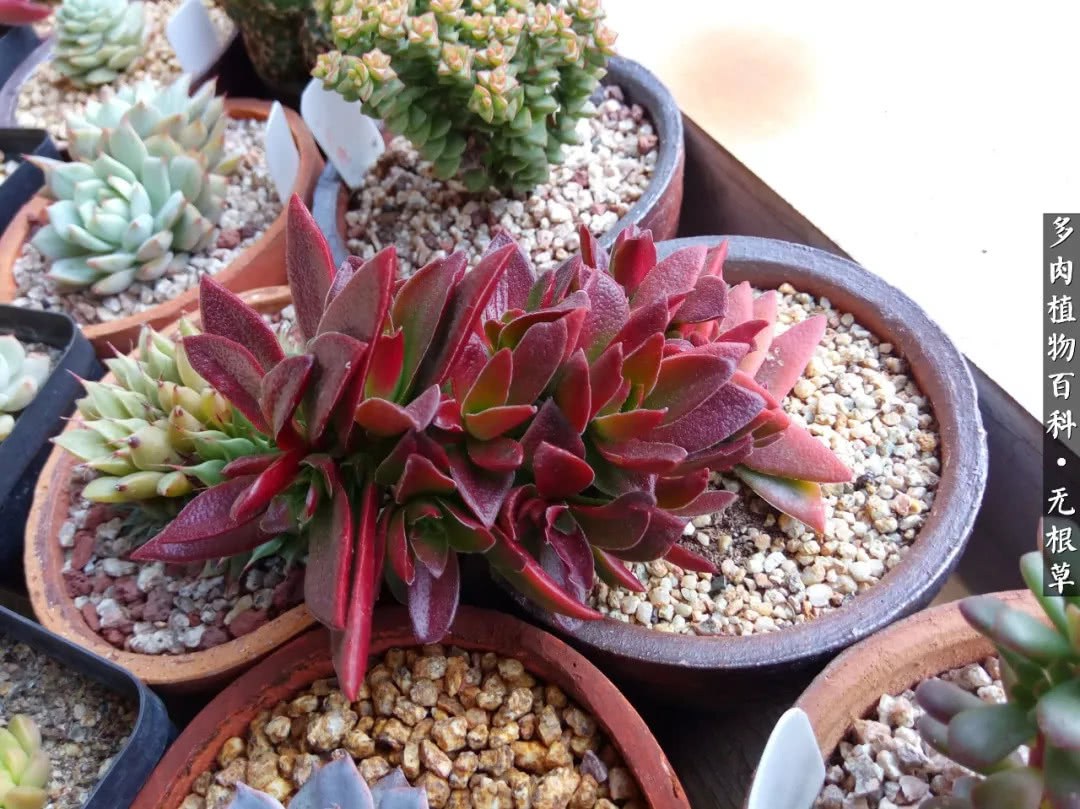
Kalanchoe 'Lace Princess', disliked by everyone, I casually grew it from a section of PC pipe with the pups sown, and unexpectedly it strove to be so stunningly beautiful. The princess's genes are strong
Sedum 'Little Mi Star'
Echeveria 'Guanghan Gong' - a cold and alluring little fairy
A comparison from when I first got into the hobby to today's development. Among them, the one planted in the hexagonal pot, the Echeveria 'Suyipya', later surprised me the most
Graptopetalum paraguayense, no more one-by-one comparisons below! They were all grown from small seedlings. Enjoy the beautiful winter photos
Another pot of Kalanchoe 'Lace Princess'
Graptopetalum 'Bainesii'
Sempervivum tectorum
Avocado
Echeveria 'Purple Delight'
Echeveria 'Red Pink Beauty'
Echeveria 'Peach Egg'
Pachyphytum 'White Beauty'
Pachyphytum 'Winter Beauty'
Sedum rubrotinctum
Echeveria 'Lindsay'
Echeveria 'Suyipya', at first glance does this look like Tiya? Because of this photo, succulent friends once suspected that the state of my succulents was achieved by spraying them with chemicals (vitality boosters). I want to say that apart from insecticide and fungicide, I really never use this kind of state-enhancing chemical on my succulents!
Aeonium 'Green Velvet'
Aeonium 'Shaoxiu'
Aeonium 'Black Bronze Pot'
Aeonium arboreum 'Zwartkop'
Aeonium 'Halloween'
Group photo of Aeoniums
Group photo of winter outdoor growing! In pursuit of sunlight and large temperature swings to bring out their colors, many are moved to the rooftop for outdoor growing, and then every day I happily climb up and down with a ladder. Here I also suggest to succulent friends in the south where winter temperatures stay above 0°C, if you have the conditions for outdoor growing, do it as much as possible! (But be careful about bird protection)
Finally, let's appreciate my bonsai and flowers
Hydrangea
Lily
Below I've attached my personal care experience; take what suits you! If there's anything I said incorrectly, I hope everyone will be understanding!
In the succulent-growing community, the three questions we hear most often are watering, ventilation, and soil mix. First, I want to clear up a few misconceptions: some succulent lovers in the south like to use pure grit for control! Although the southern weather is relatively hot and humid, and the purpose is to increase permeability to prevent black rot and control shape, doing so often makes it hard for the succulent's root system to grow strong and healthy. Once water is lacking, the fine roots will quickly die; furthermore, succulents grown this way mostly tend to grow aerial roots, (aerial roots don't only grow when the soil is stuffy, wet and impermeable) which is also a sign that the fine roots under the soil can't grow normally and absorb water, dying off frequently, prompting the succulent to instinctively grow lots of aerial roots to absorb moisture from the air; there's another point, grit stones mostly absorb heat and retain warmth, easily scalding the succulent's roots. If the roots aren't strong and healthy, heavy watering will also increase the risk of black rot and liquefaction, and that won't guarantee your succulent will be controlled into a cute, plump, round shape either; it's more likely to cause stunted growth.
Personal recommendationSoil mix: grit 60%-70%, peat soil 30%-40%
Grit: maifan stone, volcanic rock, green zeolite, pine bark (decomposed) and charcoal (rice husk charcoal) in small amounts as appropriate
Fine soil: peat and (a small amount of coal cinder as appropriate, to prevent water from failing to penetrate when the potting soil is too dry)
Here I should explain, decomposed pine bark is really great to use, a good material to replace stony grit. It maintains a stable temperature and doesn't easily absorb heat, resists powdering and contains nutrients, and is lightweight - strongly recommended for balcony and bay window growers to reduce weight, (except for those with strong wind and no railings, haha)
Watering:I guess everyone knows that in summer it's best to water at night! They say watering takes ten years of practice, and this question really can't be explained clearly in just a few words. Actually, this saying comes from the bonsai world, but often it's also applicable across the board, such as "don't water until dry, water thoroughly when you do," "alternate between dry and moist," etc. But for growing succulents, we focus more on how to control water. Some succulent friends understand "control" as "cut off water, water, cut off water..." controlling until the plant is almost dead before rescuing it. Many succulent friends do this in summer, and the result is still failing to get through summer safely. So my personal approach is to water thoroughly as soon as I see healthy leaves developing wrinkles or feeling limp and soft to the touch (if I control any longer, I'll at most delay watering by another three days), because when leaves show limpness and wrinkles, it means the potting soil has been completely dry for more than just a day or two.
Ventilation:There are misconceptions here too. We all know that "ventilation" is an effective and necessary condition for succulents to prevent black rot and disease! But sometimes when our growing environment, just after watering, or the specific season requires enhanced ventilation, many use fans to assist; the method is correct, but in summer some succulent friends may notice: why do I run my fan 24 hours a day without interruption and still have a large number of succulents with black rot and disease? "Ventilation" actually refers to the flow of air; "wind" is just an aid to enhance this "flow." And blowing with strong wind for such long periods will cause the stomata (respiratory pores) on the succulent's leaves to close, which will inevitably backfire. So when ventilation is insufficient, you can use a fan to assist, but don't blow strong wind for long periods! (Is this better? No! This uses more electricity)
Appreciate the author
If you like this article, besides sharing it to your Moments, you are also welcome to long-press and recognize the WeChat payment code on the left to tip the author of this article! Even one cent is love, any amount counts as kindness!
This article has beenexclusively authorizedby the author to the WeChat public account: Succulent Plant Encyclopedia (ID: duoroubaike). The article content does not represent the views and stance of the public account! The Encyclopedia has signed with a third-party internet copyright enforcement company and has opened network-wide rights protection. Unauthorized reproduction by other platforms is strictly prohibited! If unauthorized reproduction is discovered, infringement liability will be pursued! Netizens are welcome to report!
Advertisement ADVERTISEMENT
Succulent culture needs you and me to promote it! Remember to share good articles more, so more people fall in love with succulents! Use the power of plants to influence and heal the people around us!